Explore
Volumes
35 volumes in the archive
Fresh Ink

Odd Wonderful
The Light From Below
On Pell, everybody pays for their magic with something they can never get back. Nemi is twenty-six, and he still hasn't paid.
His parents rowed out through the reef when he was two and never came home. The world looked at that and decided it didn't count.
So Nemi mends the island's nets and walls, and he laughs along when the neighbors joke about his bare skin. His aunt Vara has never once laughed.
Then a stranger drifts through the reef in a boat patched with a cupboard door. They're half dead and cold all the way through. Before they ask for water, they ask where Pell keeps its stones.
They came from the northeast, the way Nemi's mother went. They know his grandmother's name, the one nobody on Pell has said out loud in fifty years. And they need his hands to wake something in the grove that his aunt has spent her whole life keeping asleep.
Begin this story →
The Archive
Sharing Location
Say Cheese
The doctor heard two heartbeats, and Carol Kessler believed him for seven months.
Then a March snowstorm shut York Road from the beltway to the county line. Her water broke five weeks early, while she was filling the tub. The ambulance couldn't get past the plows on Joppa Road.
Walt delivered the babies on the bedroom floor, with a 911 dispatcher named Bev talking him through it. Then the phone line went dead.
The paramedics walked up the hill at dawn. The first one through the bedroom door smiled at her.
"Morning, Mom," he said. "How many we got?"
Carol gave him a number. Then she spent five years keeping it right.
Say Cheese is the prequel to Sharing Location. It's Carol's story, from the night of the storm to her boys' fifth birthday. Long before Jen ever checked a little blue dot, there was a woman in a brick house in Towson who was very particular about what got counted.
Sharing Location
Sharing Location
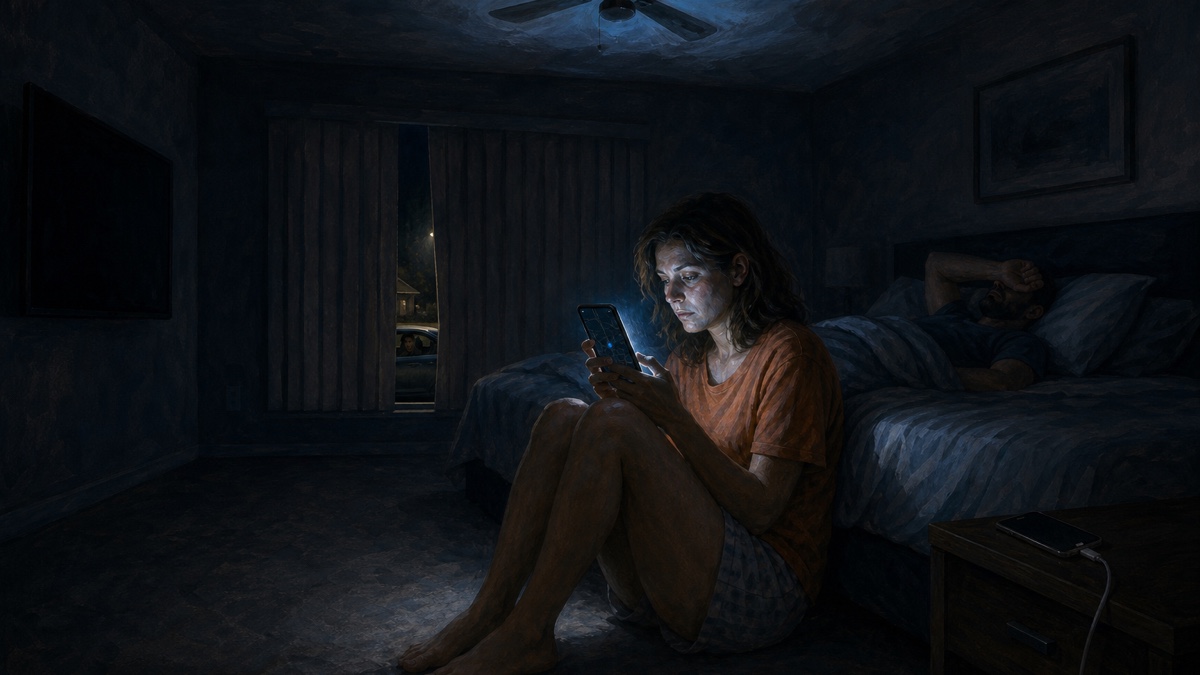
Jen and Mark Kessler have shared their locations since the day they got married. Eleven years of a little blue dot she stopped noticing.
Then one Tuesday at two in the morning, his phone is charging on the nightstand next to her. His dot is eleven miles away, on a road she's never heard of.
She tells herself there's a normal explanation. There's always a normal explanation.
At six-fifteen he kisses her forehead and leaves for work. She watches his dot go down their street toward the office, the way it does every morning.
The other dot doesn't move.
Sharing Location is a domestic suspense serial about a woman who can't stop checking.
Hollowed
Sixty-Two
Some people are born without something. No soul, no inner life, just a perfect replica of human emotion. They smile when you smile. They grieve when you grieve. They never slip up. Society has developed tests to identify them and institutions to deal with them. The Hollowed are considered dangerous. Not because they've done anything, but because of what they might do.
The detection system is thorough and normalized — regular screenings, behavioral assessments, a whole bureaucratic apparatus. People report neighbors, family members, coworkers. A positive identification triggers removal. What happens after removal is handled quietly. The institutions don't publish reports.
Echo
Please
You're going to hear things before they happen.
Not everything. Just certain sounds. The ones that matter.
A scream three seconds before someone falls. A car door slamming four seconds before it actually closes. Your own voice saying something you haven't said yet.
At first you'll think it's nothing. Your mind playing tricks. Stress from the move.
Then you'll start to notice the echoes don't quite match what really happens.
They're longer. Worse. Like they're showing you what was supposed to happen instead.
And you'll realize you're not hearing the future.
You're hearing something else.
Something that arrives too early because it doesn't follow the same rules you do.
The house is too quiet now. You've been sitting at the kitchen table for hours. The basement door is still open.
And you're trying to remember if you opened it or if it opened itself.
Welcome to a place where sound doesn't work right. Where echoes come first and reality catches up later. Where listening too carefully might be the last mistake you make.
Three stories. Three perspectives. One house that shouldn't exist.
The Obsidian Tavern
Obsidian Adventures Vol I
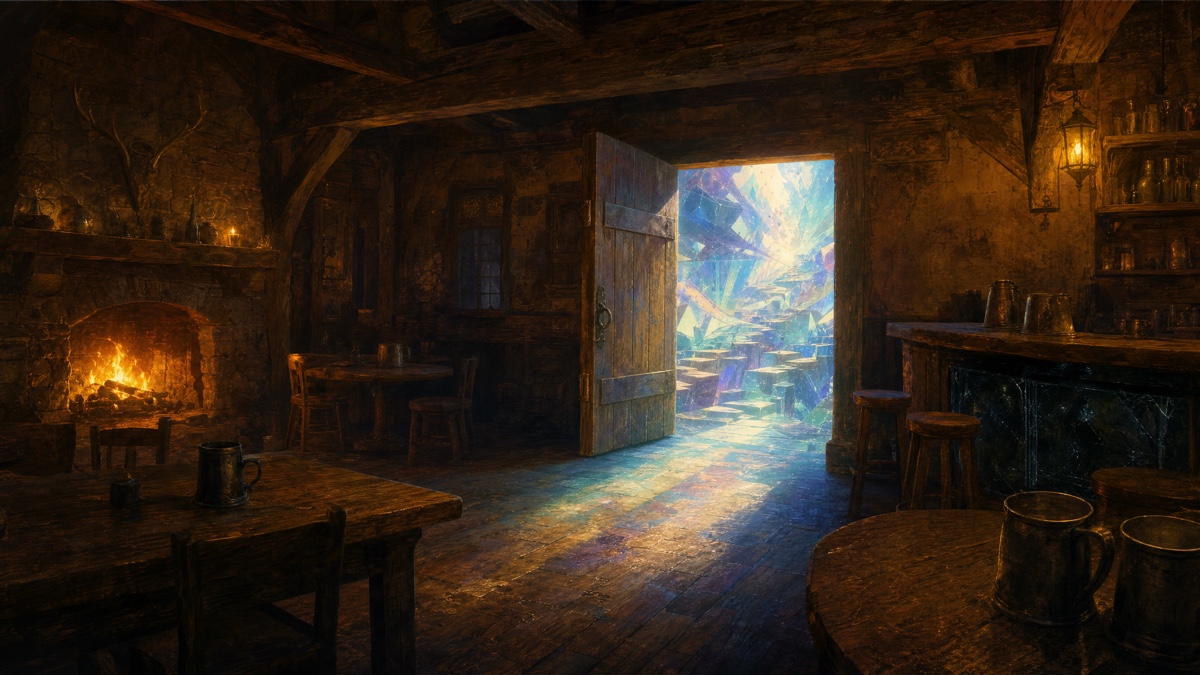
The first crossings. Every tale in this volume opens at the bar and closes at the bar, and in between somebody goes through the back door.
These are the ones about grief mostly. People who walked in carrying a weight they'd stopped being able to name, and got sent through to the exact world that would make them decide what to do about it. Xerves doesn't hand out worlds that go easy on you. He hands out the ones that ask the hard thing plainly and then wait.
Some of these he lived himself, out on the other side of the door. Some of them spilled out two tables over and he only had to overhear. Either way he tells them the same, warm and unhurried and never overselling, a man who has seen enough worlds that nothing shocks him and grief still gets him every time.
Read them in any order. The door doesn't care which one you needed first.
Cast
Cast Anthology Vol I
Imagine a world exactly like ours, with one difference. Your shadow tells the truth.
Not a metaphor. When you lie, your shadow doesn't. When you smile at someone you can't stand, the shape on the wall behind you leans away. When you want something you'd never say out loud, it reaches for it. You can control your face. You spend your whole life learning to control the thing on the floor, and most people get good enough to make it through a workday.
Most people.
So you learn the rules everyone learns. You don't take a first date somewhere bright. You interview for jobs in rooms with the blinds half drawn. You watch what your kid's shadow does before you believe a word out of their mouth. It's just how things are. It's the ocean you swim in, and you stop noticing the water.
Then you notice something small. A shadow that's a beat too still. A shadow pointing the wrong way. A shadow doing something the person it belongs to would never, ever do.
And you can't stop noticing it.
Every story in Cast starts there, with one ordinary life and one small wrong thing on the floor beside it. Nobody explains the shadows. Nobody ever has. You just live with them, and read them, and hope the one attached to you keeps your secrets a little longer than it wants to.
Read them somewhere the light is good.
Corriveau
Corriveau Tales Vol I
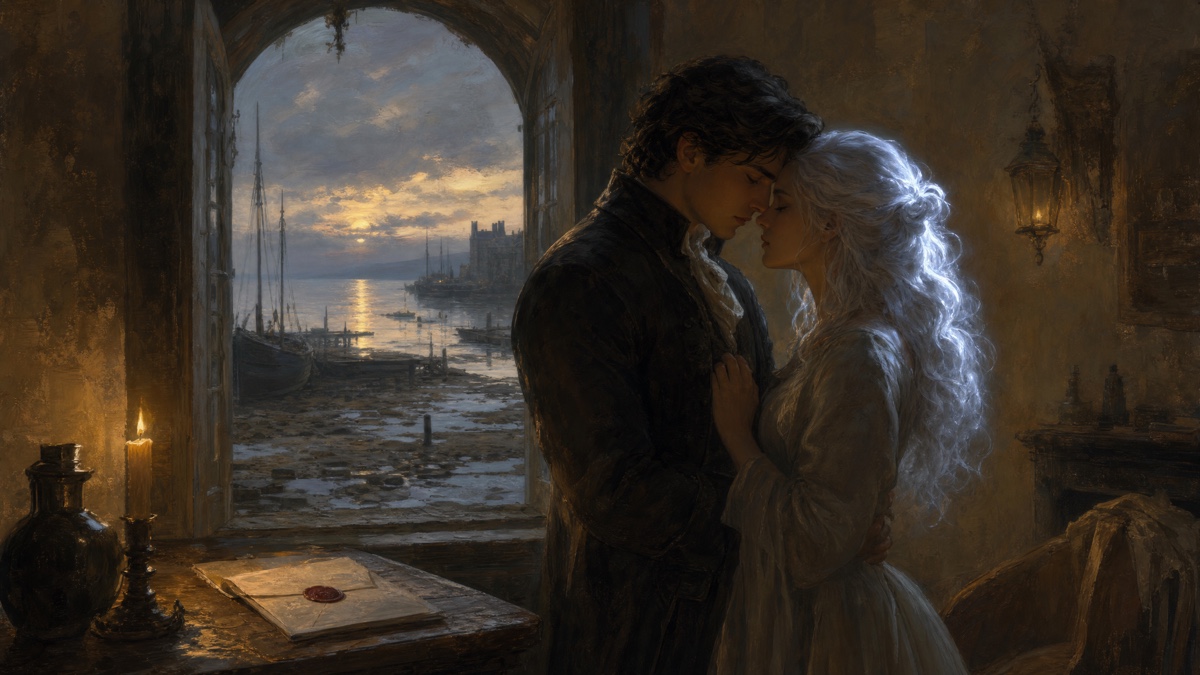
In Corriveau, love that is sworn aloud has to be paid for in years off the end of your own life, and only one of you ever pays. The one who pays goes silver. The one who is loved keeps the hair they were born with.
Nobody can see the cost, or how much anyone has left. These are the people living inside that.
A couple who have loved eleven years unbound, finally holding the certificate that asks which of them will go silver for the other. A marriage sworn cheap to feel nothing, that doesn't hold. A Keeper who comes to prove a widow never paid, and learns her husband dyed his own silver head brown for thirty years so the ledger would name her the one who loved.
A man who reads a stranger's white hair as great love and buys her a drink, and gets the whole story wrong. Two people who kneel to swear deep and feel the words refuse, and understand, without a number, that one of them is near the end. A house girl who opens the wrong door in the cellar and finds what her mother's dark hair actually cost.
Each one drops you all the way into a single couple and a single impossible choice, and each ends somewhere you didn't expect.
The forger who fakes devotion for a living and won't fake it for the woman he loves. The lovers who run for the border just to love the way another country lets them, both paying, both going silver, matched. The one married by a god the city stopped believing in and denied by the book the city runs on now. The widower who fills two cups every morning and will never learn how many of his own years he spent keeping her alive.
Every one stands on its own. Open to any number and you're fully inside it in a paragraph.
Together they turn the same cruel machine over and over, the sworn love that costs everything and the free love that protects nothing, holding it up to a new light each time.
These are aching, human stories about deciding who goes silver so the other can be loved, and about doing that math blind, on faith, with a life you were never allowed to count.
Mudwick
Book II: The Fracture
Eli Lawrence returns to Mudwick for a second year with a story everyone around him agrees on. The bad thing is over. The people responsible are gone. The school sent an email, the matter is closed, and he's supposed to settle in, find his friends, and learn to carry what he can do.
He can already tell it's a lie. Something in the school's hidden network is dragging, a stutter under everything, a weight hanging off a system nobody can explain. He feels it the moment he arrives, in a place that isn't supposed to be able to feel wrong. And folded into a book in his bag is a note he chose not to think about all summer, from someone who told him he'd finally see these people for what they are, and that when he was ready to do something about it, there was help waiting.
Trouble is, the adults he's meant to trust are the same ones who are always kind, always patient, always holding something back. The deeper Eli looks, the harder it gets to tell who's protecting him and who's managing him, and the more he understands that the rot he thought he'd found the bottom of goes down further than anyone let him believe. Book 2 is the year the ground gives. Friendships get tested, the cost of what he can do keeps climbing, and every warm moment starts carrying a weight he can't quite name.
It's a darker, tighter turn of the screw, still grounded, still sensory, still a story about a teenager learning to feel everything in a place that would rather he stopped asking what it's all for.
Mudwick
Book I: The Culling
Some places just feel different. You've probably noticed it yourself. An old hospital that makes your skin crawl even though you can't see anything wrong. Your grandmother's kitchen that wraps around you like a hug the moment you walk in. A battlefield where the air itself feels heavy with something you can't name.
Most people shrug it off. Practitioners don't have that luxury.
In Mudwick's world, magic isn't about wands or spells or chosen ones destined for greatness. It's simpler than that. And messier. Every intense emotion, every death and birth and heartbreak, every moment when someone felt something deeply leaves a residue behind. That residue soaks into places and objects and the land itself. Centuries of human experience, just sitting there, waiting.
Practitioners are the people who can feel it. They can sense what a place holds. Some of them can draw on it, pulling courage from battlefields or focus from libraries or warmth from family homes. A rare few can do even more.
Eli Lawrence is one of these people, but something's off. They don't read places like everyone else. They read people. Touch someone's hand and feel their buried grief. Lock eyes with a stranger and know their secrets. It's been making their life in small-town Ohio pretty much unbearable.
Then someone shows up with answers. A hidden school in Appalachia called Mudwick. A place to learn control. People who understand.
Sounds great, right? Finally somewhere to belong. Finally people who won't flinch when Eli accidentally knows too much.
But Mudwick has history. The families who run the practitioner world have been doing so for generations, and they didn't get that power by asking nicely. There are students who arrive at Mudwick full of potential and leave hollowed out. There's a woman named Miriam destroying sacred places across the country and everyone says she's dangerous. There are teachers with secrets and alliances that go back decades.
The hidden world isn't some magical escape from the regular one. It's got the same problems. Power concentrated in the hands of people who were born with it. Systems that chew up the vulnerable and spit them out. The question of what you do when you discover the institution that promised to help you might have built itself on extraction and exploitation.
Eli just wanted to stop feeling like a freak. What they found instead was a world where feeling too much might be exactly what someone designed them to do.
Mudwick
Mudwick Tales Vol I
In Mudwick, the land holds on to everything that ever happened on it. Every grief, every act of love, every death soaks into the ground and the walls and the objects people leave behind, and a rare few can feel it under their hands. These are their stories. Small ones. A kitchen, a garden, a quilt, a stretch of holler where the ground stayed warm long after it should have gone cold.
There's no world to study first and no series to have read. Each story stands completely on its own and drops you straight into one life and one body in a single page: a person who can sense what a place is still carrying, and the ordinary, human moment where that becomes too much to hold. Some of them borrow strength from where brave things were done. Some of them feel a loss in the soil that isn't theirs and can't put it down. All of them pay for what they can do, because in Mudwick you never take from a place without taking some of the place into yourself.
This first volume gathers the earliest of these shorts under one cover. They're quiet and they turn one strange, tender idea over and over, that grief runs cold and the land never forgets, until you feel it in your own feet.
The best door into Mudwick for anyone who wants the world without committing to the books. Open to any story and you're inside it.
Hollowed
Collections
Six people who work inside a system designed to find and remove what it considers defective. Six routine assignments that go exactly as planned. Six reports filed with clean data and no anomalies detected.
Except something is off. A four-minute gap in a parking lot. A word that won't leave. Details that don't serve the checklist but won't stop arriving. A recording that captured something the screener's face did without permission.
The system measures everything. But the thing that's changing the people who run it is below the threshold. And once you start noticing what the instruments can't see, you can't go back to not seeing it.
Collections is a thriller told from inside the machine, where the most dangerous thing isn't what you're hunting. It's what happens when you start to feel something about the hunt.