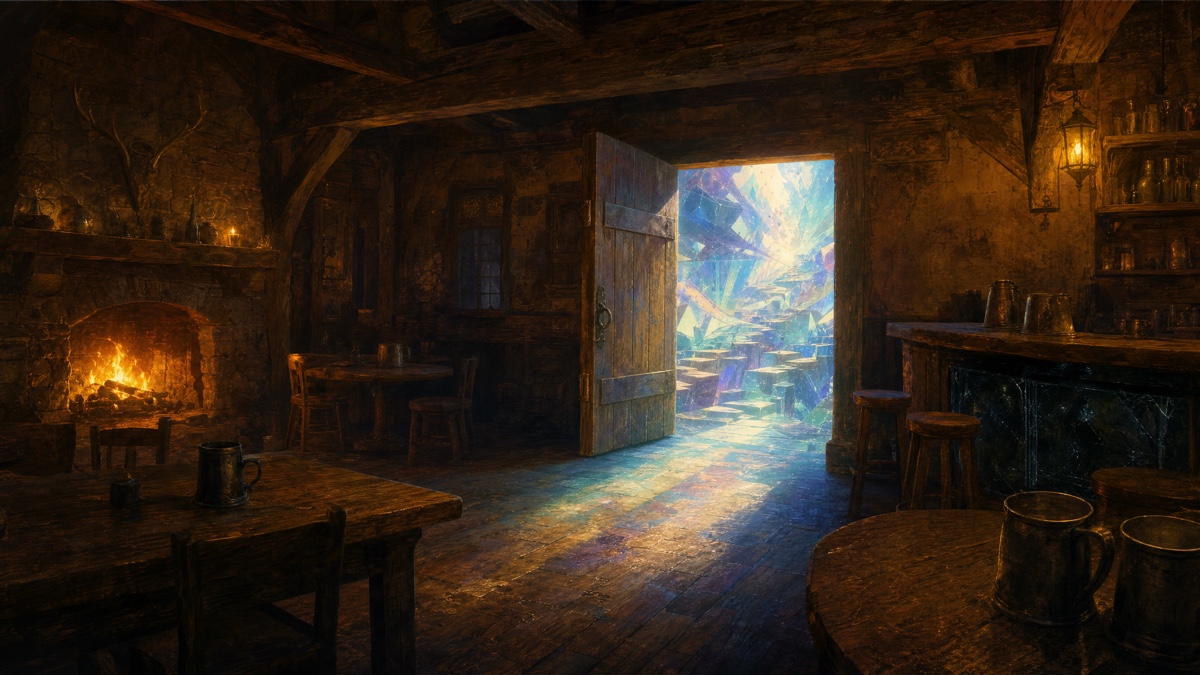
They went to the east shore first, because that was the closest of the wrong places and because Sorrel could not yet walk far.
Nemi set the pace slow and did not say he was setting it slow. Sorrel would have hated that. They went down the spine path and cut east where the grass gave way to the flat shelf of rock above the tideline, and the whole way Sorrel breathed carefully and pretended the walk was nothing, and Nemi let them pretend, because he had carried enough hurt things to know the difference between what needs help and what needs to be allowed its dignity.
At the waterline he crouched and pointed.
“There. Watch the foam when it comes in.”
They watched. A swell came up over the shelf and drew back, and the foam it left behind slid southeast along the rock instead of running straight back down to the water the way foam should.
“Been doing that my whole life,” Nemi said. “Every current says south. The wind says south. The old men who’ve fished this shore for sixty years will tell you south. And it pulls southeast, right here, this one stretch. Nobody talks about it. I think everyone decided a long time ago it was just Pell being Pell.”
Sorrel lowered themselves down beside him, slower than they wanted to, and held a hand flat above the surface of the water without touching it.
“It’s not the water,” they said. “The water’s fine. It’s the ground under it. Something down there is pulling, and the water’s just doing what it’s told.” They closed their eyes. “You can’t feel it yet. But it’s there, and it’s strong, and it’s old.”
Nemi had lived above this stretch of shore for twenty-six years and had never once thought to blame the ground. He looked at the foam sliding wrong across the rock, and the place he thought he knew all the way down turned out to have a floor under the floor.
—-
They worked in the afternoons, because Sorrel could not bear to be only a patient and Nemi could not leave Maret’s wall undone forever.
The first afternoon Nemi expected to do the work and let Sorrel watch. Instead Sorrel came down the slope to the wall, sat where the light was good, and started sorting the loose stone by size and shape without being asked, and when Nemi reached for the next course Sorrel had the right stone already in hand, held out, the one exact stone that would lock the joint. Every time. Nemi would look at the gap and Sorrel would look at the gap and the stone was already coming.
“You’ve done this,” Nemi said.
“Different stones. Different island. A long time ago.” Sorrel turned a rock over, found its face, set it in the pile. “My grandmother’s island. Before they told her she was mad and she stopped going outside.”
That was the first time Sorrel spoke of the grandmother as a place and not just a voice. It was not the last. Over the afternoons the grandmother came into the work in pieces, a saying here, a memory of hands there, and Nemi built a picture of a woman who had spent the end of her life indoors because the world had decided her truth was a sickness, and who had spent the beginning of it teaching a grandchild everything anyway, in case.
They finished Maret’s base course together on the second afternoon. It sat better than Nemi’s work usually sat, the joints tighter, the whole thing more sure of itself, and Nemi ran his hand along the top course and could not have said why it felt more finished than his walls felt when he built them alone.
“It holds better with two,” Sorrel said, watching him notice.
“Everything does.”
“No,” Sorrel said. “Not everything. But this. This holds better with two.”
—-
Vara set three places for dinner on the third night, and she set them without the pause she’d had the first night, which Nemi noticed and said nothing about.
Sorrel ate slowly and carefully, the way a person eats who has not had regular meals in a long time and does not trust their body to keep what it’s given. Nobody talked for a while. Vara watched Sorrel eat. Nemi watched Vara watch.
“So,” Vara said, when the bowls were low. “What are you doing on my island.”
Sorrel set down their spoon. They looked at Nemi, and Nemi looked at the table, and Sorrel said, “Tell her. It’s your island. She should hear it from you.”
So Nemi told it. He told it badly, the way you tell a thing you only half understand, leaving out pieces and putting others in the wrong order, the stones and the tide and the connections that used to run between the islands before someone cut them, the anchor points and the people who kept them and the word every island had that meant the same thing underneath. He waited for Vara to laugh, or to stand up and clear the bowls, which was how she ended conversations she was done with.
She did neither. She listened all the way to the end, and when he stopped she was quiet for a long moment, and then she said, “That sounds like something my mother would have said.”
Nemi had never seen Vara surprised by her own words before. It happened now. The sentence came out of her and then she sat there looking at it, as though it had been waiting in her a long time and had chosen its own moment to leave.
“Your mother,” Sorrel said. Gently. Not pushing.
“She talked about a harbor once. When I was small. Said it was alive the way this island is alive, though she didn’t say it like that, she just said the water there remembered where it used to go.” Vara’s hands were flat on the table now, and Nemi realized he had learned that stillness from Sorrel, and that Vara had it too, and had always had it. “I thought it was a story. I was twelve. I told her it was a story and she never said it to me again.”
She stood up then, and cleared the bowls, which was how she ended conversations she was done with. But she stood at the basin longer than the bowls took, her back to the room.
—-
The grove was the last place, and Sorrel wanted to go at dawn.
The light was doing the thing when they got there, coming up through the ground under the trees so the grove glowed from below, the stones in their patterns catching it. Nemi had walked through this grove a thousand times. He had never once come to it on purpose, the way you go to a place because it is the place. It felt different, arriving with intent.
“Kneel,” Sorrel said. “Put your hands flat. Don’t think about what you’re touching. Think about what’s underneath.”
Nemi knelt and put his hands on the ground between the stones. The earth was cool and damp from the night. He thought about what was underneath and felt nothing, and thought about whether he was doing it right, and felt less than nothing.
“You’re thinking about yourself,” Sorrel said. “Stop. There’s no wrong way. There’s just the ground and what’s under it. Listen with your palms.”
He tried again. He let the question of whether he was doing it right fall away, and the grove was very quiet, and the cool of the earth came up into his hands, and then underneath the cool there was something else. Not temperature. A steadiness. A slow pressure that had a shape to it, that was going somewhere, that had been going there a very long time and would keep going long after his hands were gone.
His breath caught.
“There,” Sorrel said, very quiet. “You felt it.”
“What is it.”
“That’s the anchor point. Or part of it. My grandmother said the whole island is threaded through with it, roots you can’t see under a tree you can.” Sorrel knelt beside him and put their own hands down, and their face when they touched it was the face of someone coming home to a house they’d been told had burned. “It’s not dead, Nemi. Everywhere I’ve been, it was dead. Cold ground and dead stone and people who thought I was mad for asking. Here it’s alive.” Their voice caught on the next part. “It’s sleeping. But it’s alive. And a thing that’s only sleeping can be woken.”