I never answered the door.
That is the first thing I want to put down, because I have spent the day trying to make it into something and it will not become anything.
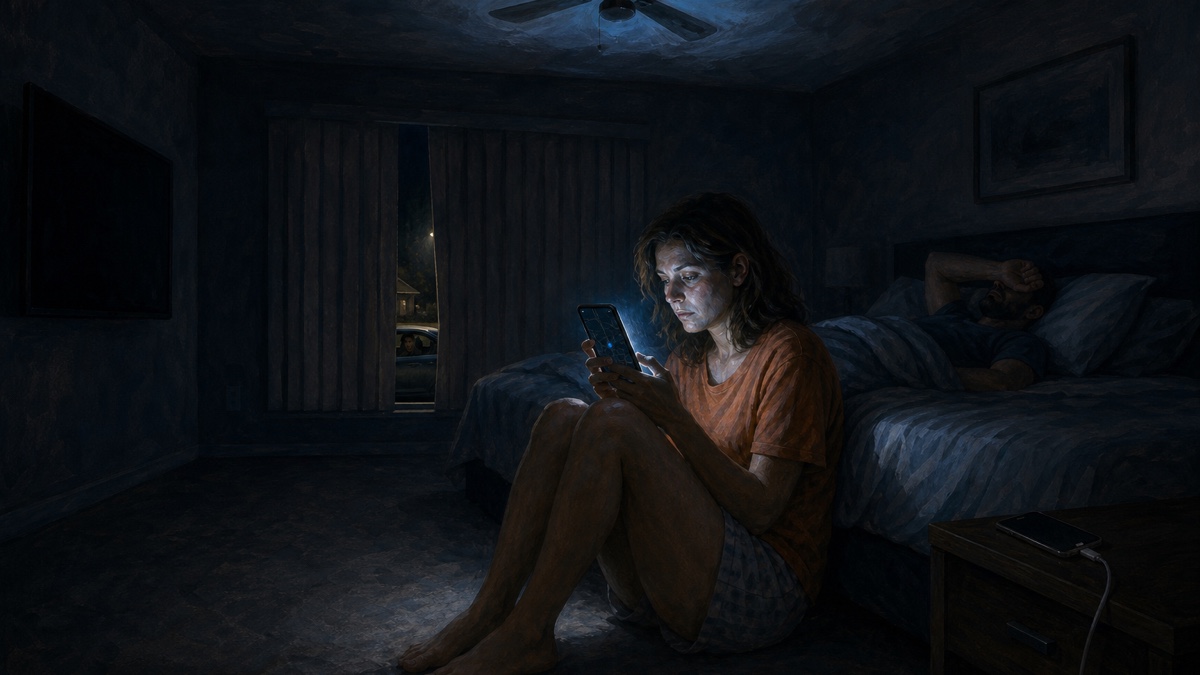
The knock came, three slow raps, patient, and I stood at the top of the stairs with my hand on a cold pillow, and I meant to go down. I told myself I was going down. And then I was still standing there and the house was quiet and the porch was empty when I finally looked, and I do not know how long I stood between the meaning to and the looking.
A minute. Maybe more. There is a hole in the evening where going down the stairs should be, and I cannot find the bottom of it.
I checked the locks after. Both on. I don’t remember setting them.
By six I have given up on sleep, circling back to it and circling back and finally just leaving it. I make coffee in the dark and I sit at the kitchen table with the mug going cold in front of me, and I do the thing I have spent forty years not doing.
I start to count.
Because I know the shape of it now. It isn’t new. What is new is that I am looking straight at it instead of past it.
My father stood up before the phone. Not when it rang. Before. There was a pocket in there, a little run of seconds where he was already reaching for a phone that had not made a sound yet, and we all laughed, Dad and his radar, and nobody ever put a number on the pocket.
You don’t put a number on it. The second you put a number on it you have admitted there is a length to measure, and a thing with a length is a thing that is real and out there and running on a clock of its own, not a mood, not nerves, not a story my grandmother told to make the jumpiness sound like a gift she was proud to hand down.
I am putting a number on it.
That morning I get my chance. I set the bowl out, the good cereal, the one I said was for weekends and then stopped saying anything about, and I walk Rex along the rim of it the way she liked.
Rex is a boat now, the milk is the sea, there is weather coming, real weather, and he had better hold on. And somewhere in the middle of the weather my other hand comes up off the counter and turns toward the table.
Fingers open. Palm out. Reaching across nothing.
I make myself count. One. The box is where it always is, the spoon is where I set it, everything on the table sitting still, and my arm is out over the placemat like I am handing something to a person who is not there. Two. Nothing. Three. The bowl slides.
It just slides. Nobody touches it. It slides toward the edge on its own and the milk jumps the lip and my hand is already under the far rim, already there, tipping it back down level before the spill can get going.
A little slops onto the wood. That is all. That is all it ever is.
Three seconds. Not the half of one it used to be, not the flat of a hand arriving at the very instant the glass goes, the way it was years ago with the orange juice, back when I still thought fast hands were a thing to be glad of.
Three whole seconds of my arm out over the table before there was anything for it to be out over.
I sit down across from the empty chair with the wet ring drying on the wood and I understand two things at the same time and I do not like either of them.
The first is that I did not reach for a spill. I reached for her. The hand went to the place at the table where she sits, the exact height, the exact angle, and it went there three seconds before the bowl she is not sitting behind decided to slide.
My body is not catching things. My body is catching her, over and over, at a table she is not at, and the things it saves along the way are just what happens to be in her chair when it reaches.
The second thing is worse and I have no word for it yet, so I write down the small version. It is getting longer. Half a second became one. One became three. The pocket my father had was never more than a breath. Mine is opening.
I clean up the milk. I look at the green numbers on the stove and I think about how you would time a thing like this if you wanted to, a stopwatch you could not reach fast enough, a phone propped against the sugar to film the counter so you could count the frames after.
And I stand there with the wet paper towel balled in my fist and I understand that I have become a man who has thought about filming his own kitchen to measure how early his hand is. I put the towel in the trash and I do not let myself go any further than that.
But I do go further than that. That is the whole trouble with me. All the way through the morning I am running it, my father and his pocket, my mother and the plate she took out of the air before it fell, and the question none of us ever asked, which is how long, because how long is the question that turns a gift into a symptom.
And then, at the sink, doing the breakfast dishes, it happens the other way.
I am rinsing the bowl, the water running, and it does not reach forward. It reaches back.
I need to say this carefully because I have been getting it wrong all day and I want to get it right once.
The scream from that first night. I have carried it as a thing that came from her room, down the hall, three seconds ahead of the real one. Her scream, out ahead of itself.
That is how I have held it. That is how I held it standing in the hall.
But at the sink this morning, with the water going, it came again, and it was not down the hall. It was here. It was close.
And there was something under it this time that was never there before, a sound beneath the scream, low and steady and stupidly ordinary.
Water. Running water. A tap left going somewhere in the dark.
And a voice in it. Mine. Early or late I could not tell you, saying the only thing I ever say, saying it low, and the scream running long over the top of it and dropping at the end the way it drops, going down, giving out, stopping expecting anyone to come.
I turned the tap off so hard the pipe knocked in the wall.
I stood there in the quiet with my heart going and I made myself think it through like a reasonable man. A memory does not gain parts. It loses them.
It goes soft at the edges and pale in the middle. But it does not sharpen. It does not hand you a new sound on a Tuesday morning that was not in it on Sunday.
What I heard the first night was a scream. What I heard this morning was a scream and running water and my own voice under it. And the only way a thing gains detail across three days is if it is not a memory at all.
If it is still happening. If it is out there running on its own and I am only catching pieces of it as they come around, the way you catch a station coming in and out on a long drive, more of it each time you pass under the same wire.
And if it is still happening, then it is not behind me.
Then it is coming.
I got Nora to school. I am not going to pretend I remember the walk, the four blocks, the corner, whether she held my hand at the curb or ran ahead, because I don’t. There is a smear where the walk should be the same as there is a hole where the stairs should be.
But I remember the gate, because at the gate I crouched to fix her collar and my hand went flat to the back of her neck and the words came out of me low the way they come out every time.
I’ve got you.
And my hand closed on the cold of a morning with nothing in it, at the height where the back of a six-year-old’s neck would be, and I knelt there on the concrete with my palm cupped around the shape of her.
The fifth-grade teacher who runs the gate said good morning to me, careful and gentle. I said good morning back and I stood up and my knees cracked and the street tipped the way it does when you get up too fast on no sleep and no food.
Just tired, I told myself. Bad night. A knock that turned out to be nothing.
Except the knock turned out to be nothing the exact way the table turned out to be nothing. Three seconds before it wasn’t.
I came home. I did the dishes I had already done. And then, because I could not stand the downstairs anymore, the ring on the table, the tap I did not trust, I went up.
Her room is cold. It is always cold now, colder than the hall, and I have stopped noticing that I notice it.
The bed is made because I made it. Rex is against the pillow where I put him, facing the door, so he can see her come in. Her shoes are by the closet where they have been since the spring.
I sat on the edge of the mattress and I fixed the corner of the cover that did not need fixing and I put my hand flat on the small cold pillow the way I do, and it came out of me low, before I decided anything, the way it always does.
I’ve got you.
And the room said it back.
Not an echo. Not the shape of my own voice coming off the wall. A small voice, her voice, close, from the direction of the pillow under my hand, tired and certain and a little bored, the voice of a kid settling back down into sleep after a bad dream she is already forgetting.
I know, Daddy.
I have not moved off this mattress. It is dark outside now. The water is running somewhere in the house and I did not turn it on and I am not going to go and find out which tap, because I know which tap, and I know it is running the way I know the scream is coming, three seconds ahead of a thing that has not caught up yet.
My hand is still on the pillow.
It is not cold anymore.