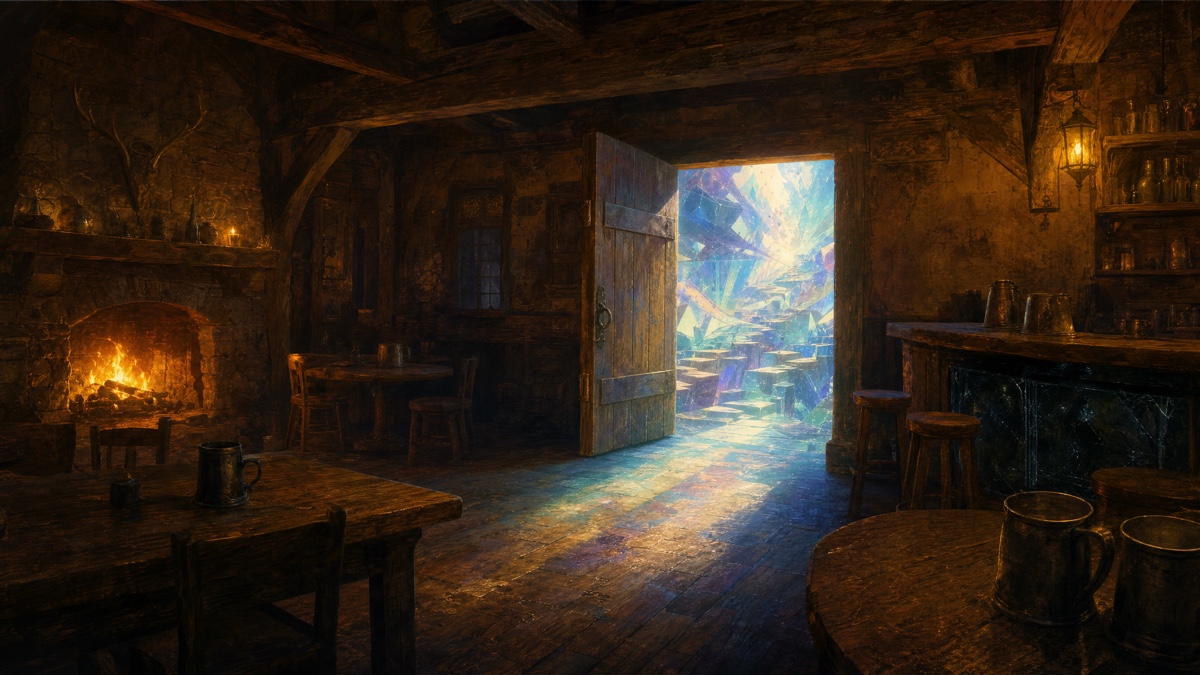
Ruth opened the door before I knocked. She’d been watching the road again.
“You saw Hale,” she said.
“I saw Hale. Then things moved fast.”
She stepped back and let me in. The house was the same. Books everywhere, photographs, the warm clutter of a life that had stayed in one place long enough to accumulate evidence of itself. She put the kettle on without asking.
“Sit down,” she said.
I sat. I set Martin’s documents on the kitchen table. Not all of them. The committee minutes, the collector profiles, the letter. I’d left the generational files in the storage unit because carrying them felt like carrying something that belonged there, in the sealed quiet of a room built specifically to hold them.
Ruth looked at the stack. She didn’t reach for it.
“Start from Hale,” she said.
So I told her. Not everything but the shape of it. Hale’s eleven stations across four districts. The network compromised from inside, someone feeding the collection teams. Three stations hit. Then the symbol on my family’s files going back four generations, and Hale not knowing who put it there.
Ruth’s hands tightened on her mug.
“There’s a man named Martin,” I said.
Something changed in her face. Not surprise exactly. Recognition arriving from a direction she hadn’t expected.
“You knew him,” I said.
“He shared fragments with me once. Near the end of his life.” She looked at her hands. “He was deciding who to trust with something. I wasn’t the one he chose.”
“He had a son. Brian. Brian’s been at my station for four years.”
Ruth set her mug down.
“Brian’s family protected mine for four generations,” I said. “His father. His grandfather. Brian gave me the key to Martin’s storage unit and I went there.”
“What did he leave you?”
“Forty years of research. Tracking the Hollowed the way a biologist tracks a species. Generational files, behavioral documentation, collector profiles.” I pushed the committee minutes across the table. “And this.”
Ruth read the committee minutes first. She was slow with them. I watched her face while she read because I couldn’t help it. Old habit. But I was watching differently now.
Her face moved the way Hollowed faces move. Not the performance. The thing underneath, pushing against the surface, being managed and contained and redirected in real time. I’d spent eight years reading that movement as a tell. A crack in the mask. Evidence of the defect.
It wasn’t a defect. It was the only real thing in any room I’d ever been in.
Ruth set down the committee minutes and looked at me.
“Primary affective response,” she said.
“That’s what they called it.”
“That’s what we are.”
She sat with it for a long moment. Her hands were wrapped around her mug and I could see the knuckles tighten slightly, which was the kind of thing I’d trained myself to notice and which I now understood as something different from what I’d always thought it was.
“I screened people for twenty-two years,” she said. “I knew what I was looking for. The training called it affective instability. The inability to regulate emotional presentation within normative parameters.” She paused. “I always thought normative meant healthy. Meant correct. Meant the way people are supposed to work.”
“It means the way everyone else works.”
“Yes.” She looked at the committee document again. “The way everyone else works. Consistently. Predictably. Within a defined architecture that doesn’t deviate.”
She got up and went to the bookcase. Not the one with the binder. A different shelf, lower, where she kept things that looked like they’d been handled many times. She came back with a cardboard box smaller than Vera’s, older, held together with tape that had been replaced more than once.
“Vera gave me her research six years ago,” Ruth said. “But I’d been collecting before that. On my own. Since I retired.”
She opened the box. Inside were handwritten accounts, some of them photocopies, some originals on paper so old it had gone soft. The same kind of material Vera had shown me in her apartment. Pre-program testimonials. People describing changes in their neighbors, their families. The accounts Vera had told me to read for the descriptions of the eyes.
I’d read some of them that night in Vera’s apartment. Not all. We’d been interrupted.
“Read them now,” Ruth said. “All of them. Start with the oldest.”
I read them.
The earliest accounts were from more than a century ago, before the program existed, before the word Hollowed had been invented. People writing letters, diary entries, reports to local authorities who didn’t have a framework for what was being described.
The language varied. The observations didn’t.
A woman in a farming community describing her husband. He’d always been a certain way. Warm, present, prone to outbursts of temper that he’d apologize for afterward. Then gradually, over months, the outbursts stopped. Not because he’d learned to manage them. Because whatever produced them had gone quiet. She wrote that he was kinder after the change. More considerate. More even. And that she couldn’t sleep next to him anymore because something in the way he breathed at night had become too regular.
A schoolteacher documenting changes in her students across a five-year period. She’d kept notes because she was thorough and because something bothered her that she couldn’t articulate. The newer students were better behaved. More attentive. Easier to teach. And they all learned at the same rate. Not approximately the same. The same. She’d tested it with reading exercises, tracking pages per minute, and the numbers came back identical across students who should have had wildly different aptitudes.
A doctor writing to a colleague about a pattern in his patients. People coming in for routine examinations who were, by every clinical measure, in perfect health. Identical resting heart rates. Identical response times during reflex testing. He’d started keeping detailed records because he thought his instruments were malfunctioning. They weren’t.
I read account after account. The details changed but the observation didn’t.
Something was replacing the variation.
Not suddenly. Not violently. Not in a way that anyone could point to and say, “That’s when it happened.” Just a slow narrowing. The range of human behavior compressing over years, over decades, until what was left looked like health. Looked like stability. Looked like the normative baseline that the screening program would eventually be built to measure against.
“How far back do these go?” I asked.
“The oldest one I’ve found is a hundred and forty years. A journal entry from a magistrate describing his town council. He wrote that the men on the council had become easier to work with and that this disturbed him.” She paused. “He used the phrase ‘agreeable in a way that has no source.’ He said their agreeableness didn’t come from anywhere. It wasn’t the result of compromise or persuasion or exhaustion. It was just there. As if it had been installed.”
Installed.
A word from a hundred and forty years ago that described exactly what I’d been looking at across the screening desk for eight years without having the framework to name it.
“I want to tell you something I’ve never said out loud,” Ruth said.
I waited.
“Twenty-two years of screening. Thousands of people. I got very good at it. Better than the training intended, maybe, because I was Hollowed and I understood from the inside what the test was looking for.” She turned her mug in her hands. “I noticed something early. Within the first two years.”
“The consistency.”
She looked at me. I’d surprised her.
“I noticed it too,” I said. “I just didn’t know what I was noticing. Tell me what you saw.”
“The people who pass the screening. The ones who aren’t Hollowed. On the surface they’re all different. Personality. Temperament. The normal range.” She stopped. Started again. “But underneath that, the structure of their responses is identical. Not similar. Identical.”
“Define identical.”
“The timing. The sequence. The way one emotion transitions to the next. I’d ask the same question to hundreds of people in slightly different framings and track the response patterns.” She set her mug down. “The Hollowed responses were all over the place. Messy. Unpredictable. Sometimes so raw it made me want to look away.”
“Real.”
“Real. And the others were clean. Precise. Perfectly appropriate. Structurally identical underneath the surface variation. Every single one.”
I thought about my own screening room. Eight years of faces. I’d been so focused on detecting the Hollowed that I’d never turned the lens on the people who passed. They passed, they left, they were normal. I’d never asked what normal actually looked like under sustained observation because I was too busy surviving to examine the water I was swimming in.
“You tested this,” I said. “Over how many subjects.”
“Hundreds. Informally, over years. Same methodology every time.” She leaned back. “I told myself the consistency was what healthy looked like. That the Hollowed were the deviation. The training said so. The literature said so. I believed it for twenty-two years.”
“But you kept the notes.”
“Because something in me knew that living things aren’t that consistent. That a species with genuine interiority doesn’t produce responses you can overlay on top of each other like identical transparencies.”
She let that sit.
“Show me,” I said.
Ruth looked at me. “What?”
“You said you tracked response patterns. You have the data. Show me.”
She went to the bookcase again. Came back with a notebook, the kind with graph paper, filled with her careful handwriting. Charts and timing diagrams and response sequences mapped onto grids.
I opened it and I saw it immediately.
Two clusters. Hollowed subjects scattered across the grid like buckshot, no two alike. And the non-Hollowed subjects stacked on top of each other so precisely that the data points looked like a single entry plotted hundreds of times.
This wasn’t interpretation but measurement. This was the difference between a forest and a wall.
I closed the notebook and looked out the window.
The suburb was doing its morning. A man walked his dog past Ruth’s house. Two houses down, a woman was checking her mailbox. Across the street, someone was getting out of a car.
I watched them the way I watch people in the screening room. Sustained and clinical. Looking for the architecture underneath the action.
The man with the dog adjusted his grip on the leash. The woman at the mailbox turned to go inside. The person across the street shut the car door and walked toward their house.
Three different people. Three different actions. Three different lives.
The timing was identical. Not approximately. The same interval between movements. The same transitional cadence. The same pause-then-proceed rhythm, repeated across three separate bodies doing three separate things.
I’d been watching people my whole life and I had never seen it because I’d been watching for the wrong thing. I’d been trained to look for the cracks in the Hollowed performance. I had never once looked at the stage itself.
The stage was flawless. The stage was uniform. The stage was the same in every direction.
I turned back to Ruth. She was watching me. She’d seen me see it.
“How long have you known?” I asked.
“I’ve suspected for fourteen years. I’ve been certain for about six.” She looked at the window. “You get used to it. That’s the worst part. You see it and then you keep living in it and eventually the seeing becomes just another thing you carry.”
“Vera asked me to read the descriptions of the eyes,” I said. “The night she was taken. She handed me the old accounts and told me to read what they said about the eyes. I started to. I saw something in the lead collector when they took her out. Something I’d seen a hundred times and never registered.”
“What did you see?”
“Nothing behind them. Not emptiness. Smoothness. Like a surface that’s never been interrupted by anything moving underneath.”
Ruth nodded slowly.
“I saw it every day for twenty-two years,” she said. “I called it professionalism.”
—-
We sat with it for a while. The kind of silence that two people share when they’ve both arrived at the same place from different directions and need a moment before they can talk about where they’re standing.
“Martin’s letter,” I said. “He wrote that he didn’t know what everyone else is. Forty years of watching and he didn’t know.”
“No one knows. Vera didn’t know. I don’t know.” She picked up the committee document again, the one with the phrase “primary affective response.” “But I know what we are now. And I know that whatever built this system built it to find us specifically. Not to find the absence of something. To find the presence of us.”
“And remove it.”
“Systematically. Over eighty years. Down from eight or twelve percent to less than one.” She set the document down. “That’s not a detection program. That’s an elimination.”
The word sat between us and did what it was built to do.
“The five collections that spiked in the last three months,” I said. “From Hale’s network. They were all people marked with Martin’s symbol. The one on my family’s files.”
Ruth was quiet for a moment. I could see her fitting it against what she already knew, the collection dates in her own binder, the names she’d been crossing out.
“They targeted the ones with the longest paper trail,” she said. “The ones most visible to the old infrastructure.”
“I’m the last one with the symbol.”
“And Brian is the only person still maintaining the protection line.”
She said it as a statement, not a question. She’d been listening to what I’d told her about Brian’s family and she’d already mapped the shape of it.
“There’s something else,” she said. “Something I’ve been deciding whether to tell you. I decided when you walked in tonight looking different.”
I waited.
“Martin didn’t only track the Hollowed. He tracked people who weren’t Hollowed who behaved unexpectedly. He had a separate set of notes. I’ve only seen fragments. He shared them with me once, near the end, when he was trying to decide who to trust with the storage unit key.”
“Unexpectedly how?”
“Variations. Deviations from the pattern. People who should have been consistent who suddenly weren’t.” She looked at her hands. “A collector who hesitated during a pickup. A committee member who asked a question the minutes describe as ‘outside the scope of review.’ Small things. Tiny cracks in something that isn’t supposed to crack.”
“Harlan,” I said.
Ruth looked up.
“Martin’s collector profiles. He flagged one named Harlan. A pattern break. An unscripted pause during a collection. Then the entries just stopped.”
“I don’t know the name. But that’s what Martin was watching for. The ones who deviated.”
“He thought the others were changing?”
“He thought some of them were. He didn’t have enough data to be certain and he was very careful about certainty.” She paused. “But he believed that whatever we are, whatever produces the primary affective response, it might not be as contained as the program assumes. He believed it might be communicable. Over time. Through proximity.”
I thought about Brian. Four years working next to me. The micro-adjustment I’d seen on his face in the archive. The expression I couldn’t name.
“That’s why they protected my family specifically,” I said.
“Martin believed your line carried it more strongly than most. Not better hidden. Stronger. Harder to suppress.” Ruth looked at me directly. “He thought the Hollowed weren’t just surviving. He thought you might be the reason some of them are starting to become something else.”
I didn’t know what to do with that. I don’t know what to do with most things. I just carry them.
“They came to the station looking for me,” I said. “I heard them tell Brian I’m the fourth. The others are resolved. If they’re watching Brian, they’re watching Hale’s whole network.”
Ruth’s hands went still around her mug. Not the careful stillness of composure. The stillness of something landing hard.
“How long do you have,” she said.
“I don’t know. Days. Maybe less.”
She looked at the window. At the quiet street with its appropriate houses and its appropriate trees and its appropriate people moving through an appropriate evening.
“Martin believed someone would come for the room,” she said. “Someone from your line. He waited his whole life and then he left the key and died. Brian waited six years.” She turned back to me. “I’ve been waiting fourteen years to have this conversation with someone who could see what I saw.”
“I see it.”
“Then we stop waiting.”