Vessen had mapped three hundred and twelve buildings across fourteen cycles. He knew the permanent structures of Thornwell District better than he knew his own face. Every archway, every foundation stone, every inexplicable corner that didn’t match the architectural records.
He also knew his wife was slipping away.
Brith sat at the kitchen table, her tea going cold, staring at the window with that particular emptiness that meant she was somewhere else. Her hands moved occasionally, gesturing at conversations he couldn’t hear.
“Brith.”
Nothing.
“Brith, love.”
She blinked. Turned to him. Smiled that smile she’d had when they first met, forty-three years and six cycles ago.
“Vessen! When did you get home?”
“I’ve been home for an hour.” He kept his voice gentle. No point in frustration. She couldn’t help it.
“Have you?” She looked around the kitchen like she was surprised to find herself there. “I was just thinking about the day we met. Do you remember? At the archive dedication ceremony?”
He remembered. He also remembered her telling him this story three times yesterday. And twice this morning.
“You were wearing that blue coat,” she continued, warming to the tale. “The one with the brass buttons. And you kept dropping your notes because you were trying to watch me instead of where you were walking.”
“I was nervous.”
“You were adorable.” She reached across the table and took his hand. Her grip was still strong. Her mind was the problem, not her body. “I told Mother that night, I said, ‘I’ve met the man I’m going to marry.’ She thought I was being dramatic.”
“You were right, though.”
“I was.” Brith squeezed his hand. “I’m always right about the important things.”
Vessen looked at his wife. Forty-seven years old in body, but her mind contained eleven cycles at that same age. Seventy-seven years of memories crammed into a space meant for seven. She’d refused to advance for the last four cycles. Cost too much, she said. They needed the money for his materials, his research, the life they’d built.
He’d begged her. Offered to sell his equipment. Promised they’d find the funds somehow.
She’d refused. Stubbornly, lovingly refused.
“I’ve had a good life,” she’d said. “Better than my mother got. Better than most. If I advance now, I might lose you. I might wake up and not remember our wedding, or our first apartment, or the night we stayed up until dawn arguing about whether the moon was actually silver or just looked that way.”
“It looks silver because of the reflection off the—”
“I don’t want to know! That’s the point.” She’d laughed then, four cycles ago, when her mind was still mostly hers. “I want to keep having that argument with you forever.”
Forever was getting shorter.
—-
They’d met at the archive dedication, just like she said. He’d been twenty-five, fresh from his apprenticeship, carrying too many rolled maps and not enough sense. She’d been twenty-two, there with her father who worked in the memorial preservation office.
She’d caught one of his maps when it rolled off the pile. Handed it back to him. Asked what he was working on.
He’d talked for twenty minutes about foundation surveys and structural anomalies before realizing she probably didn’t care about load-bearing calculations.
“I’m sorry,” he’d said, mortified. “I get carried away.”
“Don’t be sorry.” She’d smiled at him. “I like how much you care about things.”
That was Brith. She liked how much people cared about things. It didn’t matter what the things were. She collected passions the way other people collected coins or stamps. She’d listen to anyone talk about anything, as long as they truly loved what they were discussing.
They’d married two cycles later. Built a life in a small permanent apartment in Thornwell. He mapped buildings. She worked at a textile cooperative, then later at a school, teaching children how to weave. They’d never had children of their own.
“We don’t need them,” Brith had said once. “We have each other. We have enough.”
—-
“Vessen.”
He looked up from his maps. Evening had fallen while he worked. Brith stood in the doorway of his study, still in her day clothes.
“Yes, love?”
“I can’t remember where the bedroom is.”
His heart cracked. Clean down the middle.
“Down the hall,” he said, keeping his voice steady. “Second door on the left.”
“Down the hall.” She repeated it like a student memorizing a lesson. “Second door on the left.”
“That’s right.”
“I knew that.” She shook her head, frustrated. “I know I knew that. It’s just… everything looks the same tonight. Like I’m seeing three apartments at once.”
He set down his pen. Crossed the room. Took her arm.
“Let me walk you there.”
She leaned into him as they moved down the familiar hallway. “I’m getting worse, aren’t I?”
“You’re tired.”
“I’m not tired, Vessen. I’m breaking.” She stopped at the bedroom door, looking at it like it might disappear. “I told you the story about the archive dedication today. Didn’t I.”
“Yes.”
“How many times?”
He didn’t answer.
“How many times, Vessen?”
“Four.”
She closed her eyes. When she opened them, they were wet.
“I don’t remember telling you even once.” Her voice was small. Scared. “I thought I was just thinking about it. I didn’t know I was talking out loud.”
“It’s all right.”
“It’s not all right.” She pulled away from him, sudden and sharp. “Stop saying that. Stop pretending everything is fine. I’m losing my mind and you just keep smiling and nodding and treating me like I’m made of glass.”
“What do you want me to do?”
“I want you to be angry!” She was crying now. “I want you to yell at me for not advancing when I had the chance. I want you to tell me I was stupid, that I should have listened, that you warned me and I didn’t listen.”
“You weren’t stupid.”
“I was proud.” She wiped her face with the back of her hand. “I thought I could handle it. I thought I was strong enough.”
“You are strong.”
“I’m not. I’m drowning, Vessen.” She looked at him, and for a moment her eyes were perfectly clear. Perfectly present. “I’m drowning and I can feel myself going under and I can’t stop it.”
He held her. Didn’t speak. There was nothing to say that would help.
After a long time, she pulled back.
“Help me into bed?”
He did.
She fell asleep quickly. He lay beside her, listening to her breathe, watching the moonlight move across the ceiling.
She’d called the moon silver, that night forty-three years ago. He’d tried to explain about light refraction and atmospheric particles. She’d put her hand over his mouth and said, “Some things don’t need explanations. Some things just need to be beautiful.”
He’d fallen in love with her right then.
—-
The next morning, she didn’t recognize him.
It lasted three hours. She called him her father’s name. Asked why he was in her bedroom. Threatened to scream for help.
He’d retreated to the kitchen. Made tea. Waited.
Eventually she came out, confused but herself again.
“Vessen?” She looked at him like she was checking to make sure he was real. “I dreamed… I dreamed you were someone else.”
“Just a dream.”
“Was it?” She sat across from him. Took the tea he offered. “It felt real. More real than this does right now.”
“This is real.”
“How do you know?” She wasn’t being philosophical. She was asking an actual question. “How do you know which moment is the real one? When they all feel the same? When I can remember having breakfast with you a thousand times and none of them feel any more true than the others?”
He didn’t have an answer.
“I want to advance,” she said quietly.
His hands went still on his teacup.
“Brith—”
“I know what I said before. I know I was afraid of losing memories of us. But I’d rather lose some of them than lose all of them.” She met his eyes. “I’d rather remember you as a stranger than forget you while you’re standing right in front of me.”
“It’s expensive. We don’t have—”
“We’ll find the money.” She reached across the table. Took his hands. “I need to do this. Before it’s too late. Before Dawn Day comes and I’m stuck like this for another seven years.”
Dawn Day. Three months away. If she advanced now, she’d register at the Memorial Archive, lock in her new reset point, and then wait. Three months of living with the knowledge that something was coming. Three months of looking at every precious memory and wondering if it was marked for deletion.
And then she’d wake up after Dawn Day with a hole she’d have to discover.
“Can you handle three months of waiting?” he asked. “Knowing what’s coming?”
“I don’t know.” Her honesty was devastating. “I don’t know what I’ll be in three months. But at least I’ll have a chance.”
—-
They sold his mapping equipment. His reference books. The good furniture from the living room. Everything they could spare and some things they couldn’t.
It still wasn’t enough.
Advancement fees were set by the Archives. The same rate for everyone, theoretically fair. But “fair” didn’t account for cartographers who made modest wages and wives who taught weaving for almost nothing. “Fair” meant the wealthy could advance every cycle while people like Brith accumulated decades of memories they couldn’t afford to escape.
Vessen took extra work. Night surveys. Dangerous assessments in unstable structures. Anything that paid.
It still wasn’t enough.
He applied for hardship exemptions. Charitable foundations. Emergency relief programs. The waiting lists were years long.
Two months before Dawn Day, he found a solution.
—-
“No.”
Brith’s voice was sharp. Clear. One of her good moments.
“It’s the only way.”
“You are not selling the apartment.”
“It’s just a building.”
“It’s our home.” She stood in the middle of the living room, the room they’d emptied of furniture, and her eyes were fierce. “It’s the only permanent thing we have. If you sell it, we’ll be temporary. We’ll have to rebuild every seven years.”
“I don’t care about rebuilding.”
“I do.” She crossed to him. Took his face in her hands. “Listen to me. I’m not always going to be here. Not mentally. You know that. I know that. But when I’m gone, you’re going to need somewhere to come home to. Somewhere that stays. Somewhere you don’t have to rebuild from nothing every time the world resets.”
“I need you more than I need walls.”
“You can’t have me.” Her voice cracked. “That’s what I’m trying to tell you. Even if I advance, I might not come back. The deterioration is too far. The scribe said—”
“I know what the scribe said.”
“Then you know there’s a chance the advancement kills me. Or takes everything. Or leaves me worse than I am now.” She pulled him close. “I won’t let you give up our home for a gamble.”
“It’s not a gamble. It’s a chance.”
“Same thing.” She kissed his forehead. “Find another way. Please.”
—-
He found another way.
It cost him something he couldn’t name. A favor owed to someone who dealt in favors. A promise he’d have to keep someday, the details left deliberately vague.
But he got the money.
The night before they were scheduled to go to the Archives, Brith had one of her bad episodes. Didn’t recognize him. Didn’t recognize the apartment. Wandered from room to room asking where her mother was.
Her mother had been dead for thirty years.
Vessen guided her gently. Answered her questions. Pretended to be a helpful stranger in what she thought was a stranger’s home.
By morning, she was Brith again. Exhausted. Embarrassed. Apologetic.
“Did I do it again?”
“It’s all right.”
“It’s not.” She sat on the edge of the bed, head in her hands. “I called you names. I told you to get out. I threatened to call the guards.”
“You didn’t know.”
“That’s the problem.” She looked up at him. “I don’t know anything anymore. I don’t know what’s real. I don’t know what I’ve said. I don’t know who I am from one hour to the next.”
“You’re Brith. My wife. The woman I love.”
“Am I?” She smiled, but it was broken. “I don’t feel like anyone’s wife. I feel like a ghost wearing someone else’s memories.”
—-
The scribe at the Archives was young. Probably on his first cycle in the position. He looked at Brith’s records with growing concern.
“Eleven cycles at the same reset point. That’s… significant deterioration.”
“We know.”
“The advancement process requires coherent memory identification. The subject has to be able to focus on a seed memory for the chain collapse to work properly. If she can’t distinguish between cycles—”
“What are you saying?”
The scribe hesitated. “I’m saying there’s risk. Substantial risk.”
“Risk of what?”
“The chain collapse could cascade. Instead of losing one memory chain, she could lose… more. Much more.”
“How much more?”
“Everything.” The scribe met Vessen’s eyes. “It’s rare. But with deterioration this advanced, the mind sometimes can’t contain the process. It’s like…” He searched for words. “It’s like pulling one thread from a tapestry that’s already unraveling. Sometimes you just get that thread. Sometimes the whole thing falls apart.”
Vessen’s mouth was dry. “And if we don’t advance her?”
“Then the deterioration continues. Based on her progression, I’d estimate…” The scribe checked his notes. “Six months to a year before she loses coherent identity entirely.”
“What does that mean?”
“It means she might not recognize herself. Might not know her own name. Might live entirely in memories of other cycles with no connection to the present.”
“She’s already doing that.”
“It will get worse.” The scribe’s voice was gentle but honest. “Much worse.”
—-
Vessen sat in the waiting room. Brith was in with the memory scribes, being assessed for advancement readiness.
Around him, other families waited. Wealthy ones with private consultants. Middle-class ones clutching savings. A few desperate ones like him, hollow-eyed with hope and fear.
A woman across the room was crying quietly. Her husband held her hand.
“It’s going to be fine,” he kept saying. “She’ll be fine.”
But his voice shook.
—-
The assessment took three hours.
When they brought Brith out, she looked confused. Lost. She didn’t recognize Vessen until he spoke.
“I’m here, love.”
“Vessen.” Relief flooded her face. “I couldn’t find you. I kept looking but all the rooms looked the same and I didn’t know—”
“I’m here.” He held her. “I’ve got you.”
The scribe appeared beside them. His face was carefully neutral.
“May I speak with you? Privately?”
—-
“She’s not a good candidate.”
Vessen had expected this. Had prepared for this. But hearing it still felt like a knife.
“She can still advance. The option exists. But I have to be honest about the risks.”
“Tell me.”
“Her mind is too fragmented. When we tested her ability to isolate seed memories, she couldn’t maintain focus. The memories kept bleeding into each other. Different cycles, different ages, all overlapping.”
“What does that mean for the advancement?”
“It means the cascade is unpredictable. We can’t control which chain collapses. We can’t guarantee she’ll keep anything important. And there’s a…” He paused. “There’s a meaningful chance the cascade won’t stop at one chain.”
“How meaningful?”
“Forty percent. Maybe higher.”
“Forty percent chance she loses everything?”
“Forty percent chance she loses more than intended. Everything is… possible. But unlikely.”
“And the alternative?”
“She continues as she is. Deteriorates further. Eventually requires full-time care. Eventually stops recognizing anyone or anything. Eventually…” He didn’t finish.
“Eventually dies?”
“Eventually stops living in any meaningful sense. The body might persist. But the person inside…” The scribe shook his head. “I’m sorry. There’s no good option here.”
“There never is.”
—-
He told Brith about the choice. Or tried to.
She listened politely, nodding in the right places, then asked if he was from the maintenance department.
He tried again. Explained who he was. Who she was. What the advancement would mean.
She smiled at him.
“That’s a very sad story,” she said. “About the married couple. I hope they find a way.”
“Brith, it’s us. You and me. We’re the couple.”
“Oh, I don’t think so.” She shook her head firmly. “I’m not married. I would remember that.”
He showed her their wedding certificate. Their wedding portrait. The little ceramic bird she’d bought him on their first anniversary because she said he needed something beautiful in his study.
She looked at the evidence. Looked at him.
“You seem very certain.”
“I am certain.”
“Then why can’t I remember?”
He didn’t have an answer.
—-
Six weeks before Dawn Day, Brith had a moment of clarity.
It happened sometimes. Less and less frequently. But that evening, she looked at him and her eyes focused and she said, “Vessen.”
He dropped the dish he was drying.
“Brith?”
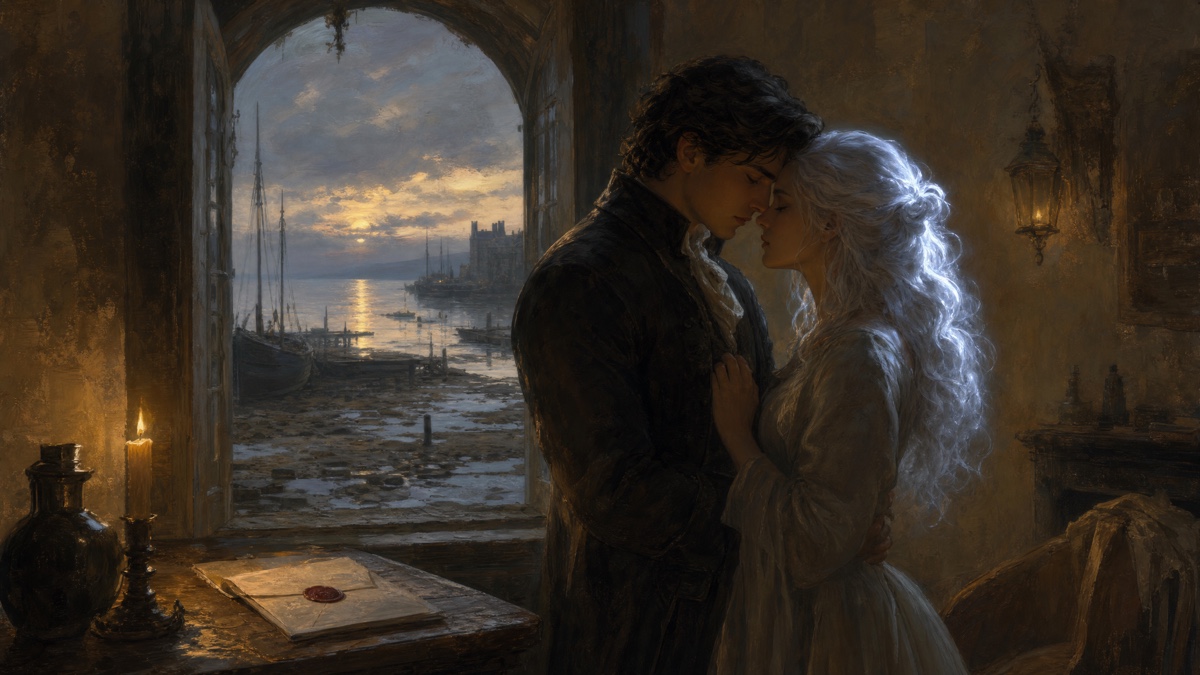
“I know what you’ve been doing.” She was sitting in her chair by the window, the moonlight making her face silver. “Selling your things. Working nights. Trying to save me.”
“You’re worth saving.”
“Am I?” She looked out the window. “I’ve been gone for months. You’ve been taking care of a stranger who happens to live in my body.”
“You’re still you.”
“Parts of me are still me.” She turned back to him. “Fragments. Pieces that float to the surface sometimes. But mostly I’m just… confused. Drowning in a thousand versions of a life I can’t sort out.”
“The advancement—”
“Might kill me.” She said it calmly. “I know. I’ve heard you discussing it with the scribe. Or I think I have. It’s hard to tell what I’ve really heard and what I’ve imagined.”
“It might save you.”
“It might save some of me.” She reached out her hand. He crossed the room and took it. “But which part? The part that knows you? Or some other part that doesn’t?”
“I don’t know.”
“No one does.” She squeezed his fingers. “That’s the joke, isn’t it? We spend our whole lives trying to hold onto ourselves, and in the end we lose anyway. Either we lose pieces through advancement or we lose everything through deterioration.”
“Brith—”
“I want you to choose.” She cut him off. “Whether I go to the Archives and register. I want you to decide.”
“I can’t make that decision for you.”
“You’re going to have to.” Her eyes were wet but her voice was steady. “Because I won’t remember this conversation in an hour. I won’t know what we discussed, what I wanted, who you are. You’ll have to choose for both of us.”
“It’s not fair to ask me that.”
“Nothing about this is fair.” She smiled at him. That same smile from the archive dedication. From their wedding. From a thousand mornings across forty-three years. “But you’re the only one I trust to make it. Whatever you decide, I’ll accept. Even if I don’t remember agreeing.”
“What if I choose wrong?”
“Then at least one of us will know you tried.” She pulled him closer. Kissed his forehead. “I love you, Vessen. I’ve loved you since the day you dropped your maps at my feet. Whatever else I forget, please remember that I loved you.”
“I’ll remember.”
“Good.” She settled back in her chair. Closed her eyes. “Stay with me? Until I go?”
“Always.”
He held her hand as the clarity faded. Watched her face go slack, then confused, then empty. Listened to her start humming a song from a cycle he didn’t recognize.
By morning, she was gone again.
—-
The Memorial Archive was quieter in the afternoon. Most people came in the mornings, wanting the whole day to process whatever they’d decided.
Brith sat beside him, pleasant and confused.
“This is a lovely building,” she observed. “Very permanent.”
“Yes.”
“Are we waiting for something?”
“Yes.”
“What?”
“A decision.”
A few other families sat in the hall. A young couple holding hands, nervous. An older man alone, clutching a worn photograph. Everyone here for the same reason. Everyone trying to outrun something they couldn’t escape.
When their turn came, Vessen led Brith to the consultation room. The same scribe waited, professionally neutral.
“Have you decided?”
Vessen looked at Brith. She was examining the room with detached curiosity, running her fingers along the edge of the desk, humming softly.
He thought about her smile at the archive dedication.
He thought about their wedding night, when she’d cried because she was so happy.
He thought about forty-three years of mornings and evenings and arguments about whether the moon was silver.
He thought about her asking him to choose.
He thought about what came next. If they registered today, her new reset point would lock in at forty-seven. Then they’d go home and wait. Six weeks of watching her deteriorate, knowing that Dawn Day was coming, knowing that she’d either wake up with holes in her memory or not wake up at all.
Six weeks of dread. Six weeks of looking at every precious moment and wondering which ones she’d lose.
Or they could walk away. Go home. Let her continue as she was. Watch her fade without the sharp cut of advancement, just the slow blur of deterioration until there was nothing left.
“No,” he said.
The scribe blinked. “No?”
“No advancement.” Vessen stood. Took Brith’s hand. “I’m taking her home.”
—-
They walked back through the late afternoon streets. The city hummed around them, oblivious to their private grief.
Brith walked beside him, docile and confused, occasionally pointing at things she found interesting.
“Look,” she said. “The roses are blooming.”
He looked. Someone had planted roses in a window box. Red ones. Beautiful.
“They are.”
“I planted roses once. I think.” She frowned. “Or maybe I dreamed it.”
“Maybe both.”
She considered this. “Can something be both a dream and real?”
“I don’t know.”
She accepted that. They kept walking.
—-
Dawn Day came six weeks later.
Vessen woke in the pre-dawn darkness, that strange stillness that always preceded the reset. Brith was asleep beside him, breathing softly.
She hadn’t recognized him in three days. Called him by her brother’s name, mostly. Sometimes her father’s. Once, heartbreakingly, by the name of a childhood friend who’d died before they met.
But she was still here. Still breathing. Still able to smile at roses and wonder about dreams.
The reset took everything temporary. Walls that weren’t permanent crumbled to dust. Possessions vanished. The world remade itself.
Their apartment was permanent. Built on foundations that had stood for centuries. The walls stayed. The roof stayed. Brith stayed.
Her body didn’t change. She hadn’t advanced, so her reset point was still wherever it had been before. Forty-seven. Same as always.
When she woke, she looked at him with that familiar confusion.
“Good morning,” she said politely. “Are you the landlord?”
“Something like that.”
“This is a nice apartment. Very solid. I feel safe here.”
“Good.” He got up. Started making tea. “Would you like breakfast?”
“Yes, please.” She sat up, looking around. “Have I been here long?”
“A while.”
“I don’t remember arriving.” She frowned. “I don’t remember much of anything, actually.”
“That’s all right.” He brought her the tea. Sat on the edge of the bed. “I remember for both of us.”
She sipped the tea. Smiled at him. Not the smile of recognition, but something softer. A stranger appreciating a kindness.
“That’s nice of you. Remembering for someone else.”
“It’s not hard. Not for you.”
“Did we know each other? Before?”
“Yes.”
“Were we friends?”
He looked at his wife. Forty-seven years old in a body that would never age. Seventy-seven years of memories tangled together in a mind that couldn’t sort them. She didn’t know his name. Didn’t know her own name, half the time.
But she was still here. Still able to smile and drink tea and wonder about roses.
“Yes,” he said. “We were friends.”
“Good friends?”
“The best.”
She nodded, satisfied. “I thought so. You have a kind face.”
He sat with her while the sun rose. Told her stories about a young man who dropped his maps at an archive dedication. About a woman who collected other people’s passions. About forty-three years of mornings and evenings and arguments about whether the moon was silver.
She listened politely. Smiled at the right places. Didn’t recognize any of it.
But she was still here.
He’d made his choice.
Now he just had to live with it.