Silla painted faces for people who might forget them.
That’s how she described her work when anyone asked. Not portraits. Not art. Just faces. Preserved in oil and canvas so that when the advancement took them, something would remain.
She’d been doing it for twelve cycles now. Had painted hundreds of faces. Mothers, fathers, children, lovers, strangers. Anyone who could pay her modest fee.
The wealthy didn’t need her services. They had memory scribes and guided advancement and all the tools money could buy.
But the poor came to her in steady streams. Sat in her studio while she worked. Told her about the person they were about to lose. Or might lose. Or had already lost but wanted to remember anyway.
—-
Her current client was a young man named Garrett.
Twenty-five. Third cycle at that age. About to advance for the first time because his family had finally scraped together enough money.
“It’s my mother,” he said. “She died two cycles ago. But I’m worried… what if I lose her?”
“The face specifically? Or the memory of her?”
“Both. Either.” He looked at the blank canvas with desperate hope. “I just want something that can’t be taken.”
Silla understood. Most of her clients came with similar fears. The advancement was supposed to be random, but everyone had stories about someone who’d lost something crucial. A parent. A spouse. A child.
“Tell me about her,” Silla said, setting up her paints.
—-
She didn’t work from photographs.
Photographs captured surfaces. What a person looked like in one frozen moment. But faces were more than surfaces. They were expressions. Emotions. The way someone’s eyes crinkled when they laughed or tightened when they were scared.
She painted from stories.
“She had this way of looking at me when I’d done something wrong,” Garrett said. “Not angry, exactly. Just… disappointed. Like she expected better.”
Silla’s brush moved. Captured something in the eyes.
“And when she was happy, really happy, she’d laugh with her whole body. Couldn’t help it. Even in serious situations.”
A curve to the mouth. A looseness in the features.
“She worked her hands raw every day so I could have food. Never complained. But you could see it in her face at night, when she thought no one was watching. The exhaustion. The worry.”
Lines around the eyes. Tension in the jaw. Love and fear and determination layered together.
—-
The portrait took three sessions.
When it was done, Garrett stared at it for a long time without speaking.
“That’s her,” he finally said. “I don’t know how you did it from just stories, but that’s her.”
“The stories are the person. The face is just where we keep them.”
“Will it work? Will looking at this help me remember if I lose her?”
“It won’t bring back the memories. Nothing can do that. But it might anchor something. Give you a reference point.” She paused. “Some clients say it helps. Some say it doesn’t. Everyone’s different.”
“How much do I owe you?”
She named her fee. Modest. She could have charged more. Should have charged more, probably. But the people who needed her services were the same people who couldn’t afford the guided advancement that might have protected their memories in the first place.
Seemed wrong to profit too much from that.
—-
Her studio was in the permanent district.
Small space, but it survived the resets. Walls lined with portraits she’d painted over the years. Hundreds of faces, watching her work.
She kept the ones whose owners never came back to claim them. It happened more often than she’d expected. People would commission a portrait, then advance and lose the memory of commissioning it. Would walk past her studio without a flicker of recognition.
She kept the portraits anyway. Felt wrong to destroy a face that someone had once wanted preserved.
—-
Her next client was different.
Older woman. Maybe sixty. Wealthy, based on her clothes and bearing. Not the usual type who sought out Silla’s services.
“I want you to paint my husband,” the woman said.
“I don’t usually work for wealthy clients. There are better portraitists who…”
“I don’t want a portraitist. I want you.” The woman sat in the client chair without being invited. “I’ve heard about what you do. Painting faces from stories instead of from life.”
“That’s right.”
“My husband has been dead for fifteen years. I have photographs, but they don’t capture him. Not really.” She met Silla’s eyes. “I’m advancing next month. First time in eight cycles. I’m worried I’ll lose him.”
“If you haven’t advanced in eight cycles, you’re at significant risk of deterioration. Why wait so long?”
“Because I was afraid of exactly this. Losing the memories I was trying to protect.” The woman’s voice cracked. “Stupid, isn’t it? I’ve spent eight cycles terrified of forgetting, and now I can barely remember what I was trying to hold onto.”
—-
The husband’s name had been Darreth.
Merchant. Kind man. Had died of a fever that swept through the city fifteen years earlier.
“We met at a trade fair,” the woman said while Silla sketched. “He was selling cloth. I was looking for something for my sister’s wedding. He talked me into buying twice what I needed.”
“What was he like?”
“Persuasive. Charming. But not in a false way. He genuinely believed in what he sold. Made you believe too.”
Silla’s charcoal moved across the paper.
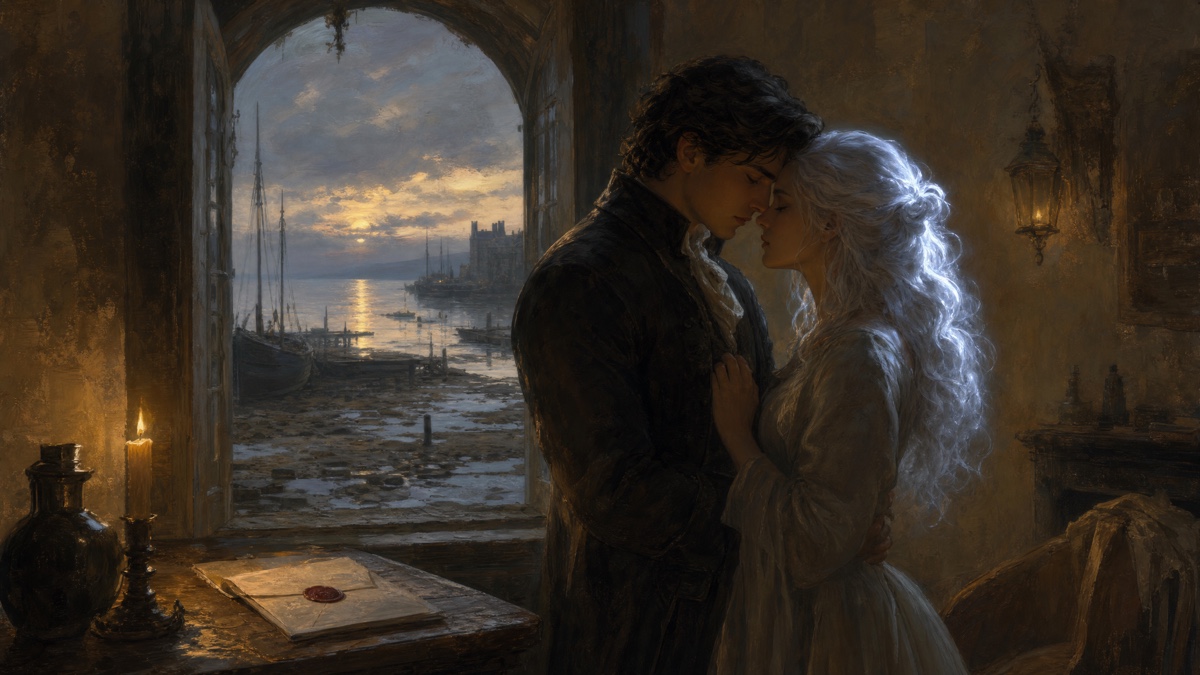
“He had these ears that stuck out. Hated them. Always tried to cover them with his hair. But I thought they were endearing.”
Ears captured. The slight self-consciousness around them.
“And his smile. Crooked. One side always went up higher than the other. He said it was from a childhood accident, but I think he was just asymmetrical.”
The smile took shape. Imperfect. Real.
—-
“Why did you really come to me?” Silla asked during the second session.
The wealthy woman. Helora, she’d said her name was. Hadn’t answered that question before.
“Because my daughter showed me a portrait you did for her. Her father. My late husband.”
Silla stopped painting.
“Your daughter?”
“She came to you three years ago. Before her own advancement. Wanted to make sure she’d have something of him.”
“I remember her.” Young woman, nervous, had talked about her father for hours. “I didn’t know she was wealthy.”
“She wasn’t. Isn’t. She married a tradesman. Lives in the temporary district. We don’t speak often.” Helora’s voice was carefully neutral. “But she sent me the portrait after her advancement. Said she’d lost the memory of commissioning it, but the face still meant something. Still anchored something she couldn’t quite name.”
“I’m glad it helped.”
“It did more than help. It reminded me that some things are worth preserving. Even when we’re afraid of losing them.”
—-
The portrait of Darreth took four sessions.
Longer than most. Helora kept remembering new details. The way he held his teacup. The sound of his laugh. The particular rhythm of his footsteps on the stairs.
Silla painted it all. Not as visible details, but as the feeling behind the face. The love. The loss. The decades of memory compressed into features.
When it was done, Helora cried.
“That’s him. That’s exactly him.”
“Your daughter gave good stories too. I think she remembered him more clearly than she realized.”
“She was close to him. Closer than to me, sometimes.” Helora traced the edge of the canvas without touching it. “I was always the practical one. He was the dreamer.”
“You loved him.”
“More than anything. Even now, even with my memories fragmenting, I know that. I feel it when I can’t feel anything else.”
—-
Helora advanced two months later.
She came back to the studio afterward, looking for the portrait. Remembered commissioning it, thankfully. That memory had survived.
“I lost our wedding,” she said, holding the canvas. “And the first year of our marriage. And the night our daughter was born.”
“I’m sorry.”
“Don’t be.” She was crying, but smiling too. “I still have his face. I still know I loved him. The details are gone, but the core of it remains.”
“Does the portrait help?”
“It helps me remember what I’m missing. Is that help?” She shook her head. “I look at this face and I know it meant something, even when I can’t feel the meaning anymore. Like a door I can’t open but still know is there.”
—-
Silla kept painting.
Year after year. Cycle after cycle. Faces accumulating on her walls. Stories she’d heard and rendered into oil and canvas.
Sometimes the clients came back. Told her what they’d lost. Told her what the portraits had meant afterward.
Sometimes they didn’t. Just walked past her studio with blank expressions, unaware of the face hanging inside that they’d once been desperate to preserve.
She never judged either outcome. Both were part of the same terrible system. People losing pieces of themselves, one way or another, advancement or deterioration, two paths to the same destination.
—-
She finally advanced again at sixty-two.
First time in nine cycles. She’d been putting it off, afraid of what she might lose. The faces on her walls. The stories behind them. The identity she’d built around preserving what others couldn’t hold onto.
But the deterioration had started creeping in. Clients’ stories beginning to blur together. Faces she’d painted overlapping in her memory. The early signs of what came for everyone eventually.
So she went to the Archives. Paid the fee. Rolled the dice.
—-
She lost the first year of her career.
The memory of deciding to become a painter. Of her first commission. Of the mentor who’d taught her to see faces instead of just looking at them.
Gone.
She came back to her studio and looked at the portraits on the walls. Still knew what they were. Still understood her purpose.
But the origin was missing. The why of it. The moment she’d chosen this path.
—-
Her daughter found her crying surrounded by faces.
“Mom? What’s wrong?”
“I don’t remember why I started.”
“Why you started painting?”
“Why I started keeping faces.” She gestured at the walls. “I know I do it. I know it matters. But I can’t remember the moment I decided it mattered. The thing that made me understand.”
Her daughter sat beside her.
“Does it matter? You’re still doing the work.”
“I don’t know. It feels like it should matter.”
“Maybe the work is enough. Maybe it has to be.”
—-
Silla kept painting.
Lost more memories over the cycles that followed. Advancements and deterioration both taking their toll. By the end, she couldn’t remember most of her clients. Most of the stories she’d collected.
But her hands remembered how to work. Her eyes remembered how to see.
And the faces on the walls remained. Hundreds of them. Preserved in oil and canvas and the complicated love of people who’d been afraid of forgetting.
She died at eighty-one. Natural causes.
Her daughter inherited the studio. And all the portraits.
—-
She didn’t know most of them.
Anonymous faces. Stories her mother had never shared or had forgotten before she could share them.
But she kept them anyway. Felt wrong to destroy faces that someone had once wanted preserved.
Eventually, she started her own practice. Learned her mother’s techniques. Painted faces from stories instead of from life.
“Why do you do it?” her first client asked.
She thought about her mother. About the portrait of her grandfather that had started everything. About faces preserved and faces lost and the gap between them.
“Because someone should,” she said finally. “And I’m the one who knows how.”
—-
The studio passed through four more generations.
Each painter learned from the one before, training their replacement early in case the next advancement took too much. Each added their own portraits to the walls. The faces accumulated, layer upon layer, a visual history of everyone who’d ever been afraid of forgetting.
By the time the last painter retired, there were over ten thousand faces in the collection.
Most of them anonymous. Stories lost to time and advancement and the simple entropy of memory.
But they existed. That was the point.
Proof that someone had lived. Had loved. Had been worth remembering even when no one could remember why.
—-
The building survived.
Permanent structure in a permanent district. Walls lined with faces that no one living recognized.
People still visited sometimes. Tourists and scholars and curious strangers. They’d walk through the gallery, looking at the faces, wondering about the stories behind them.
They never found the stories. Those were gone.
But the faces remained.
And sometimes, for reasons they couldn’t explain, visitors would stop in front of a particular portrait. Feel a connection they couldn’t name. A sense that this face, this stranger, mattered somehow.
That was enough.
That was all any of them had ever wanted.
To matter. Even when no one remembered why.