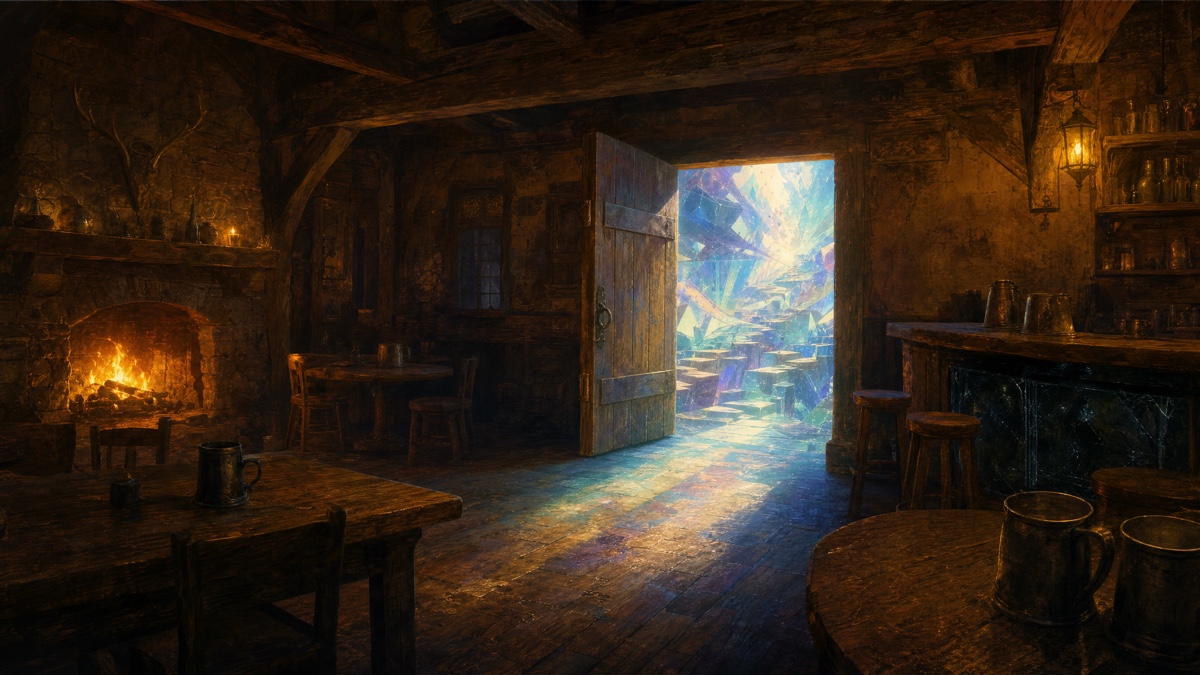
Brennick had been building permanent structures for thirty-five cycles.
Longer than most people lived. Longer than most people remembered. Longer than he could reliably sort through himself anymore, though he’d never admit that to anyone.
The deterioration had started around cycle twenty-eight. Subtle at first. Conversations from different projects bleeding together. Faces of apprentices overlapping with faces of masters who’d died decades ago. The usual progression.
He refused to advance. Always had. Something about the idea of losing memories of buildings he’d created felt wrong. Like erasing part of the city itself.
So he kept working. Let his mind fragment around the edges while his hands stayed steady.
The hands were what mattered anyway.
—-
The current project was a memorial hall.
Client was some wealthy family wanting to honor their ancestors. Standard commission. The Verrath family had enough money to build in permanent stone, enough influence to get the permits, enough ego to want something that would survive the resets.
“We want it to last forever,” the family patriarch had said at the initial meeting.
Brennick hadn’t corrected him. Nothing lasted forever. The oldest permanent structures in the city were maybe eight hundred cycles old. Eventually, even stone crumbled.
But eight hundred cycles was close enough to forever for most people’s purposes.
—-
His apprentice this cycle was a girl named Catrin.
Twenty-three. Sharp. Third cycle at that age, which meant she’d either advance soon or start fragmenting.
“Why do you do it?” she asked one morning, watching him sketch foundation plans.
“Do what?”
“Build permanent things. When you could be doing temporary work for three times the pay.”
Brennick set down his pencil. Considered the question.
“When I was young,” he said, “I watched my grandmother deteriorate. She’d been a weaver. Talented. Made beautiful things that reset every seven years along with everything else.”
“That’s sad.”
“It was sadder than you’d think. By the end, she’d sit at her loom working on tapestries that weren’t there. Responding to conversations from cycles ago. She remembered every piece she’d ever made, all at once, couldn’t tell which ones existed now and which had dissolved decades before. Everything she’d created was still in her head. She just couldn’t reach any of it clearly.”
Catrin was quiet.
“I decided I wanted to make things that stayed,” Brennick continued. “Things that would exist whether I could sort through my memories or not. Things that would be there for other people to see, to use, to live in. Proof that I’d done something, even when I couldn’t remember which cycle I’d done it in.”
“Even when they forget who built them?”
“Especially then.” He picked up his pencil again. “The building doesn’t care who built it. It just… is. That’s enough for me.”
—-
The memorial hall’s foundations went in during the third month.
Permanent stone required different techniques than temporary construction. You couldn’t just build and hope for the best. Every element had to be anchored to reality itself, tied to the structures that persisted through resets.
It was expensive. Time-consuming. Required skills that most builders never learned.
Brennick had learned them from his master, Gorreth, who’d learned them from his master before him. A chain of knowledge going back to the earliest cycles, when people first figured out how to make things that lasted.
Sometimes he wondered if the knowledge itself was more permanent than any building.
—-
“Tell me about the first structure you built,” Catrin asked during lunch.
Brennick frowned. Tried to sort through the layers.
The memories were there. All of them. That was the problem. His first bridge existed in his mind alongside every other bridge he’d built, every variation, every cycle’s worth of similar projects stacking on top of each other like transparencies.
“A bridge,” he said finally. “Small one. Over a stream in the agricultural district.”
“Is it still there?”
“Should be. Unless someone tore it down.”
“Do you remember building it?”
“I remember…” He paused. What did he remember? The keystone settling into place. But which keystone? He’d placed hundreds. The satisfaction of completion. But that feeling echoed across dozens of projects, impossible to pin to one. “I remember it being important. That feeling of making something that would survive me.”
“But not the details?”
“I remember all the details. That’s the problem.” He rubbed his temple. “I remember building it three different ways. Different weather, different helpers, different problems we solved. I know only one version actually happened, but I can’t tell which anymore.”
Catrin looked at him with something like pity. He didn’t want her pity.
“The bridge doesn’t need me to sort it out,” he said. “It exists whether I can or not. That’s the point.”
—-
The Verrath family visited the construction site every few weeks.
The patriarch, a man named Dorvath, always had opinions. Move this wall. Change that angle. Make the entrance more impressive.
Brennick listened politely and ignored most of it.
The man would be dead in a few cycles. The building would still be standing.
“I want people to remember us,” Dorvath said during one visit. “When they see this hall, I want them to think of the Verrath family.”
“They might.”
“You don’t sound convinced.”
“I’ve been building permanent structures for thirty-five cycles.” Brennick ran his hand along a newly finished wall. “The names on the dedications blur together after a while. The buildings remain. The families who commissioned them become footnotes.”
Dorvath’s face darkened. “That’s not very reassuring.”
“I’m not in the reassurance business. I’m in the building business.”
“And you think our name will be forgotten?”
“Everyone’s name gets forgotten eventually. But this hall will stand for centuries. People will gather in it. Celebrate in it. Mourn in it. Isn’t that enough?”
Dorvath was quiet for a long moment.
“No,” he said finally. “It’s not.”
—-
Brennick didn’t understand people like Dorvath.
Men who built monuments to their own importance. Who wanted their names carved in stone so strangers would remember them long after they were gone.
What was the point?
The strangers wouldn’t know them. Would just see a name, assign it to a category (wealthy, powerful, vain), and move on. The memorial hall would become “that building in the merchant district” regardless of what was carved above the entrance.
Buildings outlasted names. That was the lesson Brennick had learned over thirty-five cycles.
The work mattered. The identity of the worker didn’t.
—-
Catrin asked more questions as the project progressed.
Where did you learn this technique? Who taught you to calculate load distribution? How do you know when a foundation is deep enough?
Brennick answered when he could. Some answers came easily, muscle memory translated into words. Others required him to dig through layered memories, pulling out knowledge that existed in multiple versions across multiple cycles.
Sometimes he gave the wrong answer. Described a technique from an earlier cycle that he’d since improved. Catrin learned to double-check his instructions against the actual work, gently redirecting when his mind slipped into older patterns.
“You should write it down,” she said one evening. “Everything you know. Before the layers get too thick to sort through.”
“I’ve thought about it.”
“Why haven’t you?”
“Because…” He stopped. Why hadn’t he? “Because it feels like giving up. Like admitting I’m drowning.”
“You are drowning. Everyone does, eventually.”
“I know.”
“So why not preserve what you can?”
He didn’t have a good answer.
—-
The memorial hall’s walls went up during month seven.
Stone by stone. Each one fitted precisely, anchored to the permanent foundation, locked into place with techniques perfected over centuries.
Brennick did the difficult work himself. The keystone placements. The arch alignments. The structural calculations that meant the difference between a building that lasted and one that collapsed.
His hands were still steady. His mind might fragment, but his hands remembered what they needed to do. The knowledge lived in his muscles now, independent of which cycle he thought he was in.
—-
“Did you ever have a family?” Catrin asked.
They were taking a break, sitting on finished stonework, watching the sun set over the temporary district where buildings would vanish in a few cycles.
“A wife. Long time ago.”
“What happened?”
“She wanted me to advance. Said watching me deteriorate was killing her.” He shrugged. “I refused. She left. Married someone else, eventually.”
He remembered three versions of that conversation. Different rooms, different lighting, different words that meant the same thing. He couldn’t tell which one had actually happened. Maybe all of them had, across different cycles. Maybe only one. It didn’t matter anymore.
“Do you regret it?”
“I regret hurting her. But not the choice itself.”
“Why?”
Brennick thought about it. Really thought, for the first time in years. Or maybe he’d thought about it before, in another cycle, and was just remembering thinking about it.
“Because I’ve built things that will stand for centuries. And I remember building them. All the versions, all the variations, all layered on top of each other. I can’t always sort which cycle is which, but I can feel the weight of it. The accumulated purpose.”
“That’s worth more than a clear mind?”
“For me? Yes.”
Catrin was quiet.
“Would you make the same choice?” Brennick asked.
“I don’t know. I hope I never have to find out.”
“You will. Everyone does, eventually.”
—-
The memorial hall was finished in month fourteen.
Stone walls. Permanent foundations. A roof that would keep out rain for the next thousand cycles if no one interfered with it.
The Verrath family held a dedication ceremony. Speeches about legacy and permanence and the importance of remembering ancestors.
Brennick stood in the back, watching. For a moment he thought he saw Gorreth in the crowd, his old master, but Gorreth had been dead for twenty cycles. Just another face bleeding through from another time.
The building was good. Solid. Beautiful, in its way. He’d done good work here.
In a few cycles, the Verrath family would advance or deteriorate or die. The hall would remain. People would use it for purposes the Verraths had never imagined. The dedication carved above the entrance would become just another name on just another building.
That was how it should be.
Buildings outlasted builders. Work outlasted workers. That was the closest thing to immortality anyone actually got.
—-
Catrin left after the project ended.
Got a better offer from a wealthy client in another district. More money, more prestige, more opportunities.
“I’ll remember what you taught me,” she said on her last day.
“For a while.”
“That’s not what I meant.”
“I know what you meant.” Brennick smiled, the expression feeling strange on his face. “But you’ll advance eventually. Or deteriorate. Either way, the lessons will blur and fragment and become something you know without remembering how you learned it.”
“That’s sad.”
“That’s how it works.”
She hugged him. He let her, though physical contact had become strange and uncomfortable over the decades. He wasn’t always sure which decade he was being touched in.
“Build good things,” he said.
“I will.”
—-
His next project was a library.
Different client. Different district. Same basic work. Foundations and walls and roofs that would survive the resets.
He started sketching plans on his first site visit. Let his hands do the thinking while his mind wandered through layered memories.
Somewhere in those layers was his first bridge. His master Gorreth’s face, young and old and middle-aged all at once. His wife, or wives, or the same wife remembered across different cycles until she seemed like multiple people. Countless buildings in countless districts, all existing simultaneously in his mind.
He couldn’t sort through it anymore. The layers had grown too thick, too tangled.
But he could still build.
That was what mattered.
—-
Thirty-seven cycles into his career, Brennick died.
Heart failure. Natural causes. Nothing dramatic.
They found him at a construction site, tools in hand, working on a courthouse that would stand for the next five hundred years. He’d been talking to someone who wasn’t there, one of the other workers said. Giving instructions to an apprentice from another cycle. But his hands had still been doing the work correctly.
His apprentice at the time, a young man named Torren, finished the project using Brennick’s notes.
The notes were detailed. Meticulous. Every technique documented, every calculation explained. Brennick had started writing them down a cycle earlier, after Catrin’s suggestion finally cut through the layers.
He’d written most of them multiple times, not remembering he’d already documented the same technique. But the redundancy didn’t matter. The knowledge was preserved.
Permanent in its own way.
—-
The courthouse stood for six hundred and forty-three cycles.
Generations of people used it. Disputes settled, marriages registered, crimes prosecuted. Lives affected by the building in ways Brennick could never have imagined.
No one remembered his name.
But the work remained.
That was all he’d ever wanted.
—-
Somewhere in the city, the memorial hall still stood too.
The Verrath family had faded into obscurity. Their name above the entrance meant nothing to the people who gathered inside.
But the stone was solid. The foundations held. The roof kept out the rain.
It would stand for another four hundred cycles. Maybe more.
That was the truth about permanence. Not names or families or legacies. Just work. Just the things we make that survive us.
Brennick had understood that. Had built his life around it.
And in the end, he’d been right.
The buildings outlasted everything.
Even the man who made them.