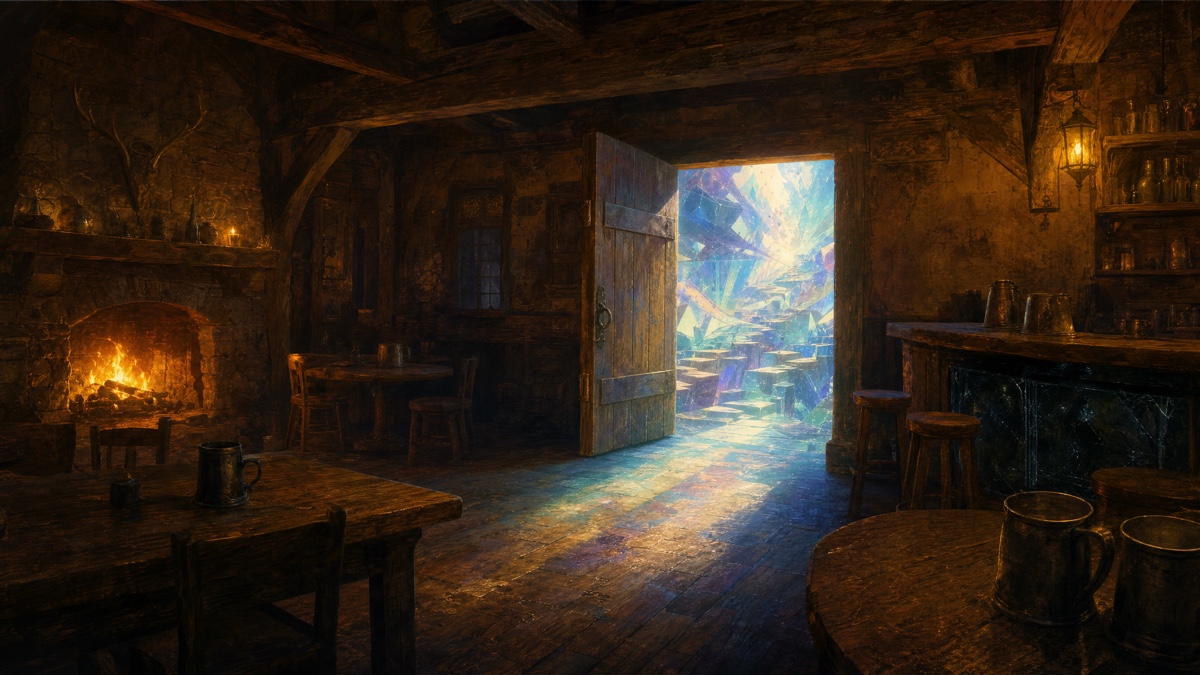
Quorra had worked at Vesper House for three cycles.
Long enough to know the rhythms. Long enough to recognize the stages. Long enough to stop being afraid of what she saw every night.
Vesper House was where families brought their deteriorated. The ones too far gone to care for at home. The ones who needed constant supervision, constant redirection, constant patience.
Quorra had all three.
—-
Her shift started at sunset.
She checked in with the day attendant, Massen, who looked exhausted.
“Rough one?”
“Belleth had an episode. Thought the whole staff were her children. Kept trying to send us to bed.”
Quorra nodded. “I’ll watch for that.”
“And Torvan is new. Third floor. Just admitted this morning.”
“Deterioration stage?”
“Moderate. But declining fast.” Massen gathered his things. “Family couldn’t handle it anymore. The wife’s a wreck.”
“They always are.”
Massen left. Quorra began her rounds.
—-
First floor: Mild deterioration.
These residents were mostly functional. They repeated themselves. Got confused about which cycle they were in. Needed reminders about basic tasks.
Old Essera was knitting the same scarf she’d been knitting for two cycles. Every night, she unraveled it. Every morning, she started again.
“How’s the scarf coming?” Quorra asked.
“Almost done.” Essera smiled proudly. “It’s for my husband.”
Her husband had been dead for thirty years. But Quorra didn’t correct her.
“He’ll love it.”
“I hope so.”
—-
Second floor: Moderate deterioration.
These residents needed more help. They got lost in the hallways. Couldn’t remember how to dress themselves some days. Had conversations with people who weren’t there.
Venn was standing at his window, waving.
“Who are you waving at?” Quorra asked.
“My brother. He’s visiting.”
The courtyard was empty.
“That’s nice. What’s his name?”
“I…” Venn’s face clouded. “I don’t… I know I have a brother. But I can’t…”
“It’s okay. You don’t have to remember.”
“I should remember.” He was crying now. “He’s my brother. I should know his name.”
Quorra held him while he sobbed.
This was the cruel part. The moderate stage still had moments of clarity. Moments when residents realized how much they’d lost.
The severe stage was almost kinder. By then, you didn’t know enough to grieve.
—-
Third floor: Severe deterioration.
These residents lived in a fog of overlapping cycles. Some were verbal, some weren’t. Most needed help with everything: eating, dressing, bathing, walking.
The new admission, Torvan, was in room 312.
Quorra checked his file. Sixty years old. Fourteen cycles at age fifty-four. Admitted this morning after a crisis at home.
She knocked softly, then entered.
He was sitting on the bed, looking at his hands.
“Torvan? I’m Quorra. I’ll be your night attendant.”
He looked up. His eyes cycled through recognition and confusion.
“Do I know you?”
“We’ve just met.”
“Are you sure?” He frowned. “Your face seems familiar.”
It was a common symptom. Faces blurred together across cycles. Strangers looked like family. Family looked like strangers.
“I have one of those faces,” Quorra said. “Can I sit with you?”
“If you like.”
She sat in the chair by his bed.
“Do you know where you are?”
“A room.” He looked around. “It’s not my room.”
“It’s your room now. At Vesper House.”
“Vesper House.” He repeated it like he was trying to make it stick. “My wife brought me here.”
“That’s right.”
“Is she…” He stopped. “Is she alive? I can’t remember if she’s alive.”
“She’s alive. She visited you this afternoon.”
“Did she?” Relief flooded his face. “Good. I was worried. Sometimes I see her dying and I can’t tell if it’s a memory or…”
“It’s not a memory. She’s alive. She’ll visit again tomorrow.”
“Good.” He lay back against his pillows. “Will you tell me if she dies?”
Quorra’s throat tightened.
“I’ll tell you.”
“Promise?”
“I promise.”
—-
By midnight, most residents were asleep.
Quorra made her rounds. Checked vital signs. Redirected the wanderers. Sat with the ones who couldn’t sleep.
Room 208: Belleth was talking to her children. All six of them, apparently lined up at the foot of her bed.
“Go to sleep now,” Belleth said firmly. “Mama needs rest.”
The room was empty except for Belleth and Quorra.
“They’re not listening,” Belleth complained.
“Children never do.”
“You have children?”
“No.”
“You should. They’re wonderful.” Belleth smiled at the empty space. “Frustrating, but wonderful.”
—-
Room 315: Cresten hadn’t spoken in two cycles.
He lay in bed, eyes open, watching something no one else could see. He ate when food was placed in front of him. Walked when led. Did nothing on his own.
Quorra checked his breathing. Changed his sheets. Made sure he was comfortable.
“Good night, Cresten.”
No response.
There was someone in there. Somewhere. Buried under decades of overlapping memories.
But he’d stopped trying to communicate with the outside world.
Quorra understood. Eventually, everyone stopped trying. The present became less real than the accumulated past. Why talk to strangers when you had a hundred years of familiar faces inside your head?
—-
At three in the morning, the alarms went off.
Room 312. Torvan.
Quorra ran.
He was on the floor, tangled in his sheets, screaming.
“She’s dead! She’s dead! I watched her die!”
Quorra knelt beside him.
“Torvan. Torvan, look at me.”
He grabbed her arm. His grip was surprisingly strong.
“I watched her die. She was in the hospital. The cancer took her. I held her hand and she stopped breathing.”
“Torvan, listen to me. Your wife is alive.”
“No. No, I remember—”
“You’re remembering something that hasn’t happened.” Quorra kept her voice steady. “Or something that happened in a different version. A different cycle. But right now, in this cycle, your wife is alive. She’s at home. She’ll visit you tomorrow.”
He stared at her.
“How do you know?”
“Because she called this evening. Asked how you were settling in.”
“She called?”
“Yes.”
Some of the panic left his face.
“She’s alive.”
“She’s alive.”
He started crying. Not from fear this time. From relief.
“I can’t tell anymore,” he whispered. “I can’t tell what’s real.”
“I know.” Quorra helped him back into bed. “That’s why you’re here. So we can tell you.”
—-
The next morning, Torvan’s wife arrived at visiting hours.
Quorra watched from the nurses’ station.
The woman’s name was Dellin. Sixty-five. Still sharp, still present, still able to recognize her husband even when he couldn’t recognize her.
“Torvan? It’s me. Dellin.”
He looked at her. The recognition flickered.
“Dellin.”
“I brought your favorite. Honey cakes.”
“You made honey cakes.” He smiled. “You always make honey cakes.”
“Always.”
They sat together. Eating cakes. Talking about nothing.
Sometimes Torvan got confused. Called her by someone else’s name. Referenced events from different cycles. Dellin gently corrected him. Stayed patient.
When visiting hours ended, Dellin came to the nurses’ station.
“How is he? Really?”
“He had a rough night. But he’s stabilizing.”
“Will he get better?”
Quorra hesitated.
“He won’t get worse for a while. We can keep him comfortable. Safe. Present as much as possible.”
“But he won’t get better.”
“No. I’m sorry.”
Dellin nodded. She’d known. They always knew.
“Can I… can I ask you something?”
“Of course.”
“Does he still know me? Inside? Even when he can’t say my name?”
Quorra thought about Torvan’s panic the night before. His terror that his wife had died.
“Yes,” she said. “He knows you.”
Dellin started crying.
“Thank you. That’s all I needed to know.”
—-
Three cycles later, Torvan died.
Peaceful. In his sleep. Dellin was holding his hand.
Quorra was there too. Standing in the corner. Watching.
“He said my name,” Dellin whispered. “Right at the end. He looked at me and said ‘Dellin’ and then he was gone.”
“I’m glad.”
“Is it always like that? A moment of clarity at the end?”
“Sometimes.” Quorra had seen it go both ways. “Not always. But sometimes.”
“I like to think he knew. That he was present. That he chose to leave.”
“Maybe he did.”
Dellin kissed her husband’s forehead.
“Goodbye, love. Say hello to the others for me.”
—-
Quorra kept working at Vesper House.
Cycle after cycle.
She watched families say goodbye. Watched residents slip away. Watched the moderate cases become severe, the severe cases become critical.
Some nights, she wondered why she stayed.
The pay was modest. The work was heartbreaking. Every relationship she built ended in loss.
But.
Someone had to do it.
Someone had to sit with the dying.
Someone had to tell them their wife was alive, their children were safe, their memories weren’t all bad.
Someone had to be present when no one else could be.
—-
Years later, a new resident arrived.
Young. Thirty-eight. Seven cycles at that age.
She was crying when they admitted her.
“I can’t tell which memories are real anymore. I keep seeing my mother and she died twenty years ago but she feels so real and I don’t know—”
“Shh.” Quorra took her hand. “It’s okay. That’s why you’re here.”
“I don’t want to be here. I want to go home.”
“I know.”
“Will I ever go home?”
Quorra hesitated.
“Maybe,” she said. “But for now, you’re safe here. We’ll help you.”
The woman looked at her with desperate hope.
“How? How can you help when I can’t even trust my own mind?”
“By being here,” Quorra said simply. “By telling you what’s real. By sitting with you when the memories get too loud.”
“That’s it?”
“That’s everything.”
The woman considered this.
“You do this for everyone?”
“I try.”
“Why?”
Quorra thought about all the residents she’d known. All the families she’d comforted. All the deaths she’d witnessed.
“Because everyone deserves someone who stays,” she said finally. “Even at the end. Especially at the end.”
The woman was quiet for a long moment.
“Will you stay with me?”
“Yes.”
“Promise?”
“I promise.”
—-
Night fell.
Quorra began her rounds.
First floor. Second floor. Third floor.
The same rhythms. The same faces. The same endless cycle of care.
Someone had to do it.
She was glad it was her.