The form wanted six things.
Full legal name. Date of birth. Social Security number. Proof of address. Parent or guardian signature. And a certified copy of a birth certificate issued by the state of West Virginia or equivalent jurisdiction.
Five of those I had. The sixth was the reason I was standing at the counter of the county clerk’s office in Barton, twenty miles from home, on a Wednesday afternoon when I should have been in school.
Dad had written me a note. Family business. Mrs. Alderman had looked at the note and looked at me and let me go without asking questions, which was how Mrs. Alderman handled most things.
She watched. She didn’t push. I’d been in her class in third grade and even then she’d had the look of someone who was paying attention to something she couldn’t quite name.
The clerk’s office was small. Brown carpet, fluorescent lights, a woman behind the counter with her hair pinned up and a pen behind her ear. She’d been typing when I walked in and she kept typing for a full thirty seconds before looking up, which I figured was a power move or just how things worked in county buildings.
“Help you?”
“I need a certified copy of my birth certificate.”
“Name?”
“Noah Calloway.”
“Date of birth?”
“March 15, 2010.”
“Place of birth?”
“Harlan’s Cradle.”
She typed. Waited. Typed again. The screen reflected in her glasses, green text on black, the kind of system that looked like it hadn’t been updated since the building was built.
“Spell the last name?”
“C-A-L-L-O-W-A-Y.”
More typing. A pause. She leaned closer to the screen.
“I’m not finding a record for that name and date.”
“It might be under a different spelling.”
“I tried the variations.” She looked at me over the glasses. “There’s no birth certificate on file for a Noah Calloway born March 15, 2010, in Harlan’s Cradle or anywhere else in the county.”
The counter was cold under my hands. The fluorescent light buzzed. Behind me a man was filling out a form at a table and his pen scratched on the paper and the scratch was the loudest sound in the room.
“Can you check again?”
She checked again. Same result. No record. She pulled up the broader database, the state one, the one that covered all of West Virginia. Nothing. She tried neighboring counties. Nothing. She tried just the name without the date, then just the date without the name.
Noah Calloway did not have a birth certificate. Not in this county. Not in this state. Not anywhere the system could reach.
“Are you sure about the date?” she said.
“Yes.”
“And the location?”
“Yes.”
She took the pen from behind her ear and wrote a number on a sticky note. “You can try the state vital records office in Charleston. Sometimes files get misfiled, especially from smaller towns. But if it’s not in the county system, it’s usually not anywhere.”
I took the sticky note. Put it in my pocket. Walked out into the parking lot where Dad’s truck was waiting with the engine running and the heat on and the radio playing something low and country that Dad liked and I didn’t.
“Get it?” he said.
“They couldn’t find it.”
Something moved in his face. Not surprise. Something that came before surprise and got swallowed before it could finish forming. A flicker behind the eyes. I’d seen the same flicker in Ethan’s face once, when someone at school asked where their mom was. The question landed and something moved behind his eyes and then it was gone and his face was just a face again.
“Bureaucracy,” Dad said. “We’ll sort it out.”
He put the truck in gear. We drove back toward Harlan’s Cradle on Route 9, which was the only way in and the only way out, and the trees pressed close on both sides and the road curved so you couldn’t see more than a quarter mile ahead and somewhere in those curves was the sign.
I watched for it. Not because I was thinking about the sign. Because I was thinking about the flicker in Dad’s face and the empty space on the clerk’s screen and the fact that my father, who planned everything, who had every piece of paper we’d ever needed filed in the desk in the living room, who had sent me to Barton with a checklist and exact change for the fee, had not checked beforehand whether the certificate existed.
Unless he already knew it didn’t.
The sign came around the bend. White rectangle, leaning left.
HARLAN’S CRADLE. POPULATION 1,295.
Dad didn’t look at it. Dad never looked at it. In sixteen years of driving this road I had never once seen my father glance at the sign. Not the quick automatic glance that everyone did. Not even the deliberate not-looking that some people did, where you could tell they were choosing not to see it. Dad’s eyes just passed over that spot on the road like the sign wasn’t there. Like his brain had edited it out of the landscape.
—-
The desk in the living room had three drawers. Top drawer was bills and receipts. Middle drawer was school stuff, Ethan’s and mine, report cards and permission slips and the forms that came home every September. Bottom drawer was locked.
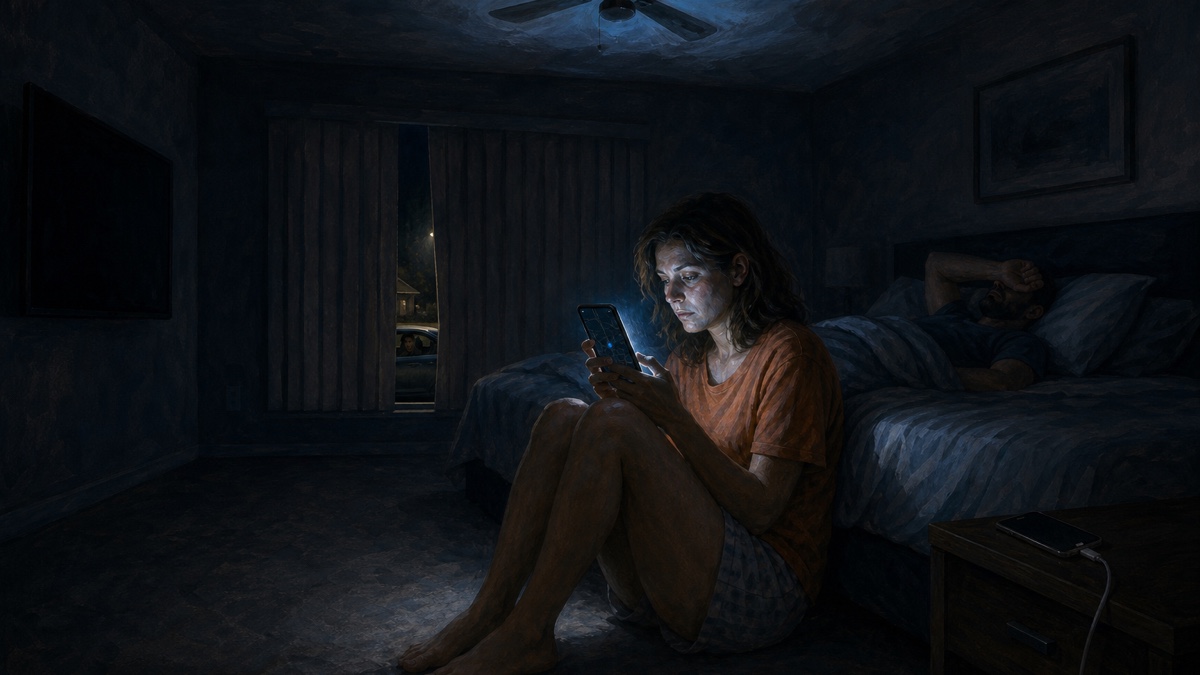
Dad was at work. Ethan was at school. The house was empty except for me and the sound of it settling, which was a sound I’d heard every day of my life and had never thought about until now.
The bottom drawer had a lock that looked serious but wasn’t. A flathead screwdriver and thirty seconds and it popped open. Inside was what I expected. Tax returns. Insurance papers. The title to the truck. Dad’s Social Security card in a plastic sleeve.
No birth certificates. Not mine. Not Ethan’s. Not Dad’s.
That was wrong. Every family had birth certificates. They were in folders or envelopes or shoeboxes. They were somewhere because you needed them eventually, for school enrollment or a passport or a driver’s permit, and a man like Dad who kept every receipt and every form and every piece of paper that had ever crossed his desk would not simply not have them.
Unless there were no birth certificates to keep.
I put everything back. Closed the drawer. The screwdriver went back in the kitchen junk drawer. The house settled. Through the window I could see Sycamore Lane running down to the dead end, three houses on a street that didn’t go anywhere, and beyond the trees the ridge climbing up toward the road that turned to gravel and then to nothing.
I’d lived here my whole life. That was the sentence. The one you say without thinking, the one that sits in the back of your identity holding everything else up. I’d lived here my whole life. 14 Sycamore Lane. Dad and Ethan and me. School and home and the route between them and the town holding it all in place.
But my whole life had a gap at the beginning. A gap I’d never looked at because there was nothing there to look at. No memory of before. Not the fuzzy, half-formed memories that everyone has from early childhood, the fragments of a crib or a face or a sound. Nothing. My earliest memory was this house, this street, this town. I was here and then I remembered being here and there was no before.
Everybody’s memory works that way, I told myself. Nobody remembers being two. Nobody remembers being three. You start somewhere and the start just feels like the beginning even though you know it isn’t.
Except most people have a birth certificate that says where the actual beginning was. And I didn’t.
—-
The school had records. Mrs. Alderman’s classroom had a file cabinet. The office had enrollment forms going back years. If I existed in this town, the paper trail was there.
But I’d already seen what paper trails looked like in Harlan’s Cradle.
Ethan had been in Mrs. Alderman’s class for two months and every record said he’d been there since September. I knew this because Ethan had told me, in his quiet way, on a night when Dad was asleep and we were in the room we shared and Ethan said the teacher looked at me funny today and I said which teacher and he said Mrs. Alderman and I said she looks at everyone funny and he said no, she looked at me like she didn’t know me and then he was quiet and the quiet lasted a long time.
I didn’t ask Dad about it. I didn’t ask Dad about anything that mattered because asking Dad about things that mattered produced the flicker and the flicker was followed by a sentence that was technically an answer but landed on the question like a lid on a box.
The library was two blocks from the school. Not a real library. A room in the back of the community center with donated books on metal shelves and a computer that took three minutes to boot up and a connection that ran through the phone line and sounded like a cat being strangled.
I looked up my own name. Noah Calloway. Harlan’s Cradle. West Virginia.
Nothing. No results. No social media, no school directory, no sports roster, no church bulletin. I didn’t exist online. That wasn’t unusual for people in this town. Half the older residents had never touched a computer. But I was sixteen. I should have been somewhere. A class photo. A list. Something.
I looked up my father. R. Calloway. Harlan’s Cradle.
Nothing.
I looked up our address. 14 Sycamore Lane.
The property record said the house had been vacant since 2004. Twenty-one years. Owner listed as the county, which meant nobody was paying taxes on it, which meant nobody owned it, which meant we’d been living in a house that officially had nobody in it for as long as I could remember.
The computer hummed. The connection crackled. The screen was showing me a version of my life that didn’t include me in it and I sat there reading it because there was nothing else to do with information like this except sit with it and let it settle.
—-
The walk home took me past the gas station. Bobby was behind the counter. I’d been buying candy and sodas from Bobby since I was old enough to walk here by myself and Bobby had always known my name and I had always known his.
“Hey, Noah.”
“Hey.”
“Your dad coming by later? He’s got fuel on the account.”
“I’ll tell him.”
Normal and easy. Bobby knew me. Bobby had known me for years. Bobby was real and the candy bars were real and the gas station was real and none of that changed the fact that the county had no record of my birth and the property database said my house was empty.
On the way out I saw the sign. Not from the gas station window but from the road, Route 9, where it bent toward the town line. White rectangle, same lean to the left.
1,295.
I counted. Not the sign. Myself. I counted the facts. No birth certificate. No property record. No online presence. A father who never looked at the sign. A brother who appeared in a classroom and was accepted without question. A house that had been officially vacant for two decades.
Three people on Sycamore Lane. Dad, Ethan, me. Three people in a house the county said was empty. Three people with no birth certificates in a town where the sign counted everyone and was always right.
If the sign was right, it counted us. We were in the number. 1,295 included the Calloways of Sycamore Lane, the ones with no paper trail, no records beyond the town line, no proof that we existed outside of a place that accepted us without question.
The walk home was cold. The trees were bare on Sycamore and the sky through the branches was the color of an old nickel. Ethan’s bus would be here soon. Dad would be home by six. Dinner would be whatever Dad made, which was always simple, always enough, always eaten at a table where nobody talked about the things that mattered.
I went to my room. Under the bed, in a shoebox, I kept the things that were mine. Not valuable things. A pocketknife Bobby had given me for my birthday three years ago. A photo of me and Ethan on the porch, squinting in the sun. A rock from the creek bed that was flat enough to skip but too perfect to throw.
And a piece of paper I’d found in the back of my closet when I was twelve. Folded once, yellowed, with a single line of handwriting that wasn’t Dad’s.
The boy was Thomas Garrett before he was yours.
I’d never shown it to Dad. I’d never shown it to anyone. I’d read it when I was twelve and didn’t understand it and put it in the shoebox and let it sit for four years under a pocketknife and a rock and a photo of a life I was starting to suspect had a seam running through the middle of it.
Thomas Garrett. Before he was yours.
Before I was a Calloway. Before Sycamore Lane. Before the town that counted me and the sign that included me and the father who never looked at it.
Thomas Garrett. A name that wasn’t mine and had been mine and was written on a piece of paper in a closet in a house the county said was empty, in a town where the records changed to fit whoever was standing in them.
Ethan’s bus pulled up outside. The door opened and closed. His backpack hit the floor. His shoes came off. The house held us both, held us the way it always had, and through the window the white rectangle on Route 9 was just visible through the bare trees, counting us, including us, in a number that was always right even when nothing else was.