Linda put sugar in her coffee.
She’d been doing it for nine months and every morning it still caught me. Thirty-one years of black coffee, no sugar, not even when she was sick, not even when the doctor told her to eat more because she was dropping weight after her mother died.
Black coffee was Linda the way brown eyes were Linda. It was a fact. Always was.
Then one morning in February she reached for the sugar bowl and put a spoonful in her mug and stirred it and drank it like she’d been doing it her whole life.
I didn’t say anything.
That was the first thing I didn’t say anything about.
The list had gotten long since then. The sugar.
The way she started opening cabinets on the wrong side of the kitchen, reaching for where things used to be before we’d rearranged ten years ago.
The way she stopped humming when she cooked. Linda hummed. Not songs, exactly, just a low continuous sound that meant she was thinking about something she wasn’t going to share. Thirty-one years of that sound and then nothing. Just Linda cooking in silence, the only noise the knife on the cutting board and the gas hissing under the pan.
She still looked the same. Same gray-brown hair she wouldn’t dye because she said vanity was for people with more time than sense.
Same hands, same walk, same way of sitting on the couch with one leg tucked under her.
Same laugh when something on TV was funny, though the things she laughed at had shifted. She used to like the dry stuff. Now she laughed at the obvious jokes, the ones she used to roll her eyes at, the ones she called “laugh-track humor” with a tone that could strip paint.
Small things. All of them small. None of them big enough to say out loud without sounding crazy.
Your wife takes sugar now. So what. People change.
Your wife opens the wrong cabinet. She forgot. It happens.
Your wife stopped humming. Maybe she ran out of things to think about.
Every explanation made sense on its own. Together they made something else.
—-
The morning it broke was a Thursday. Nothing special about it. October, cool enough for a jacket, the kind of morning where the fog sits in the valley and the mountains disappear and the town feels like it exists inside a cloud.
Linda was at the stove making eggs the way she always did now, which was slightly different from the way she always did before.
A little more butter. The heat a touch too high. The eggs came out stiffer than they used to and I ate them without commenting because I’d stopped commenting.
“Did Karen call yesterday?” I asked.
Karen was our daughter. Lived in Raleigh. Called every Wednesday. Had called every Wednesday for six years since she’d moved, not because we’d asked but because Karen was Karen and Wednesday was her day.
Linda looked at me across the table. “I don’t think so.”
“She calls every Wednesday.”
“Maybe she was busy.”
“She wasn’t busy. She called at four. I talked to her for twenty minutes. You talked to her after me.”
Something moved behind Linda’s eyes. Not confusion. Something quicker than that, something that looked almost like calculation, a flicker of adjustment, and then it was gone and her face was her face again.
“That’s right,” she said. “I forgot.”
She didn’t forget. Linda didn’t forget phone calls from Karen.
Linda wrote them on the calendar in the kitchen, the date and the time and whatever Karen had mentioned that was worth remembering. The calendar was on the wall behind Linda’s head and I could see yesterday’s square from where I was sitting and it was blank.
I looked at the blank square. I looked at Linda.
“You didn’t write it down,” I said.
“I guess I didn’t.”
“You always write it down.”
“Carl.” She said it gently. The same gentle tone she used when she thought I was making too much of something.
Except Linda’s version of that tone used to have an edge underneath it, a sharpness that said I love you but you’re being ridiculous. This version was just gentle. Just smooth. Like the edge had been filed off.
“Carl, I just forgot.”
I ate my eggs. They were overcooked.
—-
The errands were an excuse to leave the house.
Bobby at the gas station needed to be paid for the fuel delivery. The hardware store had a box of screws I’d ordered for the church porch. The pharmacy had Linda’s blood pressure medication ready, which was another thing on the list.
Linda had been on the same medication for eleven years. Nine months ago she’d switched to a different brand and when I asked why she said the doctor recommended it. I called the doctor’s office. They hadn’t recommended anything. They didn’t even have a record of an appointment.
I didn’t say anything about that either.
The gas station was quiet. Bobby was behind the counter doing something on his phone. Good kid. Twenty-three, worked the day shift, had the kind of patience that came from growing up in a place where nothing moved fast enough to require impatience.
“Fuel delivery’s all set, Mr. Holt. Receipt’s in the drawer.”
“Thanks, Bobby.”
“Mrs. Holt doing alright? Haven’t seen her in a while.”
That was true. Linda used to stop at the station every few days for a Diet Coke, the kind in the glass bottle that they kept in the back of the cooler. She hadn’t been in months. She’d switched to water. Just water. No explanation.
“She’s fine,” I said.
“Tell her we got those glass bottles back in stock. The ones she likes.”
“I will.”
I wouldn’t. Because if I told Linda about the glass bottles she’d look at me with that smooth gentle expression and say I don’t really drink those anymore and the sentence would be true and wrong at the same time and I’d have to sit with that for the rest of the day.
The hardware store was next. The box of screws was on the counter and Gary had already written up the receipt. Gary always had things ready. He was the kind of man who anticipated what you needed before you asked, which in most places would feel like good service and in Harlan’s Cradle felt like something else that nobody talked about.
“How’s Linda?”
“Fine.”
“Good. Good.” Gary looked at me a beat too long. Not suspicious. Careful. The kind of look that meant he knew something he wasn’t going to say unless I said it first.
I took the screws and left.
The church was three blocks from the hardware store and the sign on Route 9 was visible from the parking lot. Not the numbers, not from this distance, but the white rectangle against the trees.
I’d been driving past it for sixty years and most of those years it was nothing. Background. Part of the landscape, same as the mountains, same as the church, same as the tree line.
But today, for no reason I could name, I stopped the truck in the parking lot and looked at it.
The white rectangle sat there doing what it always did. Nothing. But the nothing felt different today, the way a room feels different after someone has been in it even though nothing’s been moved. An absence with weight.
I hadn’t looked at the sign in months. I couldn’t remember the last time I’d actually looked at it, actually read the number, actually let it register.
Nine months, maybe. About nine months.
—-
The pharmacy was the last stop. Linda’s medication was in a white bag with her name on it. LINDA HOLT. The pharmacist, Donna, handed it over with the same smile she gave everyone, the warm professional kind that was more uniform than personal.
“Same as last time?”
“Same as last time,” I said, though I didn’t know what last time was because I hadn’t been the one to pick it up last time. Linda had gone herself, which she’d started doing about nine months ago, which was another thing.
The bag was lighter than it should have been. Two bottles instead of three. The blood pressure medication was there. The thyroid pill was there. The third one, the one she’d been taking for years for the pain in her shoulder, was missing.
“Donna, there’s usually three.”
She checked her screen. “We only have two prescriptions on file for Linda.”
“There were three. The shoulder one. She’s been on it for years.”
Donna looked at me over her glasses. “Mr. Holt, I’ve only ever had two prescriptions for your wife. Since she started coming here.”
“She’s been coming here for twenty years.”
“Right. And it’s always been two.”
I stood at the counter with the bag in my hand and the store humming around me and Donna already turning to the next customer and the floor not moving under my feet but wanting to.
Two prescriptions. Twenty years. Donna had been the pharmacist for all twenty of those years and she was telling me there had never been a third.
But I’d seen the bottles. Three bottles in the medicine cabinet, lined up the way Linda lined everything up, neat and straight and evenly spaced. Three bottles for years.
Then nine months ago, two bottles. And a space where the third one had been that I’d noticed and filed away and added to the list of things I didn’t say anything about.
Except now Donna was telling me there had never been a third bottle. Not that Linda had stopped taking it. That it had never existed.
Like the medication had been Linda’s and when Linda changed, the record changed with her.
—-
I drove home the long way. Past the yellow house on Bower where Helen Morse used to live, the one with the porch light that stayed on day and night even though Helen had been dead for months now.
Past the church where I needed to fix the porch but wouldn’t fix it today. Past the gas station where Bobby waved from the window.
And past the sign.
I slowed the truck.
HARLAN’S CRADLE. POPULATION 1,247.
I’d known that number without reading it, the way you know your own phone number. But standing in that number now was a hole, a subtraction, and the subtraction had a shape and the shape was the one that sat across from me at breakfast and put sugar in her coffee and couldn’t remember yesterday and had two prescriptions instead of three and laughed at the wrong jokes and cooked eggs a little too hot and didn’t hum anymore.
1,247. One less than it was. One less than it should be if everyone was still here.
Everyone was still here. Nobody had left. Nobody had recently died. I’d have known. In a town this size, you know.
Which meant someone was still here but didn’t count anymore. Someone the sign used to see and now didn’t.
I pulled into the driveway. The house looked the same as it always looked. Linda’s car was in its spot. The kitchen light was on. Through the window I could see her at the counter, doing something with her hands, working at something I couldn’t make out from this distance.
She wasn’t humming.
I sat in the truck with the engine running and the screws for the church on the passenger seat and the pharmacy bag in my lap with two bottles inside it and I looked at my wife through the kitchen window and tried to find the thing that was different. The specific thing. The one thing I could point to and say that’s not Linda and mean it in a way that wouldn’t make me sound like I was losing my mind.
But it wasn’t one thing. It was everything.
It was the sugar and the cabinets and the silence and the eggs and the medication and yesterday and the way she said Carl without the edge, without the sharpness that meant she loved me enough to be annoyed by me, without the thirty-one years of rough specific human texture that made her Linda and not just someone who looked like Linda.
The engine idled. The kitchen light stayed on. My wife moved behind the window and she was right there, ten yards away, close enough to touch if I walked through the door, and the sign on Route 9 said there was one fewer person in this town than there used to be and I was looking at the reason.
I turned the engine off. I went inside. Linda was slicing tomatoes for dinner. She looked up and smiled and the smile was fine. Warm, even. Nothing wrong with it.
“How were the errands?”
“Fine,” I said.
I put the pharmacy bag on the counter. Two bottles. She didn’t notice anything missing.
We ate dinner. The tomatoes were cut slightly thicker than Linda used to cut them. I didn’t say anything.
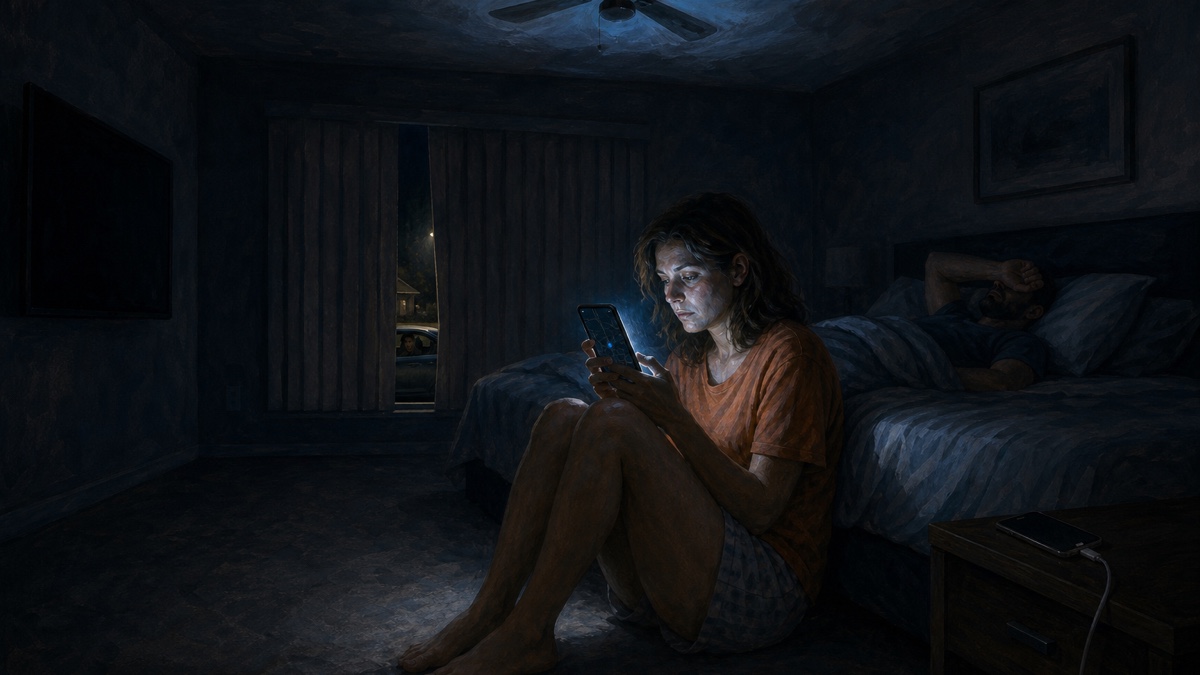
After dinner she went to bed early and I sat in the living room with the TV on and the volume low and I thought about the sign and the number and the space where the third bottle used to be and the blank square on the calendar where Karen’s call should have been written.
And I thought about how long. Not how long since Linda changed. Nine months. I knew that.
How long before I stopped noticing. How long before the sugar in the coffee was just how she took it. How long before the eggs and the silence and the missing medication were just the way things were. How long before the memory of the real Linda faded enough that this one, this smooth gentle version with no edges, became the only one I could remember.
And I thought about the other houses on my street. The other kitchens, the other breakfast tables, the other husbands and wives sitting across from each other in the morning light.
How many of them had noticed.
How many of them had stopped.