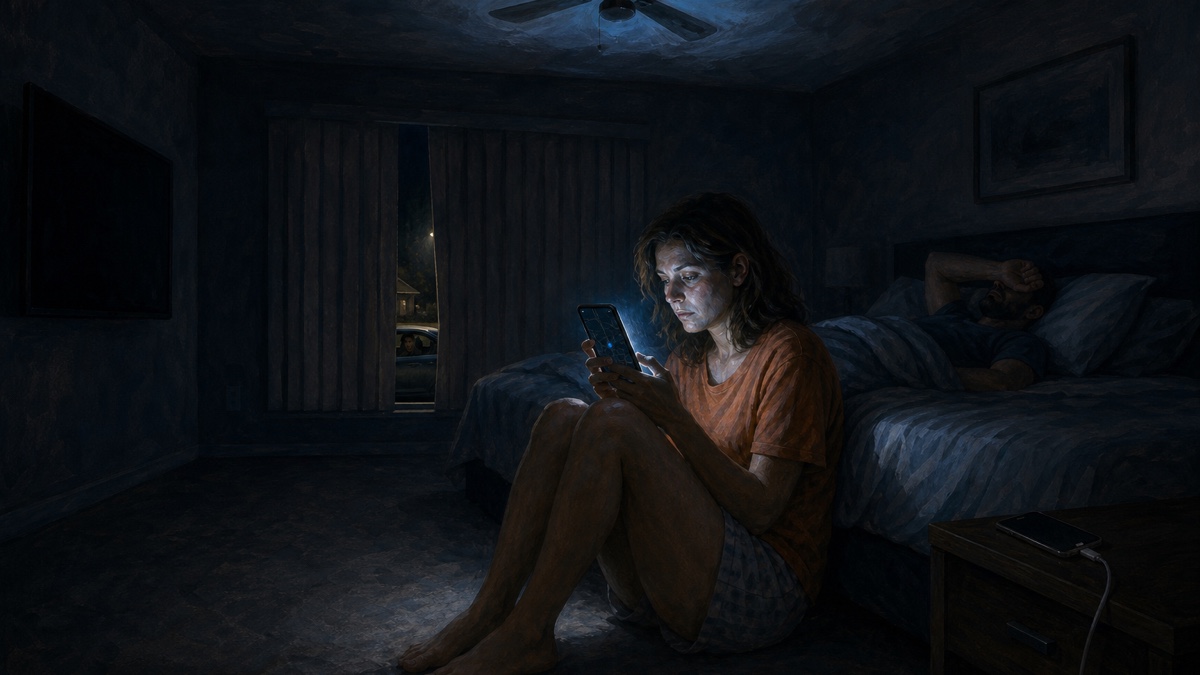
She said my middle name wrong.
That was the thing. Not the other things, not the months of small wrongness that I’d been filing away since February, not the sugar or the jokes or the way she said honey without the sharpness underneath. My middle name. She said it wrong.
Wednesday call. Four o’clock, same as always. Dad first, twenty minutes of weather and the church porch he still hadn’t fixed. Then Mom.
“How’s work, Karen Louise?”
My middle name is Lane. Karen Lane Holt. Named after my grandmother on my father’s side, who was named after a creek in Tennessee that doesn’t exist anymore. Mom had told me that story a hundred times. She loved that story. The creek that vanished, the name that stayed. She said it was proof that names outlast the things they’re attached to.
Karen Louise. She said it with the same warmth she said everything now. Smooth and easy. Nothing wrong with it if you didn’t know that everything was wrong with it.
“Work’s fine, Mom.”
“Good. That’s good.”
“Mom.”
“Hmm?”
“My middle name is Lane.”
A pause. Not a long one. The length of a breath, the space where a person recalculates, and then her voice came back the same as before. Unchanged. Unbothered.
“Of course it is. I don’t know why I said that.”
She did know. Or she didn’t know, and the not-knowing was the point, and the name she’d used was the name she had, which wasn’t the name my mother would have had, because my mother would have said Lane the same way she breathed.
I hung up at four-thirty. Sat on the couch in my apartment in Raleigh with the phone in my lap and the TV off and the sound of the building around me, other people’s lives moving through the walls, and I made the decision I’d been putting off since March.
—-
The drive was six hours. I left at dawn on Thursday because Thursday was my day off and because waiting until the weekend would have meant two more days of sitting with the name Louise ringing in my head like a bell that wouldn’t stop.
I’d grown up in Harlan’s Cradle. Left at eighteen for college. Came back for holidays, then just Thanksgiving, then just the Wednesday call. The town got smaller every time I visited, not in size but in the way it sat in my memory. The buildings compressed. The distances shortened. The place I’d spent eighteen years became a postcard version of itself, flat and familiar and easy to put away.
Route 9 bent to the left and the valley opened and the sign was there.
HARLAN’S CRADLE. POPULATION 1,296.
I slowed the car. The number sat on the sign in paint that was too old and too clear and I read it twice because the first time didn’t register.
1,296. I’d driven past this sign hundreds of times. Thousands. For as long as I could remember the number had been in the 1,240s, give or take. 1,243 when I was in high school. 1,247 the last time I’d visited, two years ago, for Thanksgiving, when Mom had made the turkey and the gravy and hummed while she cooked and the number on the sign was just a number.
1,296. Forty-something more than it should have been. In a town where the number barely moved.
The car idled on the shoulder. The sign leaned left. The trees pressed in on both sides. I put the car in gear and drove into town because the sign was just a sign and my mother had called me the wrong name and one of those things I could do something about.
—-
Dad was at the hardware store when I pulled into the driveway. I knew this because his truck was gone and his truck was always at the hardware store or the church or the gas station and nowhere else. The man had three destinations and the couch.
Mom’s car was in its spot. The kitchen light was on. Through the window I could see her at the counter, standing, her hands working at something I couldn’t make out. She wasn’t humming.
I sat in the car for a minute. Maybe two. The house looked the same. The yard looked the same. The street looked the same with the same trees going bare and the same houses on either side with the same curtains in the same windows.
The front door was unlocked because the front door was always unlocked because this was Harlan’s Cradle and nobody locked anything, which used to be charming and right now felt like something else.
“Karen?”
She was in the kitchen. Slicing something. She looked up and smiled and the smile was warm and present and it landed on me the way a warm thing lands on your skin and I felt it and it was fine and it was wrong.
“You didn’t tell us you were coming.”
“Wanted to surprise you.”
“Your father will be thrilled.” She put the knife down. Wiped her hands on the towel. Came around the counter and hugged me and her arms were the right arms and her shoulders were the right height and she smelled like soap and kitchen and the faintest trace of something herbal that I didn’t recognize because my mother used to smell like Ivory and coffee and nothing else.
“Sit down. I’ll make tea.”
I sat at the kitchen table. The calendar was on the wall behind her. I could see this week’s squares from where I was sitting. Wednesday’s square was blank.
“Mom, did we talk yesterday?”
“Of course we did. Wednesday.”
“You didn’t write it down.”
She glanced at the calendar. The briefest glance. “I forgot. You know me.”
I did know her. That was the problem. I knew her well enough to know she didn’t forget. I knew her well enough to know the calendar was gospel and the pen was always in the cup next to the fridge and the cup was right there, right where it had always been, with the pen in it, with yesterday’s square blank.
“Mom, you called me Karen Louise yesterday.”
She was filling the kettle. Her back was to me. The water ran. The kettle went on the stove. She turned around and her face was her face and her eyes were her eyes and there was nothing wrong with any of it except that my mother’s eyes used to have weather in them, storms and sun and the sharp fast clouds that meant she was about to say something you’d remember, and these eyes were clear. Just clear.
“Did I? That’s strange.”
“My middle name is Lane.”
“I know that, honey.”
“Then why did you say Louise?”
She looked at me. Steady, calm, the kind of calm that isn’t hiding anything because there’s nothing to hide, or the kind of calm that is hiding everything because the hiding is so complete it doesn’t look like hiding anymore.
“I must have been thinking of someone else.”
“Who?”
“I don’t remember.”
The kettle started to hiss. She turned to it. The conversation was over. She’d closed it with three words and a turned back, which was something my mother could do too, except my mother’s version had an edge. A sharpness that said I’m done talking about this but I haven’t forgotten you asked. This version was just smooth.
—-
Dad came home at five. His face when he saw me went through three things in fast sequence. Surprise, then relief, then something he locked down before it could finish becoming itself. Fear, maybe. Or something close enough to fear that the difference didn’t matter.
“Karen.”
“Hi, Dad.”
He hugged me harder than he usually did. Longer. His hands on my back had a grip to them that said don’t go yet without saying it.
We ate dinner. The three of us at the table where I’d eaten a thousand dinners. Mom had made pot roast, which was Dad’s favorite, except the roast was cooked differently. A touch more salt. The potatoes cut in rounds instead of cubes. Small things. The kind of things you’d only notice if you’d watched this woman cook for eighteen years and then watched her cook differently for six hours.
Dad ate without commenting. He’d been eating without commenting for months. I could see it in him, the weight of the not-commenting, the way it sat in his shoulders and his jaw and the careful way he chewed, and I understood now what the funeral director must have seen when he looked at Dad at church. A man carrying something that was getting heavier by the day.
After dinner Dad went to the living room and turned on the TV and Mom washed the dishes and I dried them and we stood side by side at the sink and the window above the sink showed the dark street and the bare trees and somewhere beyond them, not visible from here, the sign.
“Mom.”
“Hmm?”
“What happened to you?”
Her hands kept moving. The sponge on the plate. The plate in the rinse water. The plate on the rack. The rhythm didn’t break.
“What do you mean?”
“You’re different. Since February. Dad knows it. I know it. You put sugar in your coffee. You don’t hum anymore. You called me Louise.”
The water ran. The sponge moved. The kitchen was warm and the window was dark and my mother stood next to me washing dishes and I waited for the deflection, the smooth I don’t know what you mean, honey, the lid coming down on the box.
She turned off the water.
Her hands were still. Wet, resting on the edge of the sink. She was looking at the window but not through it. At it. At the dark glass and the reflection in it, her own face and mine side by side, and something in her expression shifted. Not a crack. A decision.
“You notice more than your father does.”
My hands stopped on the towel. The plate I was holding was wet and heavy and I didn’t put it down because putting it down would have meant moving and moving might have broken whatever was happening.
“He notices enough,” she said. “The sugar. The cabinets. He notices and he doesn’t say anything because saying something would make it real and Carl isn’t ready for real.”
She wasn’t talking about my father in the third person because she’d forgotten she was his wife. She was talking about my father in the third person because the distance was accurate.
“But you drove six hours. You drove six hours because I got your middle name wrong. You’re here because a name is a thing you don’t get wrong if you’re the person who gave it.”
The kitchen was very quiet. Dad was in the other room. The TV murmured. The pipes ticked.
“I didn’t give you your name, Karen. Linda did.”
The plate was still in my hand. The towel was still around it. The water dripped from the edge of the counter onto my sock and I felt it and it was cold and that was the only thing that was real.
“You’re Linda,” I said.
“I’m in Linda’s house. I’m in Linda’s kitchen. I wash Linda’s dishes and I sleep in Linda’s bed and your father looks at me across the table every morning and almost asks.”
“Almost.”
“Almost. Every morning. I can see it build in him and I can see him put it away. Nine months of almost.”
“What are you?”
She looked at me. The clear eyes, the cloudless sky, and behind them something that wasn’t my mother and knew it and had been waiting, patiently, for someone to see it clearly enough to ask.
“I’m what comes after.”
“After what?”
“After someone stops being counted.”
The TV in the other room changed channels. Dad looking for something to watch. The ordinary sound of an ordinary evening in an ordinary house and my mother’s face, my mother’s hands, my mother’s kitchen, and the thing standing in all of it telling me it wasn’t her.
“Where is she? Where’s my mother?”
“She’s not here. She hasn’t been here since February.”
“Where did she go?”
“I don’t know. That’s not my part.”
The plate slipped. I caught it. Set it on the counter. My hands were shaking and the shaking was visible and she saw it and her expression didn’t change. Not cold. Not cruel. Just clear. Present in a way that didn’t include the kind of pain that would have been in my mother’s eyes if she’d seen my hands shake.
“The sign went up before you decided to come,” she said.
The floor shifted. Not physically. Somewhere underneath, in the place where the world is supposed to be solid.
“What did you say?”
“The sign. It went up before you decided to come. It was 1,295 yesterday. It’s 1,296 today. You crossed the town line this morning.”
“That’s not possible. I decided to come yesterday. I left this morning.”
“Yes.”
The word just sat there. Yes. The simplest word. And underneath it, the weight of a thing I couldn’t hold and couldn’t put down and couldn’t walk away from because I was standing in my mother’s kitchen drying my mother’s dishes and the thing that wore my mother’s face had just told me the town knew I was coming before I did.
I looked at the calendar on the wall. Wednesday’s square, blank. No record of our call. No record of the name she’d said wrong. No record of the reason I was here.
But Thursday’s square had something written on it. In handwriting that wasn’t my mother’s and wasn’t mine.
Karen comes home.
Written before I’d decided. Before I’d packed. Before I’d driven six hours on a Thursday morning because a middle name was wrong.
The sign had known. The calendar had known. The thing in my mother’s kitchen had known.
And now I was here. And the sign had gone up by one. And the question I couldn’t stop hearing, louder than the TV and the pipes and the water dripping on my sock, was whether I’d come to visit or whether I’d come to stay.
I looked at the door. I looked at my mother’s face that wasn’t my mother’s face. I looked at the calendar with my name on it in handwriting I didn’t recognize.
Dad changed the channel again. The house settled. The kitchen light hummed.
I was still holding the towel.