The U-Haul pulled heavier than it should have.
Six hours on the road and my back had fused to the seat. The trailer didn’t want to be here.
That made two of us.
But the lease was up and the apartment was empty and a lawyer in a town I’d never heard of had sent me a key to a dead woman’s house, so here we were, the U-Haul and me, dragging ourselves through the kind of country where the GPS gives up and the radio turns to static and the trees lean in close enough to brush the mirrors.
Route 9 bent hard to the left. The valley opened below.
The sign was the first thing. Wooden post, painted white, leaning slightly left.
HARLAN’S CRADLE. POPULATION 1,247.
The paint looked too old to be readable and too clear to be as old as it looked. Something about it didn’t sit right but the trailer was pushing me downhill and the brakes were soft, so the sign slid past and I let it.
A church steeple. Smoke from somewhere. The dashboard clock said 11:14 and my stomach said I hadn’t eaten since a gas station donut at dawn.
Nobody knew I was coming. That was the thing about having no one left. You could drive six hours into Appalachia and not a single phone would ring wondering where you were.
Helen’s lawyer had found me through a forwarding address I’d forgotten I’d filed. My aunt’s house, left to me in a will nobody told me about, from an aunt who’d stopped calling nine years ago. Or maybe I’d stopped answering. Same result.
The road flattened. A gas station appeared on the right, the kind with two pumps and prices painted by hand. A man sat in the window behind the counter. He watched me pass the way you watch weather coming in.
Two blocks later, no address. The lawyer’s letter was somewhere in the trailer, buried under books and kitchen boxes I’d packed in the wrong order because I’d started packing at midnight after two glasses of wine and a decision that felt like giving up on something I couldn’t name.
So I stopped at the hardware store.
It had a bell that rang too loud. A man in a canvas apron was restacking wood stain on a shelf that was already neat. He turned before the bell stopped.
“Help you?”
“My aunt’s house. Helen Morse?”
His hands paused on the cans. A beat too long. Then they kept moving.
“Helen’s place. Sure. Route 9 north, quarter mile past the church, left on Bower. Yellow house. Porch light’s probably still on.”
“Still on?”
“She kept it on. Nobody’s been in since.” He faced me fully. “You’re the niece.”
Not a question. A fact he already had.
“How did you know that?”
“Small town.” The smile was fine. Warm, even. Nothing wrong with it that I could point to, which was its own kind of wrong. “You need anything, we’re open till six. I’m Gary.”
“Jenny.”
“I know.”
He didn’t explain. He went back to the shelf. The bell rang behind me on the way out and the sound followed me to the car.
—-
The house was yellow. The porch light was on at noon.
Not on the way a light is on in the daytime, where you know it’s there but it doesn’t register. This one held a circle of warm gold against the clapboard that had no business being visible with the sun up.
Like the house was expecting someone. Like it had been expecting someone for a while.
My hands were stiff on the key but the lock turned easy.
Inside, lavender. And under the lavender, something older. The held-breath smell of a house where the air hasn’t moved in months.
Helen’s things were still here. Mug on the counter, upside down on a towel. Sweater over a kitchen chair. Shoes by the door, three pairs, lined up the way only someone who lived alone would line them up.
Not abandoned but paused. Like she’d be right back.
The kitchen table had a chip in the corner and a water ring from a glass that was probably in the cabinet now. This was where Helen had eaten her dinners. The chair closest to the window was worn differently than the others.
Hunger hit me then. The fridge hummed. It was empty. I don’t know why i expected anything less.
Someone had cleaned it after she died but left it running, which was either thoughtful or strange and I was too tired to decide which.
I went to the back bedroom and I didn’t like it.
Small room. Desk pushed against the window, lamp shade tilted wrong, and a stack of envelopes held together with a rubber band.
My name on every one. Twelve envelopes in Helen’s careful handwriting. No return address, no stamps. Written and kept.
The chair was still warm from the sun coming through the glass. From this angle, leaning forward, the population sign was visible through the trees. Just the white rectangle. Not the number.
But there, the way it must have always been there, hanging in Helen’s periphery every time she sat at this desk.
She’d been sitting here for twenty-two years. Writing me letters she never sent while looking at a sign that meant nothing.
I opened the first letter because I had nothing else to do.
—-
Jenny, I’m writing this because I think you’ll come here eventually, even though I know you won’t come while I’m alive. That’s not a complaint. I wouldn’t have come either, if I were you. The house is yours when I’m gone. The lawyer will find you.
There’s a thing about this town you’ll notice. Everybody notices it, eventually, and then everybody stops noticing it, and that’s how the town works. The sign at the edge of town keeps a count.
You’ll think it’s just a sign. It isn’t. But you won’t believe that right away and I’m not going to try to convince you because convincing isn’t how it works here. You’ll see.
I moved here because your mother told me something about our family, a long time ago, that I didn’t believe until I checked. I’ve been checking for twenty-two years. The count is always right, Jenny. Always. And I need you to understand what that means before you find the rest of what I’ve left you.
Don’t open the other letters until you’ve been here a week. I mean that. Live in the town first. Talk to people. Go to the gas station. Walk past the sign. Give it a week. Then read the second letter.
You are not here by accident. The number on the sign went up before you decided to come.
The last line sat there.
The number on the sign went up before you decided to come.
My hand put the letter down. Picked it back up. The line was still the same.
Helen had always been dramatic. That was my memory anyway, the memory of a fifteen-year-old who wasn’t paying attention.
But this wasn’t dramatic. Dramatic would be vague. This was specific.
This was a woman who had been checking something for twenty-two years and had decided it was true enough to put in writing.
The sign through the trees looked the same as it had five minutes ago. The same as it probably looked every day, from this chair, for the last two decades.
Eleven more envelopes sat on the desk. Helen wanted a week before the second one.
A week.
—-
The gas station was the only place in town that sold bottled water. Gary had told me that when I’d circled back to ask, which meant passing the sign again on Route 9.
HARLAN’S CRADLE. POPULATION 1,247.
The number should have been 1,248.
Unless it already was, before I’d decided to come.
The car idled on the shoulder while my brain tried to make that make sense. The seven had a horizontal line through it, European style. Somebody had learned to write numbers somewhere other than here. The paint was the wrong age.
Everything about the sign was slightly off center in a way that wanted to be noticed and refused to be explained.
A truck went by. The driver waved. People here waved at strangers. That was going to take some getting used to.
The gas station man looked up from behind the counter like he’d been waiting.
“Evening.”
“Is it?” My phone was dead weight. No signal, no clock, no connection to the life I’d had this morning.
“Nearly six.” He reached under the counter. “Water, right? Everybody who moves here wants water the first day. Takes a while to trust the tap.”
Everybody. Like this was a thing that happened. Like people moved to Harlan’s Cradle regularly enough to have a pattern.
“The tap is fine?”
“Better than fine. But it takes a while.”
Two bottles, a bag of pretzels, and a question I couldn’t keep down any longer.
“The sign. The population sign. Does it update? Does someone go out and change it?”
His hands went flat on the counter. Not casual but deliberate. A gesture with weight behind it.
“Nobody repaints it,” he said.
“Then how—”
“Helen was your aunt, right?”
“Yes.”
“Then you’ll figure it out.” The water slid across the counter toward me. “Give it a week.”
Everybody kept saying a week.
—-
The porch light was on. The headlights swept across the front of the house and the porch light flickered. One blink. The kind of thing you tell yourself was the angle of the car.
Pretzels for dinner, standing at the counter. The house was quiet. No traffic, no neighbors through walls, no city hum. Just the fridge and the settling bones of a house old enough to know who was inside it.
Helen’s bed was the only option. The quilt smelled like lavender and something warmer underneath, something that was probably just age but felt like a person had been there recently.
Sleep came fast. Too fast, the kind where exhaustion drags you under and you don’t even get to think about the things you should be thinking about.
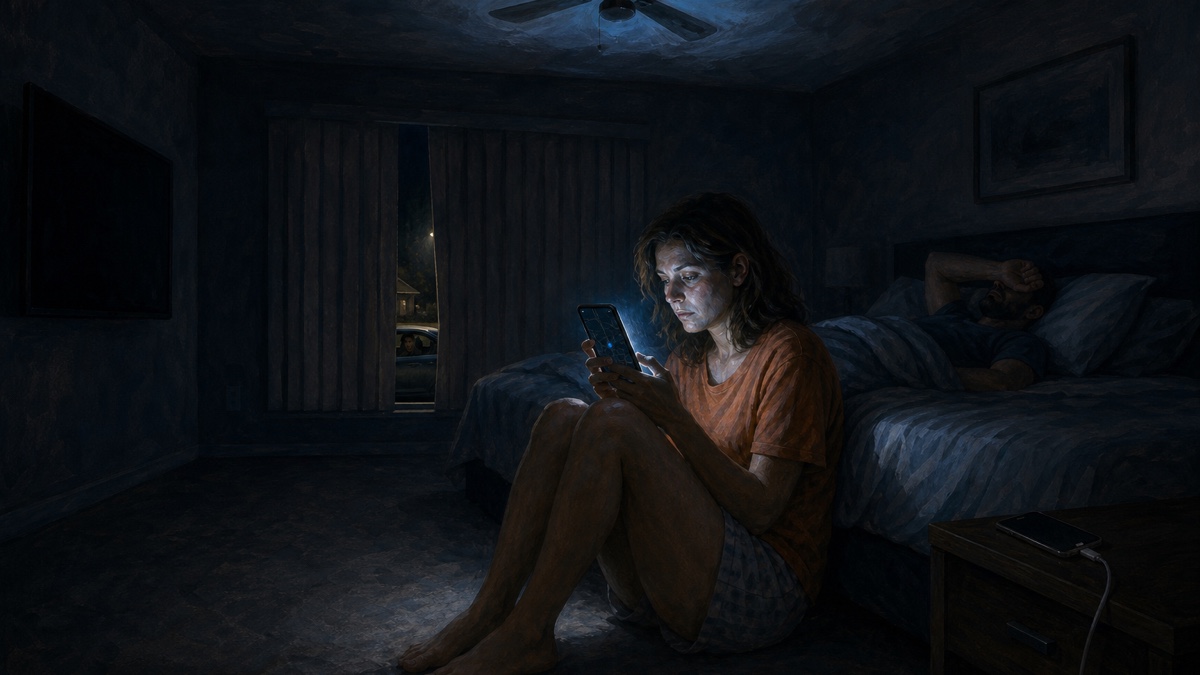
Then 3 AM.
I woke up because my mouth was dry. I couldn’t see anything because the dark was so complete it had weight. The house holding its breath again.
Footsteps on the porch.
Not hurried or sneaking. Just someone walking the length of the porch, front steps to the garden wall, and back. And again. And again.
My body went rigid under the quilt. The footsteps had a patience to them. Whatever this was, it wasn’t in a rush. Back and forth. Back and forth. Ten minutes of it while the dark pressed in and my heartbeat filled the spaces between the steps.
They stopped at the front door.
Silence.
The knock never came. Instead, the soft scrape of paper sliding under the door. Then the footsteps again, down the steps, across the gravel, and gone. Not running. Just walking. Whoever it was had done what they came to do.
Twenty minutes before my legs worked enough to get me out of bed. The floor was cold through my socks. The house was empty. The porch was empty. But on the floor by the door, a single sheet of paper.
Not Helen’s handwriting. Heavier hand, different ink.
Forty-seven names in a column. No heading. No explanation. Nobody I knew.
And at the bottom, in different ink, a number.
1,248.
The names swam in the bad light. Forty-seven of them. My finger moved down the column because my brain had stopped trusting my eyes. Forty-seven. Again. Forty-seven.
The kitchen table was cold under my arms. The list sat in front of me, the way something sits across from you at a table when you can’t look away from it.
The porch light blinked again through the kitchen window. One flicker. There and gone.
My hands shook. Both of them, at the same time, a tremor that started in the fingers and went up to the elbows. Not fear, exactly. Something past that. The feeling of standing at the edge of a fact you can’t walk back from.
Dawn came eventually. Gray light through windows. Woodsmoke smell from somewhere unseen. The town was silent in a way that was different from the night silence, like something had finished.
The sign was visible from the front door. That white rectangle through the trees. Even from here, the last digit was different. The seven with the line through it was gone.
Route 9 was empty. My bare feet hit gravel, then asphalt. The cold came up through the soles. Helen’s sweater smelled like her house.
HARLAN’S CRADLE. POPULATION 1,294.
Forty-seven more than yesterday.
The number just sat there on the sign, in paint that was already the wrong age, like it had been there for years.