The twelfth letter was thicker than the others.
I’d opened one a week, the way Helen asked. Tuesdays, because Tuesday was the day I’d arrived, and Helen’s first letter said to live in the town for a week before reading the second one and I’d started on a Tuesday so Tuesdays became the day.
Eleven letters over eleven weeks. Each one in Helen’s careful handwriting, each one sealed in an envelope with my name on it, each one telling me something about Harlan’s Cradle that I wasn’t ready to hear until I’d lived through enough Tuesdays to understand it.
The first letter told me the sign was real. I’d already known that by then. You can’t live in a house where the sign is visible through the back window and not know it’s real.
The paint that’s the wrong age. The numbers that change without anyone touching them. The lean to the left that shows up in photos from a hundred years ago. The sign is real. Helen wanted me to know she knew it was real, and that knowing it was real was the first step and not the last.
The second letter told me about the count. Not what it counted. Just that it counted, and that the counting was always accurate, and that accuracy was the thing people in this town had learned to live with the way people in flood plains learn to live with water. You don’t fight it. You don’t understand it. You build your house above the line and you keep living.
The third letter told me about Helen. Why she came. What she’d been looking for. The thing my mother had told her about our family that I never heard because my mother died when I was twelve and Helen stopped calling when I was fifteen and the gap between those two events was the gap that brought me here.
The fourth letter was about the replacements. Helen didn’t call them that. She called them what comes after.
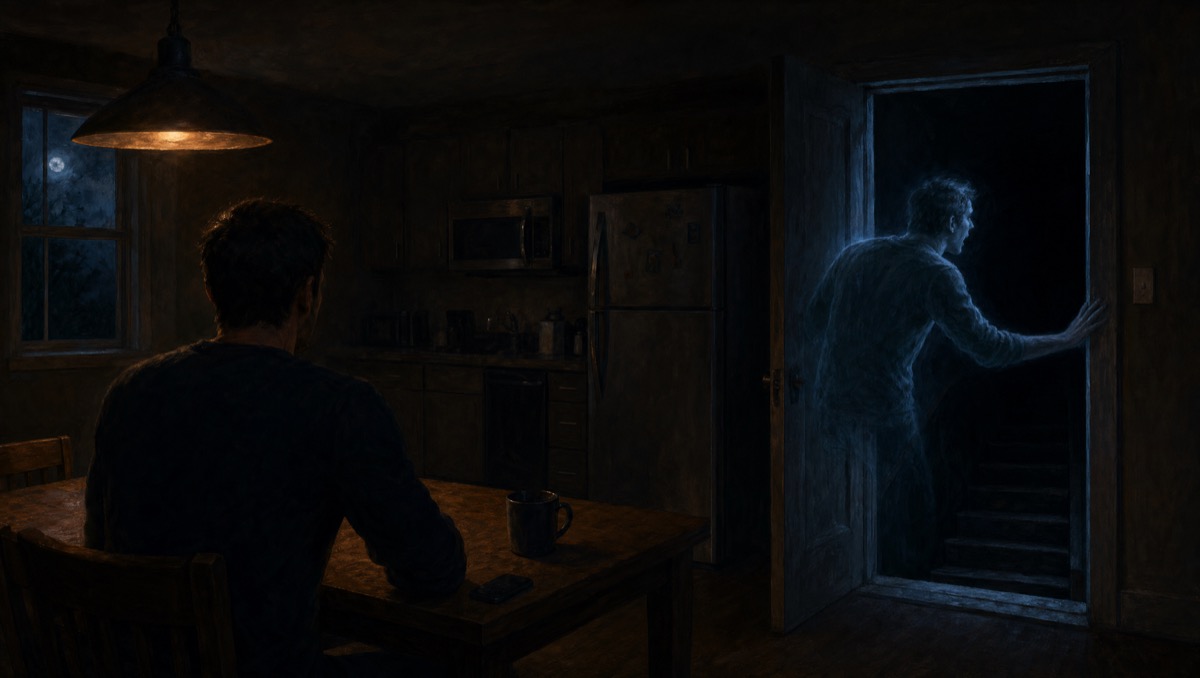
She’d been watching for twenty-two years. Sitting at the desk in the back room, the one I was sitting at now, looking through the window at the sign through the trees, and she’d been watching people in this town lose whatever the sign counted and become something else.
Something that looked the same and sounded the same and filled the same chair at the dinner table but wasn’t.
The fifth letter named the first one she’d noticed. A woman named Bev Garner who lived on Church Street and who one morning in 2006 stopped knowing where she kept her keys. Not forgot. Stopped knowing. As if the information had been removed.
Bev’s husband didn’t say anything. Nobody said anything. Bev found a new place for her keys and life went on and Helen watched from the desk and wrote it down.
The sixth letter was about the sign going down. Not up. Down. Helen had watched it drop by one on a Tuesday afternoon in 2009 and she’d walked every street that evening and everyone was alive and nobody had left and the next morning the number was back where it had been. One person had stopped being counted for a single day and then started again.
Helen never figured out who. She checked every face she could find and everyone looked the same. But someone, for one day, had lost whatever the sign measured and then gotten it back.
The seventh letter was about the ones who arrived. Not people who moved to town. People who appeared. The way Ethan Calloway appeared in Mrs. Alderman’s classroom. The way names showed up in records that hadn’t contained them the day before.
Helen had watched it happen five times in twenty-two years. Each time, the sign went up. Each time, the new person had a history that went back further than their presence. Each time, the town accepted them without question.
The eighth letter was about the forty-seven. Helen had known they were coming. Not the number, not the date, but the event. She’d seen the sign flicker. Three nights before the jump, sitting at this desk at 2 AM because she couldn’t sleep, she’d looked through the window and the sign had been dark.
Not unreadable, but dark.
The paint gone. The white rectangle blank. For thirty seconds, maybe less, the sign had stopped counting. And when the numbers came back, they were different.
The ninth letter was about the porch light. Why she kept it on. Not for visitors. Not for safety. Because the light was a signal.
Helen didn’t explain to whom or what. She said the light meant someone is watching. She said the watching mattered. She said if the light went off, the watching stopped, and if the watching stopped, the sign could do what it wanted without anyone noticing.
The tenth letter was about me. About why she’d left me the house. About the thing my mother had known, the thing that ran in our family, the thing Helen had spent twenty-two years confirming.
Some people could see the seams. Most people couldn’t. Carl Holt couldn’t see the seams but he could feel them, which was close enough to make him miserable but not close enough to make him useful.
Patty Alderman at the school could see them but she didn’t trust what she saw because trusting it meant trusting herself over every piece of paper in her desk drawer. Helen could see them. My mother could see them.
I could see them. Helen was sure of it.
She said it ran through the women in our family. She said my mother had seen the seams her whole life and never told anyone except Helen, in a phone call in 2003, three months before she died.
And Helen had packed a bag and driven to Harlan’s Cradle that same week because Harlan’s Cradle was where the seams were visible if you knew where to sit and where to look.
The eleventh letter was a warning. Helen said the watching had a cost. Twenty-two years at this desk. Twenty-two years of seeing what nobody else could see and writing it down and not telling anyone because telling someone meant asking them to see it too, and seeing it changed you, and the change was not something she would do to another person without their consent.
She said she was tired. She said the tiredness was in her bones and in her eyes and in the hand that held the pen. She said she’d started to wonder if the sign could see her watching. If the sign knew it was being observed. If the accuracy of the count was partly because nobody checked and Helen checking was a problem the sign would eventually solve.
She said the twelfth letter would be the last thing I needed.
—-
The twelfth letter was in my hands. Tuesday morning. The house was quiet. The porch light was on because I hadn’t turned it off since I’d arrived and I understood now why Helen hadn’t either.
The desk was warm from the sun through the window. Helen’s chair, my chair now, had a groove in the seat from twenty-two years of sitting. The sign was visible through the trees. White rectangle. The lean to the left.
I opened the envelope.
Inside was a list.
Not a letter. A list. Three pages, front and back, in Helen’s handwriting. Names, addresses, dates. A column for each. The names were people in this town. The dates were when Helen had noticed the change.
Bev Garner. 19 Church Street. March 2006. Keys.
That was the entry. The name, the address, the date, and a single word that described the first thing that changed. The first small thing. The crack that opened before the rest followed.
Donald Pratt. 5 Elm Street. August 2008. Handwriting.
June Bowman. 22 Ridgeline Road. January 2011. Singing voice.
Linda Holt. 3 Maple Street. February 2026. Coffee.
Linda’s entry was recent. Helen had been dead for months when Linda changed. But the entry was there, in Helen’s handwriting, dated February 2026, which meant Helen had written it before it happened.
The list went on. Name after name. The dates stretched forward. Some were from years ago. Some were from this year. Some were dates that hadn’t happened yet. December 2026. March 2027. Entries for changes that were coming, written in the past tense by a woman who’d been dead since spring.
Helen had been writing the future. Sitting at this desk, looking at the sign through the trees, watching the town lose its people one small thing at a time, and writing down the ones who hadn’t been lost yet.
I turned to the last page. The entries near the bottom were in different ink. Darker. The handwriting was the same but the pressure was heavier, as if the pen was being pressed harder, as if the hand holding it was tired and pushing through.
The second-to-last entry.
Helen Morse. 7 Bower Street. April 2026. Everything.
She’d written her own name. Her own address. Her own date. And where every other entry had a single word describing the first small thing, Helen’s said everything. Not one thing at a time. Everything at once. Helen hadn’t been replaced gradually. Helen had been taken whole.
April 2026. She’d died in the spring. The dates matched. Helen had sat at this desk and written the date of her own erasure and she’d done it in ink and she’d kept the porch light on and she’d sealed the letters and she’d waited.
The last entry.
My hands were shaking. Both of them, at the same time, the tremor running from my fingers to my wrists, and I could feel my heartbeat in the paper.
Jenny Morse. 7 Bower Street. November 2026.
No word after the date. No single small thing. Just my name and the address and the month, this month, now, and the space where the word should have been was blank, as if Helen had known the date but not the detail, had seen the when but not the what, had written everything she could and left the rest for me to discover.
I put the letter down. Picked it up. The entry was still there.
November 2026. This month. This week, maybe. This day.
I looked at the desk. At my hands on the desk. At the window and the sign through the trees. The white rectangle. The lean to the left. The number I couldn’t read from here but knew anyway because I’d checked it this morning on my walk to the gas station for coffee.
1,296.
I’d checked it this morning. I remembered checking it. I remembered the walk and the coffee and Bobby behind the counter and the cold air and the fog on the road. I remembered all of it.
But I couldn’t remember what I’d had for breakfast.
I sat with that. The way you sit with a sound you’re not sure you heard. Waiting for it to repeat. Waiting for the silence to confirm that it was nothing.
I couldn’t remember breakfast. I’d been in the kitchen this morning. I’d been at the counter. The coffee pot was there and the mug was there and the morning light was coming through the window and after that, nothing. A gap. Small. The kind of gap that could be exhaustion or distraction or the simple fact that breakfast wasn’t memorable.
Or the first small thing.
The porch light was on. I could see its glow from the window, a warm circle against the clapboard, holding its ground against the daylight. Helen had kept it on for twenty-two years. A signal. Someone is watching.
I was watching. I was sitting in Helen’s chair at Helen’s desk looking through Helen’s window at the sign that had counted me before I’d decided to come, and I was watching, and my name was on the list and the date was this month and the space where the word should be was blank.
I picked up a pen. Helen’s pen, the one she’d left in the cup on the desk, the same pen that had written twelve letters and a list that stretched into the future. I put the pen to the paper, in the blank space next to my name, and I waited to see if my hand would write the word.
The pen sat on the page. My hand held it. The ink touched the paper and made a small dot, a period, the beginning of something or the end of it.
The sign was through the trees. The porch light was on. The house held its breath the way it had been holding its breath since Helen left, and I was here in it, in the chair, at the desk, with the list and the pen and the small dark dot on the page next to my name.
I didn’t write the word. Not because I couldn’t. Because I didn’t know it yet. The space was blank because the first small thing hadn’t happened yet, or it had happened this morning and I’d missed it, and the only way to know was to keep watching.
Helen had watched for twenty-two years. She’d kept the porch light on and she’d sat at the desk and she’d written everything down. And the sign had taken her anyway. Everything at once. April 2026.
But she’d seen it coming. She’d written her own name. She’d sealed the letters. She’d left me the house and the desk and the pen and the light. She’d done the one thing the town couldn’t absorb.
She’d made sure someone was still watching.
The sign sat in the trees. The number was the number. The porch light hummed against the house.
I left the pen on the page. I left the list on the desk. I left the light on.
And I sat in the chair and I watched.