Twenty-three.
That was the number every morning. Had been since September. Twenty-three kids in room 104, third grade, Harlan’s Cradle Elementary, which was the only elementary because the town had never needed two.
Counting them was automatic. Not because I thought they’d be gone. Because it was the first thing I did every day and the last thing I did before the buses came and without it the day didn’t have edges.
Twenty-three in August. Twenty-three in September. Twenty-three on the Monday before Halloween when half of them had colds and all of them wanted to talk about candy.
I’d been teaching for twenty-nine years. Three more and I could retire with full benefits, which was a sentence people said to me like it was good news. Three more years. Like I was counting down. Like the classroom was something to survive rather than the only place where the hours moved at a speed that made sense.
At home the hours were slow. At home I watered plants and watched the news and ate dinner standing at the counter because sitting at the table meant sitting across from the empty chair and the empty chair had been empty for four years and I still hadn’t moved it.
Bill would have told me to move it. Bill would have said Patty, for God’s sake, it’s a chair in that voice he had, the one that was gruff and gentle at the same time, and I would have moved it because he asked and then I would have missed it and he would have put it back without saying anything.
But Bill was gone and the chair was there and the classroom had twenty-three kids who needed counting.
Monday. First week of November. Cold enough that the windows fogged from the inside by second period. The buses had come and the hallway smelled like wet coats and cafeteria oatmeal and the particular sweetness of twenty-three small bodies that hadn’t learned yet to be self-conscious about sweat.
Same spot at the door. Same hand on the doorframe. They filed in.
Backpacks and lunchboxes and shoes that were always untied no matter how many times you tied them.
Sarah Polk first because Sarah Polk was always first, a girl who took punctuality so personally it was almost a medical condition. Then the Dawson twins, then Wesley Webb, then the rest in the shuffling order that kids naturally fall into when nobody tells them where to go.
I counted. It was automatic. The same way breathing is automatic, the same way blinking is, the thing my brain did with groups of children before any other thought could form.
Twenty-four.
My hand stopped on the doorframe. The count didn’t match. I went back to the beginning. Sarah at her desk. The twins pulling off their jackets. Wesley already sharpening a pencil that didn’t need sharpening.
Twenty-four.
One extra. One more body in a room where I knew every body by name and shoe size and the sound of their cough.
He was sitting in the third row. Middle seat. Brown hair, brown eyes, a green jacket with a broken zipper. His hands were folded on the desk. Third graders don’t fold their hands unless someone has recently told them to.
I didn’t know him.
I knew every child in this school. Not just my class. Every single one.
A hundred and forty-one kids across six grades, and I knew their names and their parents’ names and which ones were allergic to peanuts and which ones cried at recess and which ones pretended they didn’t need to cry at recess.
Twenty-nine years of teaching in a school this small. You don’t forget a face. You don’t miss a new one.
This was a new face.
“Good morning,” I said to the room.
“Good morning, Mrs. Alderman,” they said back. Half-song, half-obligation. Same chorus every morning.
The boy in the third row said it too. His mouth moved with the rest of them. Good morning, Mrs. Alderman. Like he’d been saying it since September.
I walked to my desk. Opened the attendance book. Ran my finger down the list because the list would tell me. The list was twenty-three names in alphabetical order in my handwriting and it would not have a twenty-fourth name because I had written it myself on the first day of school.
Twenty-four names.
My finger stopped on the seventh entry. Ethan Calloway. Neat letters. My handwriting. The same blue pen I’d used for the rest of the list, the one that was sitting in the cup on my desk right now.
Ethan Calloway. Third row, middle seat. Enrolled since September 4th.
I looked at the name. I looked at the boy. He was watching me with the kind of patience that children don’t usually have, the settled stillness of someone who was used to being looked at and had decided a long time ago not to mind.
“Ethan,” I said.
“Yes, Mrs. Alderman?”
His voice was normal. A boy’s voice. Nothing strange about it except that I had never heard it before and it answered to a name that was in my handwriting in a book I kept locked in my desk drawer every night.
“Did you bring your permission slip for the field trip?”
The question came out automatic. The right words in the right order because the wrong words, the true words, would have sounded insane.
Who are you? How are you in my book? Why does everyone know your name but me?
“It’s in my backpack,” he said. He reached down. Unzipped. Pulled out a white slip of paper with the school letterhead and a signature at the bottom that I didn’t recognize but that was clearly a parent’s signature, the kind of hurried cursive that meant someone had signed it at the kitchen table between coffee and car keys.
I took the slip. Put it in the folder with the others. Twenty-four slips now. The folder had been sitting on my desk since Friday. I’d counted the slips Friday afternoon. Twenty-three.
The morning kept going. Math, then reading, then the fifteen-minute break where they spilled into the hallway and the noise hit a pitch that could strip paint.
I couldn’t stop watching Ethan Calloway. Not because I expected him to do something wrong. Because the possibility that he might was the only thing I could see.
He played with the other kids. They knew him. Not new-kid knew him, with the circling and the testing and the sizing up. Old knew him. Familiar knew him.
Wesley shared his crackers with Ethan without being asked. Sarah Polk told him his shoes were untied and he said I know in the bored voice of a boy who’d heard it a hundred times. The Dawson twins argued about whether he’d been on their kickball team last Friday and one of them said yes and the other said yes and neither of them hesitated.
I went to the office at lunch. Donna Pike was behind the desk eating a salad from a container that she brought every day, same container, same salad, same fork. Donna had been the school secretary for twelve years and knew every file in that cabinet by touch.
“Donna, can you pull Ethan Calloway’s file for me?”
She didn’t look up. “Third grade, right? Your class?”
“Yes.”
She put the fork down, turned to the cabinet. Pulled a folder without searching for it. Handed it across the desk.
The folder was real. The paper inside was real. Enrollment form dated September 4th. Emergency contact: R. Calloway. Address: 14 Sycamore Lane. Medical history, clean.
Previous school, blank, which meant he’d been in the district since kindergarten. Report cards from first and second grade, signed by teachers I worked with every day, with comments about his reading level and his penmanship and his habit of staring out the window during science.
Two years of a boy I had never seen.
“Donna.”
“Hmm?”
“How long has Ethan been enrolled here?”
She looked at me over the salad. Not unkind. Just confused about why the question existed.
“Since kindergarten, Patty. You know that.”
I didn’t know that. I didn’t know anything about Ethan Calloway except that he was sitting in my classroom right now with his hands folded and his shoes untied and every piece of paper in this building said he’d been here all along and every piece of my memory said he hadn’t.
“Right,” I said. “Just double-checking.”
—-
The sign on Route 9 was visible from the school parking lot if you stood at the right angle, between the dumpster and the fence, where the tree line thinned out enough to show the white rectangle.
I hadn’t looked at it in weeks. Not deliberately. The sign was part of the landscape. Background. You stopped seeing things you saw every day.
But I looked at it now. Stood by the dumpster with my coffee going cold and the afternoon light coming through the trees at the angle that made everything look like a photograph of itself.
HARLAN’S CRADLE. POPULATION 1,295.
The number sat there in paint that was too old to be that clear. I’d driven past it Friday afternoon on the way home. I always drove past it. Usually my eyes slid right over it. But Friday I’d looked, for no reason, and the number had been 1,294.
One more.
I went back inside. The hallway was quiet. Lunch wasn’t over yet. The classroom was empty except for the attendance book on my desk and the twenty-four permission slips in the folder and the faint smell of dry-erase markers and graham crackers.
I opened the bottom drawer. The one I kept locked. Inside were my files, the real ones, the ones I kept separate from the office copies because I’d learned a long time ago that my memory and the school’s records didn’t always agree and when they disagreed I wanted my own version to check against.
Class roster. Room 104. Twenty-three names.
Except it wasn’t twenty-three names. It was twenty-four. And the seventh name on the list, in my handwriting, in the blue pen, was Ethan Calloway.
My own records. The ones I kept in a locked drawer. The ones nobody else touched.
I sat down because my legs made the decision for me. The chair was cold through my skirt. The room was doing that thing where the walls feel closer than they should, where the fluorescent lights hum louder than usual, where the clock ticking is the only evidence that time is still working.
I’d written that name. My hand, my pen, my paper. There was no version of this where someone else had done it. The drawer was locked. The key was on my keyring, had been on my keyring for twenty-nine years, and I was looking at my own handwriting adding a child to my class that I had no memory of ever meeting.
The afternoon was worse than the morning because now I was watching for the cracks and there weren’t any.
Ethan Calloway sat in his seat and did his worksheet and raised his hand twice and got one answer right and one answer wrong and the wrong answer was wrong in the specific way that third graders get things wrong, not a mistake an adult would make, not a performance, just a kid who thought seven times eight was fifty-four.
At two-fifteen the buses came. Twenty-four kids filed out. I stood at the door counting them. Twenty-four backpacks, twenty-four lunchboxes, twenty-four pairs of shoes, twelve of them untied.
Ethan Calloway walked past me and said “Bye, Mrs. Alderman” and his voice was just a voice and his face was just a face and he got on the second bus and sat in a window seat and looked out at the parking lot with the blank, patient expression of a child who was used to riding buses and being counted and going home.
—-
I drove home the long way without deciding to.
My hands turned the wheel onto Sycamore Lane four blocks from the school and I let them because I was tired and the route was the route and it wasn’t until I was halfway down the street that I realized nobody I knew lived here. Three houses and a dead end. Twenty-nine years in this town and I’d never needed this street.
Number 14 was small and white with a porch that needed paint. A truck in the driveway, mud on the tires. Curtains drawn.
The car slowed. My foot did it, not my brain. And in the three seconds it took to pass I saw the front door open and a man step out onto the porch.
He looked at my car. Patient and settled. The same stillness the boy had in the classroom, the comfort of someone who expected to be noticed and didn’t mind.
I hit the dead end and turned around and on the way back the man was still on the porch. Still watching. I couldn’t see his face clearly but I could feel it. The watching had weight. It felt like being counted.
—-
Bill would have known what to do. Bill was the kind of man who trusted what he saw over what he was told and if I’d said there’s a boy in my class who wasn’t there Friday he would have said then he wasn’t there Friday and that would have been the end of it.
Not because Bill was simple. Because Bill didn’t need evidence to believe me. Twenty-seven years of marriage had taught him that when I said something was wrong with the headcount, something was wrong with the headcount.
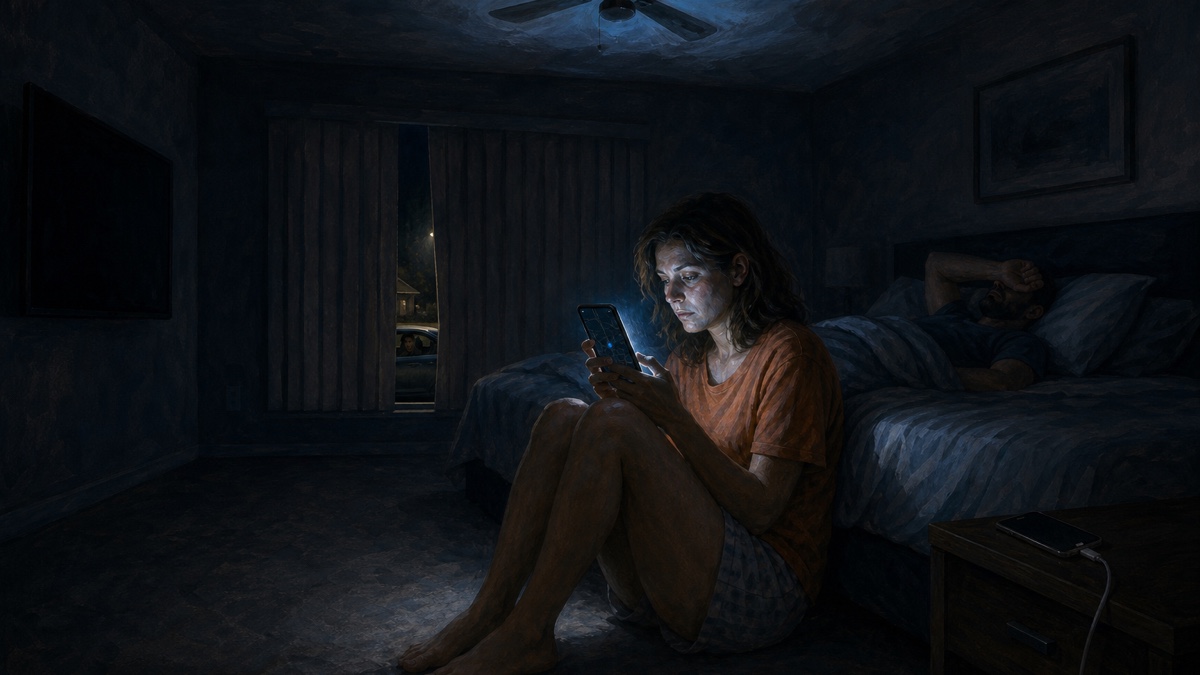
But Bill had been dead for four years and the chair was empty and I was sitting at the kitchen table with the attendance book open and a glass of wine I hadn’t touched and the house so quiet I could hear the fridge click on.
Twenty-four names. My handwriting. All of them.
I could call someone. I could call Donna. I could call Principal Hayes. I could call any of the other teachers and say do you know Ethan Calloway and they would say yes and they would mean it and I would be the woman who forgot a student she’d been teaching for two months and the conversation would end with someone suggesting I was tired, or stressed, or maybe thinking about retirement a little early.
Because that was the thing. There was no version of this conversation where I was right and everyone else was wrong. Not in a town this small. Not with a school this small.
Twenty-four names in my own handwriting. A file in the cabinet. Report cards from two previous teachers. A parent who answered the door on Sycamore Lane and watched me drive away with the calm of someone who had every right to be there.
The wine sat there getting warm. The attendance book sat there being wrong in a way I couldn’t prove.
I thought about the sign. 1,294 on Friday. 1,295 today. One more person in a town where one more child had appeared in my classroom with a history that went back further than his presence.
And I thought about the forty-seven.
Everybody thought about the forty-seven, even if nobody talked about it. A couple of weeks ago the sign jumped from 1,247 to 1,294 overnight. Forty-seven people. The town had absorbed them. Completely and without visible effort, forty-seven new names on rolls that said they’d always been there.
One morning the number was different and nobody could point to a new face and nobody could point to a new house and the streets looked the same and the church looked the same and the gas station still had two pumps and Bobby still waved from the window.
Forty-seven people who were already here according to everything except the number that used to be on the sign. Forty-seven people who had always been here, if you asked. If you checked the records. If you looked at the paperwork.
I hadn’t asked. I hadn’t checked. Because checking meant finding out that the records said forty-seven and my memory said zero and one of those things had to be wrong and I knew which one everyone else would pick.
Now it was forty-eight. One more. A boy with brown eyes and a broken zipper and the patience of something that knew it had already won.
I closed the attendance book. Finished the wine. Washed the glass and put it away and stood in the kitchen listening to the house settle around me.
Tomorrow there would be twenty-four kids in room 104. I would count them. I would count them because counting was the thing I did, the thing that made the day have edges, the thing that made me necessary.
And I would watch Ethan Calloway sit in his seat and fold his hands and get seven times eight wrong and walk to the bus with his shoes untied. And I would know he wasn’t supposed to be there and everyone would know he was and my handwriting would agree with everyone and not with me.
I checked the lock on the front door. Then checked it again.
Through the kitchen window, in the last light, the white rectangle on Route 9 was just visible through the trees. The number was too far away to read. It didn’t matter. I knew what it said. I’d been counting things my whole life. The sign was just better at it.
The third time I checked the lock was the time that meant I wasn’t checking the lock anymore. I was checking whether the world outside was still the one I recognized.
It was dark. The porch light on the yellow house down on Bower was on. Had been on for months now, ever since Helen Morse died and her niece moved in. A woman I’d seen twice at the gas station but hadn’t introduced myself to yet. I should do that. New people in town should be welcomed. That was what you did.
Forty-eight new people. I’d welcomed none of them. I didn’t know where they lived or what they looked like or what names were in their files that had always been in their files.
I turned off the kitchen light. The attendance book was on the table where I’d left it. In the morning I would open it and count the names and the number would be twenty-four and my handwriting would confirm it and I would stand at the door and watch them file in and the headcount would be correct because the headcount was always correct.
That was the part that kept me standing in the dark kitchen instead of going to bed.
Not that Ethan Calloway was in my class. Not that the records said he’d always been there. Not that the sign had ticked up by one on the same day he appeared in a seat that hadn’t existed on Friday.
The part was this. I had been counting children for twenty-nine years. Every morning, every afternoon, every field trip and fire drill and rainy-day recess. Counting was the thing I did better than anyone. It was the thing I was for.
And my own hand had written his name in my own book and I didn’t remember doing it.
I went to bed without checking the lock again. There wasn’t any point. Whatever was getting in wasn’t using the door.