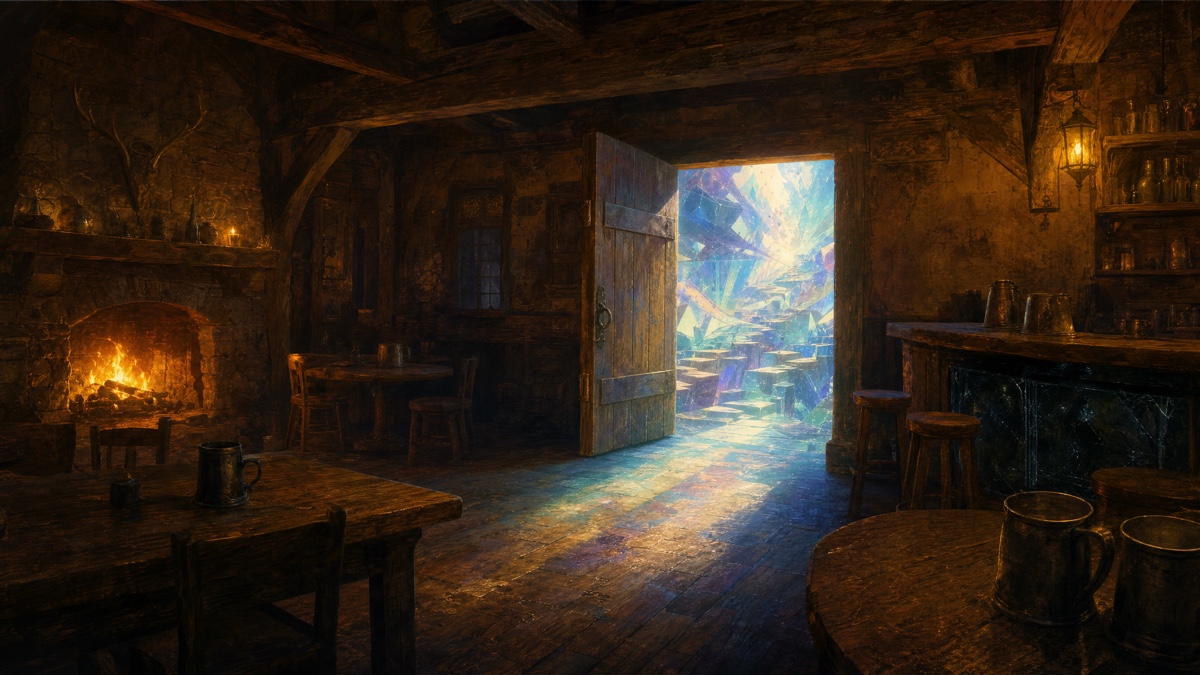
Sasha Okonkwo discovered she could feel buildings on a Tuesday in October, in the Brooklyn Public Library, while researching volcanoes for a school project.
She was twelve. She was sitting at a table in the reference section, surrounded by books she’d pulled from three different shelves, cross-referencing plate tectonics with atmospheric chemistry because the assignment only asked for one page but Sasha didn’t know how to do one page about anything.
The library was quiet. Mid-afternoon on a weekday, the kind of hour when only retirees and homeschooled kids and twelve-year-olds who’d rather be here than anywhere else occupied the reading rooms.
And then the building shifted.
Not physically. The walls didn’t move. The floor didn’t shake. But something in the air changed, like a pressure drop before a storm, and Sasha’s skin prickled and her vision went soft at the edges, and suddenly she could feel the room the way you feel bathwater. Surrounding her. Holding temperature.
The temperature was knowledge.
That was the only word for it. The accumulated weight of decades of people sitting in this exact space, studying, reading, thinking hard about things that mattered to them. The residue of a thousand students cramming for exams. Of researchers bent over microfilm machines at two in the morning. Of old men reading newspapers with the focused attention of people who believed that understanding the world was a moral obligation.
It pressed against Sasha’s awareness like something physical. Layered and dense. The older layers were deeper, harder to distinguish. The recent ones floated on top, thin and sharp, the way fresh snow sits on packed ice.
She gripped the table and breathed through her nose and waited for it to pass.
It didn’t pass. It settled. Like her senses had opened a door they couldn’t close.
She packed up her books and walked home and told no one.
—-
Her parents, Chibueze and Adaeze Okonkwo, had come from Lagos in 1998, navigating visas and green cards and citizenship with the patience of people who understood America made you earn the right to stay.
They settled in Flatbush, Brooklyn, where her father managed supply chains and her mother taught fourth grade for fifteen years while raising two daughters on a budget that required mathematical precision.
The Okonkwos were not practitioners. Had no practitioners in their family. They were Nigerian immigrants who worked hard, went to church on Sundays, and expected their children to excel academically.
Sasha exceeded that expectation so thoroughly her parents sometimes exchanged looks that were half pride, half concern.
Because Sasha didn’t just learn. She consumed. Built model ecosystems in shoeboxes at seven. Won the science fair three years running with projects that made the judges uncomfortable.
Her older sister Ngozi, who was smart but not frightening about it, once told her, “You don’t have to prove anything. You’re allowed to just exist.”
Sasha didn’t know how to explain that it wasn’t about proving. It was about understanding. Systems and patterns and rules. If you understood them, you could navigate anything. The alternative was chaos. Chaos was where people got hurt.
—-
After the library, the feelings didn’t go away.
Sasha analyzed them the way she analyzed everything. She kept a notebook. Logged every instance: the date, the time, the location, and the intensity on a scale of one to ten.
The data was clear within two weeks. What she felt wasn’t coming from people. It was coming from places. Specific places. And the feeling changed depending on what had happened there.
The school library registered as a steady hum of accumulated study, layers of student concentration built up over decades. Pleasant. Warm. Like standing near a fire that was made of focus instead of heat.
Her classroom felt different during a test than during a lecture. During a test, the air tightened with concentrated effort, dozens of kids thinking hard all at once, and the room seemed to hold its breath. During a lecture, the feeling was thinner, more scattered.
The gym was something else entirely. Competitive energy mixed with physical effort. The particular buzz of a hundred basketball games and volleyball matches and dodgeball rounds soaked into the floorboards. Sasha didn’t like the gym. It was too loud in a way that had nothing to do with sound.
But the library. The library was home.
She spent every free period there. Told her teachers she was working on extra credit, which was true enough. She sat in the stacks and let the accumulated knowledge press against her, and she tested it.
Could she feel the difference between the science section and the history section? Yes. Different flavors of the same thing.
Could she feel where someone had studied intensely versus where they’d just browsed? Yes, though it took concentration.
Could she sense the older layers, the ones that had been building since the school was built in 1967?
Yes. They were deeper, more compacted, harder to separate, but they were there. Strata. Like geology, but made of thinking.
She wrote it all down. Mapped the school building room by room, rating each space on her intensity scale. Cross-referenced with what she knew about each room’s history and use.
She was measuring something real. She just didn’t have a framework for it.
—-
The brownstone where her family lived was its own revelation.
The building was old, 1920s, and it had been home to families for a century. Sasha had always loved the apartment without being able to say why. Now she understood.
The rooms were thick with something. Not knowledge exactly, not like the library. Something warmer. The accumulated residue of people living together, cooking, arguing, laughing, raising children, growing old. A hundred years of domestic life soaked into the walls and floors.
Her parents’ bedroom was the densest spot. Twenty years of her mother and father sleeping and waking and talking in the dark and being silent together had built up a saturation that Sasha could feel from the hallway. It felt like safety. Like something solid you could lean against.
Ngozi’s room was different. Lighter. The particular energy of a teenager who was always on the phone, always laughing, always in motion. It shifted when Ngozi was home and settled when she wasn’t, like water that was either running or still.
The kitchen was something else. Sasha’s mother cooked there every evening, and her father’s mother had cooked in her kitchen in Lagos, and the recipes had traveled across an ocean and settled into this Brooklyn kitchen like they belonged here. The room tasted like turmeric and love and the particular determination of women who fed their families properly no matter what.
Sasha didn’t tell anyone what she was feeling. She was twelve. She didn’t have the vocabulary, and she didn’t trust anything she couldn’t replicate under controlled conditions.
So she built controlled conditions.
Saturday mornings. Walking Brooklyn with her notebook. Rating every building on her intensity scale and cross-referencing construction dates from public records. The correlation was strong: older spaces used intensely over long periods registered higher. Newer construction felt thinner. Glass-and-steel buildings were nearly silent. The old brownstones hummed.
She was doing science. She just didn’t know what field it belonged to.
—-
Her parents noticed something was off by November.
“You’re not eating,” her mother said at dinner, which was jollof rice and plantain and the kind of observation that mothers make after weeks of watching.
“She’s not sleeping either,” Ngozi added. “I can hear her walking around at three in the morning.”
Sasha put down her fork. The kitchen pressed against her awareness, five generations of family meals in this room, and she wanted to scream because none of it fit any framework she trusted.
“I’m going through something,” she said. “I’m handling it.”
“Handling it how?”
“Scientifically.”
Her parents exchanged the look. The one that meant their daughter was being difficult in the way only she could be.
—-
Professor Cross found Sasha in the Brooklyn Public Library on a Saturday in December. The same library where it had started.
Sasha was in the genealogy section, researching neighborhood history. Trying to understand why certain blocks registered higher on her intensity scale. A block that had hosted a major labor rally in 1938 still hummed. A block where a factory fire killed seven workers in 1942 practically vibrated.
A woman sat across from her. Middle-aged. Well-dressed.
“You’re measuring saturation,” the woman said.
Sasha looked at her. “I don’t know that word in this context.”
“I know. That’s why I’m here.” A card on the table. Professor Vivian Cross. Resonance Studies.
“You’ve been mapping residue in buildings across Brooklyn for six weeks,” Cross said. “Correlated it with historical event density. Figured out that older structures hold more, and that the intensity of events matters more than their quantity.”
Sasha’s heart was pounding but her face stayed still. Years of being the smartest person in every room had taught her the value of not reacting.
“How do you know what I’ve been doing?”
“Because I’ve been watching you. What you’re experiencing has a name and a community and a school that can teach you to use it.”
“Use it for what?”
Cross smiled. Warm and practiced. Sasha didn’t trust it, but she didn’t walk away.
“That depends on you.”
—-
The scholarship arrived in January. Full tuition, room and board, stipend. For a school Sasha had never heard of, in Appalachia, studying a discipline that existed in no academic database.
She researched. Found almost nothing. “Independent academy for gifted students.” No rankings, no alumni network.
A red flag. For Sasha, a puzzle. Puzzles were the only thing she’d never been able to resist.
She read the terms carefully. Standard boilerplate except two clauses she flagged: “periodic assessment of student potential” and the right to “reassign student resources as institutional needs require.”
She didn’t know what those meant. She photographed them and filed them in the folder she’d started, alongside her saturation maps and seventeen pages of hypotheses.
The conversation with her parents happened on a Sunday after church.
“This school is asking us to send our daughter to a place we can’t verify, to study something we can’t understand, on a scholarship from nowhere,” her mother said. “Give me one reason.”
“I can feel things,” Sasha said. “Not from people. From places. From buildings where things happened a long time ago. I’ve documented everything. I’ve tested it. It’s real, it’s getting stronger, and I don’t know how to make it stop.”
Her father set down his tea. “Show me the documentation.”
She laid it all out. The maps. The charts. The data proving she was sensing something real, measurable, and inexplicable.
Her parents read everything. Her father with systematic attention. Her mother with the assessment of a teacher who’d spent fifteen years identifying what children needed.
“This is thorough work,” her father said.
Her mother looked at her. “Are you scared?”
Sasha wanted to say no. But her mother had taught her that lying to family was a different kind of theft.
“Yes. But I’m more scared of not understanding.”
Her mother nodded. Not agreement. Acceptance. The recognition that the girl who built ecosystems in shoeboxes at seven would walk into the unknown at twelve if it promised answers.
“You call us every week,” her mother said.
Her father walked her to the door that evening, even though she wasn’t leaving for another month. He put his hand on her shoulder.
“Whatever this is, learn it properly. No shortcuts. Build the framework from the ground up.”
“That’s what I do, Dad.”
“I know. That’s why I’m not worried.” He paused. “I’m lying. I’m very worried. But I trust your methodology.”
In the Okonkwo family, trusting someone’s methodology was the highest compliment available.
—-
The night before she left, Sasha packed her notebooks. All of them. The saturation maps, intensity logs, correlation data, and hypotheses that had no theoretical framework to live in yet.
She also packed a small wooden bead her mother pressed into her palm at the door. Dark with age, polished smooth, found in a craft store in Queens.
“For luck,” her mother said.
Sasha, who did not believe in luck, who believed in data and methodology and the hard work of understanding, put the bead in her pocket and felt nothing from it at all.
No saturation. No accumulated memory. No place-history soaked into its grain.
Just her mother’s fingerprints, invisible but present. The only data that mattered and the only kind her instruments couldn’t measure.