The thing about portal travel is that the between-space isn’t empty.
I’d heard this, sure. Every practitioner hears the warnings during basic training. Don’t stop moving. Don’t look directly at the lights. Don’t answer if something speaks your name. Standard stuff, the kind of advice that feels theatrical until you’re actually standing in the gray.
The portal I was using connected an old hotel in Savannah to a train station in Chicago. Well-traveled and supposedly safe. I’d been through it a dozen times without problems.
This time, I got lost.
It started with a flicker. Just a moment where the path seemed to shift, like looking at something through old glass. I’d been thinking about my grandmother’s birthday, whether I should bring flowers or that Turkish coffee she liked. Distracted. Not paying attention.
One second I was walking the familiar route, counting steps the way you’re supposed to.
The next second the path was gone.
The between-space stretched out in every direction.
It wasn’t darkness exactly. More like fog made of nothing. Gray that had weight and texture and no form at all. I could see maybe ten feet in any direction before the nothing swallowed everything.
And at the edges of that ten feet, things moved.
Not toward me. Not yet. But I could feel their attention. Lights that drifted and bobbed like fireflies if fireflies were made of hunger. Shapes that suggested faces when I wasn’t looking directly at them.
Will-o’-wisps. The residents of the between, drawn to living practitioners the way moths get drawn to flames.
I stopped walking. That was the first mistake.
—-
My training kicked in eventually. I pulled a token from my pocket. A stone from Gettysburg, saturated with the courage of men who’d stood their ground when everything in them screamed to run.
The warmth spread through my fingers. Steadied my breathing. Reminded me that I’d done hard things before and survived them.
“Okay,” I said out loud, because sometimes speaking helps. “I’m lost in transit. The path shifted. That happens. People get lost and find their way back all the time.”
The wisps drifted closer at the sound of my voice.
I started walking.
—-
The problem with the between-space is that it doesn’t follow normal rules. There’s no north or south. No up or down, technically, though there’s something that feels like a floor. You’re supposed to follow the path, and the path is supposed to be obvious, a thread of connection between the two places the portal links.
Without the path, I was just moving. Hoping something would feel familiar. Hoping I’d stumble across an exit I recognized.
The wisps followed.
More of them now. A dozen, maybe more. Their lights pulsed in patterns that almost made sense, like words in a language I didn’t speak. They kept their distance, but the distance was shrinking.
I pulled out another token. A key from a hotel in New Orleans, saturated with the satisfaction of coming home after long travels. It was supposed to help practitioners find their way back.
The key warmed in my hand, then went cold.
Wherever I was, it wasn’t between Savannah and Chicago anymore.
—-
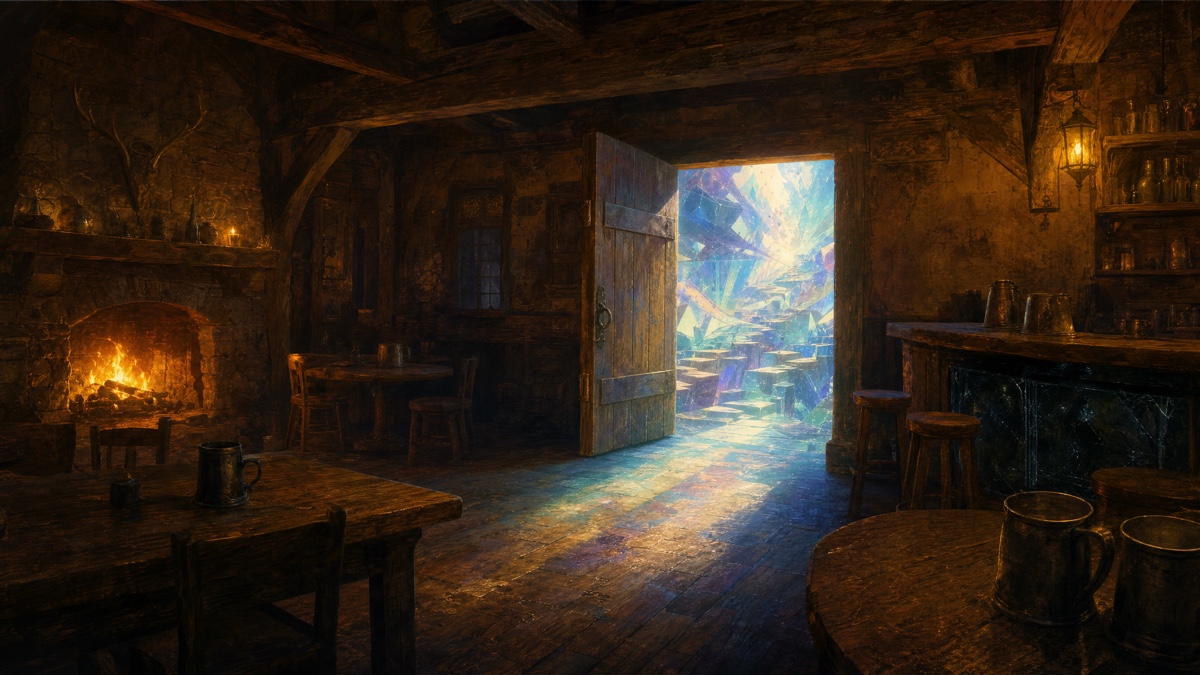
The door appeared out of nowhere.
Not a portal. Not a proper exit. Just a door, standing alone in the gray, wooden frame attached to nothing.
The wisps stopped following.
That should have been a good sign. It wasn’t. Will-o’-wisps are curious and hungry, but they’re not brave. If something scared them off, that something was worse.
I looked at the door. The door looked back.
And yeah, I know doors don’t look. But this one was saturated with something old and patient and very interested in what I might do next.
“Hello?” I said, because apparently I was determined to make every possible mistake.
The door opened.
The room beyond was a library.
Not a normal library. The shelves stretched up into darkness that had no ceiling, holding books bound in materials I didn’t recognize, and the only light came from candles that burned without melting.
And sitting in a chair at the center, reading something thick and old, was a woman who felt like a mountain.
Not literally. She looked ordinary enough. Mid-sixties, gray hair, the kind of face you’d see at a grocery store and forget immediately. But her saturation was immense. Centuries of accumulated experience, layered so deep I couldn’t sense where it started or ended.
“You’re lost,” she said without looking up.
“The path shifted.”
“Paths do that sometimes. Usually when someone’s not paying attention.” She turned a page. “You were thinking about coffee. Turkish, with the grounds in the bottom.”
“How do you know that?”
“I know everything that passes through here. It’s my job.” She finally looked at me. Her eyes were the same gray as the between-space. “This is a waystation. A place between places between places. You stumbled into it because you were thinking about your grandmother, and your grandmother passed through here once, sixty years ago.”
I didn’t know my grandmother had been a practitioner. She’d never said anything. Never hinted.
“She was running from something,” the woman continued. “Needed to disappear for a while. I let her rest here until she was ready to face whatever she was running from.”
“Did she face it?”
“Eventually. She married your grandfather three months later. Had your mother a year after that. Life worked out.”
The woman closed her book and stood. She was taller than she’d seemed sitting down. The kind of tall that felt like a statement.
“You’re not running from anything. You just got lost. That’s simpler to fix.”
She walked to one of the bookshelves and pulled out a volume that looked exactly like every other volume. When she opened it, I could see pages that weren’t pages exactly. More like windows. Moving images of places I half-recognized.
“Chicago train station,” she said, pointing at one of the images. “That’s where you were going. Step through and you’ll be back on the path, thirty seconds after you left it. Nobody will even notice you were gone.”
I looked at the window. At the familiar columns and the familiar crowds and the world I understood.
Then I looked at her library. The impossible shelves. The centuries of accumulated mystery.
“What is this place?”
“A waystation. I told you.”
“But what are you?”
She smiled. It was the kind of smile you give someone who’s asked a question they’re not ready to have answered.
“I’m the keeper. I’ve been the keeper for a long time. Eventually someone else will be the keeper, and I’ll get to rest. But not yet.”
“That doesn’t explain anything.”
“No. It doesn’t.” She held up the book with the windows. “Are you going to Chicago or not? I have other lost travelers to attend to.”
—-
I went to Chicago.
Stepped through the window and found myself back on the path like nothing had happened. The train station materialized around me thirty seconds later, exactly as she’d promised. My tokens were still warm in my pocket. The key from New Orleans was working again, pointing toward home.
Nobody noticed I’d been gone.
But I’d noticed. And I couldn’t stop thinking about that library, that keeper, that room that existed between the spaces between spaces.
I couldn’t stop thinking about my grandmother.
—-
I asked her about it the next time I visited.
Brought the Turkish coffee and the flowers and then, after dinner, mentioned that I’d gotten lost in transit. I told her about a waystation, about a keeper who’d known her sixty years ago.
Grandma got very quiet.
“You found Marguerite’s place,” she said finally. “I’d hoped you wouldn’t.”
“Who is she?”
“Someone who helped me once. Someone I owed a debt to.” She looked at her hands, wrinkled now in ways they hadn’t been when she’d run. “I was supposed to take over for her eventually. That was the deal. She lets me hide, I come back and become the next keeper when I’m ready.”
“But you didn’t.”
“I got married. Had your mother. Built a life.” She smiled, sad and defiant at the same time. “I chose to be selfish instead of keeping my promise. Marguerite’s been waiting ever since.”
“Sixty years?”
“She’s patient. Part of the job, I imagine.”
I thought about the gray-eyed woman in her impossible library. The centuries of saturation. The calm certainty of someone who had nowhere else to be.
“She’s still waiting,” I said. “She mentioned that eventually someone else would be the keeper.”
Grandma looked at me. Really looked. The way practitioners look when they’re reading something they shouldn’t be able to read.
“Don’t,” she said.
“Don’t what?”
“Don’t go back. Don’t offer. Don’t make yourself available for deals you don’t understand.” She grabbed my hand, her grip stronger than expected. “I spent sixty years running from that place. I won’t have you walking into it on purpose.”
—-
I didn’t go back.
Not on purpose, anyway. But sometimes, when I’m transiting between places, I feel something at the edges. A door that isn’t quite there. A presence that’s waiting just outside the path.
She’s not angry. I can tell that much. Just patient.
Waiting to see if I’m curious enough to get lost again.
Waiting to see if I’m selfish enough to keep my grandmother’s promise.
Some questions you’re better off not answering.
But I think about it sometimes. The library with its impossible shelves, the candles burning without melting, the books that weren’t quite books.
I think about what it would mean to be the keeper of a place between places between places.
I think about it more than I should.