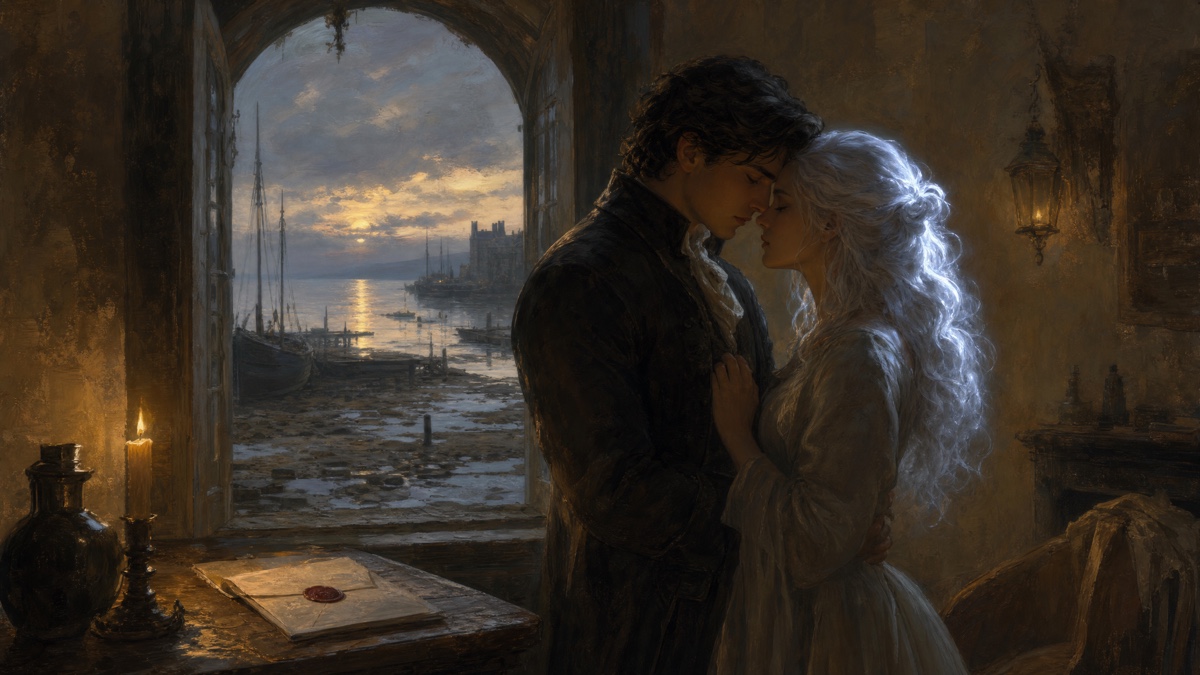
The first time Jude Alcantara kissed someone at Mudwick, he tasted gunpowder.
Not literally. Nobody was shooting anything.
But the girl he kissed, a Thornwell second-year named Regan with sharp shoulders and a laugh that cut through rooms, had just come from an hour of Drift practice.
She’d been drawing from conflict pools all afternoon, and the residue of it was still on her skin when she grabbed Jude’s face behind the equipment shed and pulled him in.
The kiss itself was fine. Better than fine.
Regan kissed like she played Drift, committed and a little reckless, and Jude liked that about her. But underneath the warmth and the adrenaline and the particular thrill of doing something semi-forbidden in broad daylight, he could taste what she’d been drawing from.
Battle-memory and old violence. The residue of someone else’s fight clinging to her lips.
He didn’t mention it. You didn’t mention things like that.
The second time they kissed, a week later in the Kinvara Hall common room while a terrible movie played on someone’s laptop and nobody was watching, he tasted something different.
Warmth.
The comfortable saturation of a gathering place soaking into Regan’s skin just from sitting in a room full of people. Her guard was down. She wasn’t pulling from anything. She was just there, and the place was seeping into her, and when Jude kissed her, he felt what Goodfire Hall must feel like all the time.
He still didn’t mention it.
Here’s the thing about being a low-grade reader at a school full of practitioners. You pick up stuff you’re not supposed to.
Not in a dramatic way, not like Eli Lawrence who apparently read people like open books, but in small persistent ways that were hard to ignore.
Jude’s sensitivity was nothing special. Average range, average depth, the kind of ability that would get him a perfectly decent career doing token consultation or place surveys for real estate developers.
But it was enough. Enough that kissing someone meant absorbing whatever was sitting on their surface. Enough that physical closeness became a constant low-grade invasion of privacy that Jude couldn’t turn off.
He and Regan became a thing. That’s how people said it at Mudwick, like the relationship was an object that appeared between two people and then you both just had to deal with it.
They were a thing by November, and by December they were the kind of thing that made other students roll their eyes in the dining hall.
She was funny. Not performatively funny, but observant in a way that caught the absurdity of things. She’d lean over during Threshold Studies and whisper something devastating about Professor Cavanaugh’s tie and Jude would have to pretend he was coughing to hide the laugh.
And she was brave in that particular Thornwell way where bravery and stubbornness are the same quality viewed from different angles.
She did things like stepping between bullies and first-years without thinking about them, which was both the best and worst thing about her.
Jude liked her. Genuinely liked her.
Not just the kissing and the way she smelled like cedar smoke after Drift practice and the way she looked at him sometimes like he was the only solid thing in a room full of fog.
He liked who she was. The person underneath the bravado.
And that was the problem. Because the more time they spent together, the more he could feel who she was, and some of what he felt didn’t match what she was telling him.
It started small. A Saturday afternoon in January, walking the grounds, her hand in his. Through the contact he could feel her day. Morning training. Breakfast with her hallmates. A phone call.
The phone call felt wrong.
Not angry or sad, exactly. Guarded. The particular emotional texture of someone performing normalcy while something underneath churned. Like she’d been talking to someone who made her feel two things at once and neither of them was comfortable.
“Who’d you call this morning?” Jude asked, aiming for casual.
“My mom.” Regan didn’t look at him. “Just checking in.”
The surface felt true. The underneath felt like a lie. Not about calling her mom, maybe, but about the checking-in part. Something had happened on that call that she wasn’t sharing.
Jude let it go. Everyone was entitled to their private stuff.
But the incidents accumulated.
A Tuesday where Regan came back from the library with someone else’s emotional residue on her that felt too intimate for a study session. A Friday where she canceled plans and the excuse tasted hollow. A Wednesday where she kissed him goodnight and he felt something on her lips that he could only describe as guilt.
He didn’t confront her. That’s important to understand. He wasn’t snooping. He wasn’t trying to read her. The information just arrived, the way sound arrives through a thin wall whether you want to hear it or not.
February. Valentine’s Day, or whatever passed for it at a school where the concept of dating was complicated by the fact that everyone could sense everyone else’s emotions if they tried hard enough.
Regan gave him a token. A small thing, a river stone she’d charged with warmth from Goodfire Hall’s common room. It pulsed gently in his palm, full of the feeling of being wanted.
He kissed her. And through the kiss he felt everything she was holding back come rushing forward in a wave she probably didn’t even know she was broadcasting.
She was thinking about someone else.
Not in a cheating way. Not like that. It was more complicated and somehow worse.
She was thinking about a version of herself that existed before Jude, a version that had feelings for someone she’d never told about them, and those feelings weren’t gone.
They were packed away in a box she kept reopening when she thought no one was paying attention. The person, a girl from back home whose name Jude sensed as a shape rather than a sound, was someone Regan had never kissed and might never kiss and was apparently unable to stop thinking about.
Jude didn’t say anything. He smiled. He thanked her for the token. He held her hand on the walk back to the dorms.
But something shifted, and they both knew it.
The next two weeks were the worst kind of slow deterioration. They didn’t fight. They weren’t cruel to each other. They just started being careful, and careful is the death of every relationship between two people who are supposed to be figuring out what reckless feels like.
Regan stopped grabbing his hand without thinking. Started offering her hand deliberately, which was different, which was a performance of intimacy rather than the thing itself.
Jude stopped leaning into kisses. Started pulling back half a second early, before the reading could settle in, before he could taste what she was carrying.
They were protecting each other from truths that were going to surface eventually anyway.
On the last day of February, he found her sitting by the lake. She was alone, which was unusual for Regan, who collected people the way some students collected tokens. The light was gray and the water was still and she looked so small sitting on the shore that Jude’s chest ached in a way that had nothing to do with saturation.
He sat down next to her. Close enough to touch but not touching.
“I can feel it,” Regan said without looking at him.
“Feel what?”
“You pulling away. I don’t even need to be a reader to notice. You used to lean in when we kissed. Now you flinch.”
“I don’t flinch.”
“You do. A tiny one, right before our lips touch. Like you’re bracing for something.”
He didn’t have a good answer for that because she was right.
“Is it something I did?” she asked.
“No.”
“Is it something you read?”
The question sat between them on the cold ground. He could dodge it. Lie. Make up something about being stressed about classes or worried about his place survey practicum. She might even believe him.
But he was so tired of the careful.
“I can feel her,” Jude said. “When you kiss me. I can feel you thinking about someone else.”
Regan went very still.
“I’m not trying to,” he continued. “I promise you I’m not. It just comes through. Physical contact makes everything louder, and whatever you’re carrying, whoever she is, it’s right there on the surface.”
For a long time Regan didn’t say anything. The lake was absolutely silent, which was its own kind of unnerving at Mudwick, where silence usually meant something was listening.
“Her name is Odessa,” Regan finally said. “We grew up together. And I never told her.”
“I know.”
“Not because I was scared. Because I was leaving. Coming here. And I thought it would be unfair to start something I couldn’t finish.”
“I know that too.”
“Stop knowing things.” Her voice cracked, and it was the first time Jude had ever heard Regan sound anything other than solid. “I hate that you know things I haven’t said yet.”
“I hate it too.”
She laughed. It was wet and sad and honest, and Jude loved her a little bit in that moment, the way you love someone you’re about to lose.
“You should have told me,” she said.
“What would I have said? Hey, I can taste your unrequited love when we make out? That’s not a conversation anyone wants to have.”
“Better than two weeks of you pulling away and me not knowing why.”
She was right. Of course she was right.
They sat by the lake until the light started to fade. They didn’t hold hands. They didn’t need to. The space between them was full enough already.
“I’m sorry,” Regan said eventually.
“Don’t be. You didn’t do anything wrong.”
“I was carrying someone else into our relationship.”
“Everyone carries things. That’s literally how this world works.”
She turned to look at him, and her eyes were red but her jaw was set in that stubborn Thornwell way that meant she’d made a decision. “I need to figure some stuff out. About Odessa. About myself. It’s not fair to you if I don’t.”
“Yeah,” Jude said. “I know.”
And that was it. No screaming. No slamming doors. No dramatic final kiss in the rain. Just two kids by a lake, sixteen years old and full of feelings they’d never asked to carry, deciding to stop pretending that proximity was the same thing as presence.
Jude walked back to Kinvara Hall alone. The stone she’d given him was still in his pocket, still warm, still pulsing with the feeling of being wanted. He put it on his nightstand and didn’t touch it again for a long time.
Spring came and the snow melted. The grounds turned muddy and then green.
He saw Regan around campus. They nodded. They were kind to each other in the particular way of people who’d shared something real and decided not to ruin it with bitterness. She seemed lighter. He couldn’t tell if that was because she’d figured out the Odessa thing or because she’d stopped pretending she didn’t need to.
Jude started kissing with his walls up. Not completely closed off, because you couldn’t really live like that at Mudwick, but enough that other people’s residue didn’t pour through every time he got close. It made kissing feel a little less vivid, a little more ordinary, but also a little more honest.
Because here’s what he figured out, walking alone across campus on a Tuesday night with the taste of someone else’s longing still fading from his memory.
You can know everything about another person and still not know how to love them. The reading, the sensing, the involuntary intimacy of sharing space with someone whose surface you could feel without trying, none of it was the same as actually understanding them. Understanding required something that magic couldn’t provide and sensitivity couldn’t shortcut.
It required asking. And listening. And being willing to hear things that hurt.
He was sixteen. He had time to get better at it.
The token on his nightstand went cool eventually, the way all tokens do when they’re separated from their source. He kept it anyway. Not because he was holding on, but because some things are worth remembering even when they hurt.
Especially when they hurt.