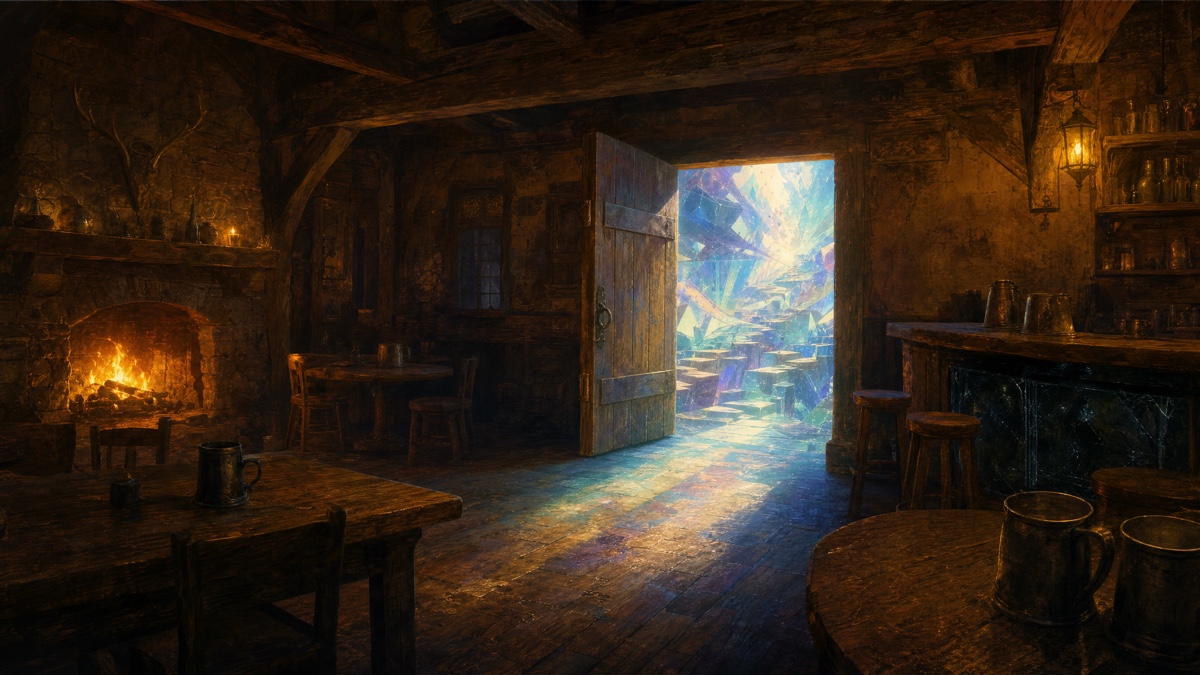
Lucille Barnes had been running a boarding house for traveling practitioners since 1952. She’d seen them all come through. Old family kids slumming it before going home to their trust funds. Scholarship students trying to scrape together enough money for tuition. Folk practitioners who’d never set foot in an institution but could do things that would make the academy professors weep with envy.
She’d also seen what happened when practitioners broke.
That’s what she was good at, even if she’d never admit it. Finding the ones who were fraying at the edges. The ones carrying too much borrowed grief or absorbed rage or accumulated fear. The ones getting close to hollowing.
She fed them. Gave them a warm bed and didn’t ask questions. Let them stay until they remembered how to be whole.
It wasn’t charity. Lucille had been hollow once. She knew what it cost to come back.
The woman showed up on a Tuesday night in February. Detroit was buried under a foot of snow and the wind coming off the river could strip skin from bone. No one should have been walking around outside, let alone a young white woman in a thin coat with no gloves and no hat and eyes that looked like they’d seen the end of the world.
“I need a room,” the woman said. Her voice was barely a whisper. “Just for tonight. I can pay.”
Lucille looked at her for a long moment. Then she opened the door wider.
“You can pay later. Get inside before you freeze to death.”
The woman’s name was Helen. She didn’t give a last name and Lucille didn’t ask. She was maybe twenty-five, with red hair going gray at the temples and hands that shook when she tried to hold a coffee cup.
She was also carrying enough saturation to power a small city.
Lucille could feel it radiating off her in waves. Grief and fear and something else, something sharp and bitter that tasted like guilt. Helen had absorbed so much of other people’s pain that she was drowning in it.
“How long?” Lucille asked.
Helen looked up from the coffee she wasn’t drinking. “What?”
“How long have you been taking without giving anything back?”
The question landed like a blow. Helen’s face crumpled and she put her head down on the kitchen table and started crying in great heaving sobs that shook her whole body.
Lucille let her cry. Made another pot of coffee. Checked on the other boarders, three practitioners who were all asleep upstairs, their own problems temporarily forgotten in dreams.
When the crying finally stopped, Helen lifted her head. Her face was blotchy and swollen, but her eyes looked a little clearer.
“Four years,” she said. “Since I finished my training. They put me in a hospital. Said I had a gift for healing.”
“Hearthwing?”
Helen nodded. “I could feel what people were feeling. Their pain, their fear. And I could take it. Make them comfortable. Help them through the worst of it.”
“But you never learned how to let it go.”
“They didn’t teach us that part.” Helen’s laugh was hollow and bitter. “They taught us how to draw and how to absorb and how to project calm into patients who were screaming. They didn’t teach us what to do with everything we took.”
Lucille had heard variations of this story a hundred times. The institutions trained practitioners to work, to be useful, to serve the families who paid for their education. They didn’t train them to survive.
“Where did you work?”
“Started in Baltimore. Then Philadelphia. Then Cleveland.” Helen counted the cities on her fingers. “Every time I started getting too full, I’d move. Start over. Hope it would help.”
“Did it?”
“For a while. Then the nightmares would start. The memories that weren’t mine. The feelings I couldn’t shake.” She looked down at her trembling hands. “I left Cleveland three weeks ago. Walked out of the hospital in the middle of my shift. Couldn’t take it anymore.”
“And you’ve been wandering since?”
“I thought maybe if I got far enough away from hospitals, far enough away from dying people, it would stop. It would drain out of me somehow.” Helen’s voice cracked. “It didn’t stop. It’s all still in here. Every patient I ever touched. Every death I ever witnessed. Every family I helped through the worst moment of their lives.”
Lucille got up and moved to the chair beside Helen. She put her hand on the younger woman’s shoulder and felt the saturation pulse like a second heartbeat.
“You’re not hollow,” Lucille said. “Not yet. But you’re close. Another few months of carrying this alone and you won’t be able to feel anything at all.”
“Would that be so bad?” Helen whispered. “To not feel anything?”
“It’s worse than you can imagine. Trust me.”
They sat in silence for a long time. The kitchen clock ticked. Outside, the wind howled and the snow kept falling on a city that was already struggling under the weight of a hundred years of accumulated loss.
“I can help you,” Lucille said finally. “If you’re willing to trust me.”
“Help me how?”
“There’s a place near here. An old foundry where they used to make car parts during the war. It’s been abandoned since ‘45, but the saturation is still there. Twenty years of workers pouring their effort and sweat and pride into the machines. It’s a place of creation, not grief. A place that can take what you’re carrying and transform it into something else.”
Helen looked at her with desperate hope. “You can do that? Move what’s inside me into a building?”
“Not move. Contribute. You have to give it willingly, piece by piece. It takes time. It’s not pleasant. But when it’s done, you’ll be free of what you’re carrying.”
“And the foundry? What happens to it?”
Lucille smiled grimly. “It absorbs. That’s what places do. Fifty years from now, some young practitioner will walk in there and feel something strange in the walls. Grief mixed with creation. Loss wrapped around effort. They won’t know where it came from. But they’ll be able to draw from it if they need to.”
“That seems unfair. Dumping my problems on future strangers.”
“That’s how it works. We take from places. We give to places. The whole system runs on practitioners leaving pieces of themselves behind for other practitioners to find.” Lucille squeezed Helen’s shoulder. “What matters is you keep living. That you take what you’ve learned about carrying too much and use it to help others avoid the same mistake.”
Helen was quiet for a long moment. Then she nodded.
“Okay. Show me.”
They went the next night, after the snow finally stopped. The foundry was a mile and a half from Lucille’s boarding house, a hulking brick building with broken windows and walls that still remembered the roar of machinery.
Lucille felt the saturation the moment they stepped inside. Twenty years of labor, of pride, of the particular satisfaction that came from making something with your hands. The war workers had poured themselves into this place, producing tanks and jeeps and parts for planes that flew over Europe and the Pacific.
“This is it,” she said. “This is where you’ll leave it.”
Helen stood in the center of the empty factory floor, surrounded by rusted machines and dust and the ghosts of purpose. Her breath came out in clouds in the freezing air.
“How do I start?”
“Think about one patient. Just one. The one who weighs on you the most.”
Helen closed her eyes. Her face contorted with pain.
“Mrs. Kowalski,” she whispered. “She had cancer. Took me six months to get her comfortable enough to die. I absorbed everything. Every day of fear. Every moment of wishing she could see her grandchildren grow up. Every prayer she made that didn’t get answered.”
“Give it to the walls.”
“How?”
“The same way you took it. But backwards. Open yourself up and let it flow out instead of in.”
Helen trembled. Lucille could see her struggling, fighting against years of training that had taught her only how to take.
Then something shifted.
A wave of grief poured out of Helen and hit the foundry walls like water breaking against stone. Lucille felt it pass through her, felt the echo of Mrs. Kowalski’s fear and love and desperate hope.
The building absorbed it.
The saturation in the walls changed, just slightly. The pride of the war workers mixing with the weight of a dying woman’s final months. Creating something new. Something layered.
Helen gasped and opened her eyes. She looked lighter already, like someone had cut a string that was dragging her down.
“Again,” Lucille said. “Another one.”
They stayed in the foundry until dawn. Helen contributed seventeen patients that night. Seventeen deaths. Seventeen accumulated loads of grief and fear and everything else she’d been carrying since she left her training.
It wasn’t all of it. Not even close. She’d absorbed hundreds of people during her years in hospitals. It would take months to empty herself completely.
But it was a start.
Helen stayed at the boarding house for eight months. Every night she went to the foundry with Lucille and gave a little more of herself away. By summer, she was sleeping through the night. By fall, she could laugh without it turning into tears.
She left in October, heading back east. Not to a hospital. To a school. She wanted to teach young practitioners what the institutions hadn’t taught her.
“They need to know,” she told Lucille on the morning she left. “They need to know that drawing is only half the equation. That you have to give as much as you take or you’ll drown in what you’ve absorbed.”
“They won’t want to hear it. The families don’t want practitioners who know how to protect themselves.”
“Then I’ll teach the ones who aren’t family. The scholarship students. The folk practitioners. The ones who need it most.” Helen hugged Lucille fiercely. “Thank you. For saving my life.”
“You saved yourself. I just showed you the door.”
Lucille watched Helen walk down the snowy street until she disappeared around the corner. Then she went back inside to start making breakfast for her other boarders.
There would be more like Helen. There were always more. Practitioners who’d been used up and thrown away, who’d taken too much and given too little, who were stumbling toward hollowing without anyone to catch them.
Lucille would catch them. That’s what she did. That’s what she’d been doing since she clawed her way back from her own hollowing twenty years ago.
The foundry was waiting. It could hold a lot more grief before it was full.
And there was always more grief to carry.