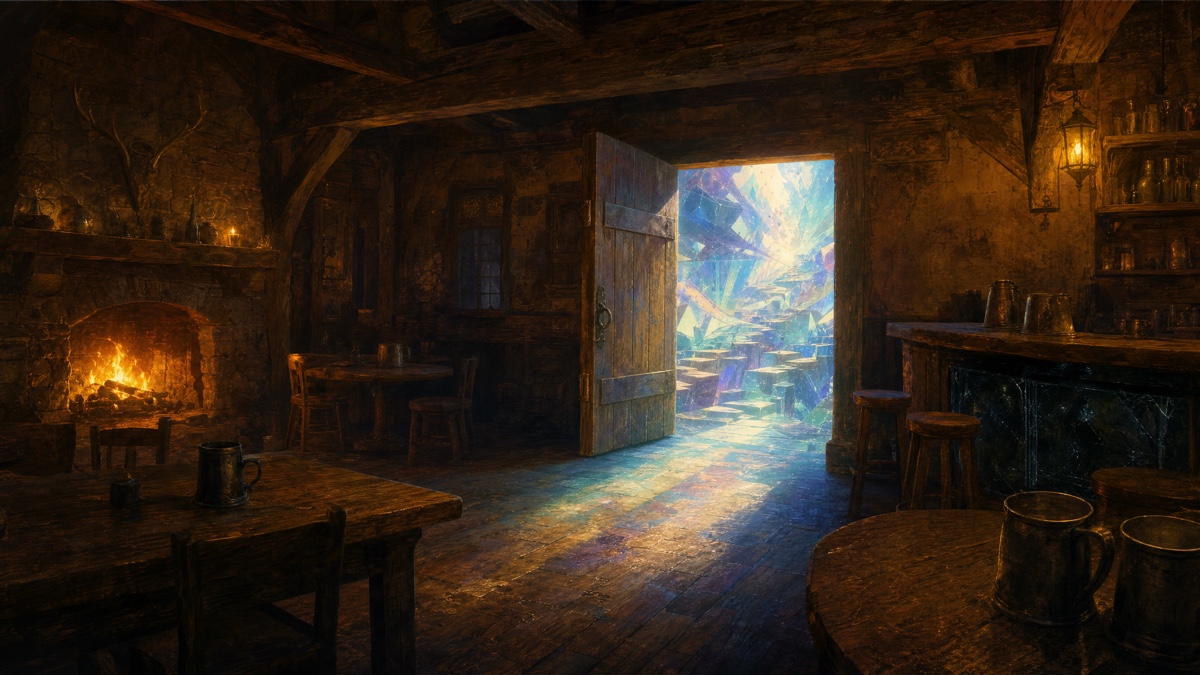
The portal dropped us into a field in Georgia on a Thursday morning in October and the first thing I thought was that the light was wrong.
Not wrong exactly, just different. Softer than Mudwick’s mountain light. Warmer, even though the temperature was about the same. Like the air itself was trying to be gentle with us.
There were nine of us.
Professor Aldridge at the front. Her boots already muddy from the wet grass. Her expression the careful neutrality of someone who’d done this trip a hundred times and still wasn’t bored by it. Eight first-years trailing behind her like ducklings who weren’t sure what water was.
“The schoolhouse is through those trees,” she said. “When we arrive, I want you to stop at the door. Do not enter until I say. And when you do enter, open slowly. This place is strong. Respect that.”
I thought she was being dramatic. I’d been at Mudwick for six weeks. I’d felt the school’s layered saturation. I’d survived the Portal Hall. How intense could a schoolhouse in Georgia be?
—-
My name is Carmen Reyes and I’m from Houston. No, I’m not related to Dao, unless I don’t think I am. My parents run a restaurant and my grandmother lights candles for the dead every November and nobody in my family tree has ever heard the word saturation.
Except me, apparently. Because I’ve been feeling things in places since I was eleven and spent four years thinking I was either psychic or crazy before a woman knocked on my parents’ door and told them their daughter had a gift that needed training.
My mother cried. My father wanted to know if it paid well.
The answer to both was complicated.
—-
The schoolhouse was small. One room. Clapboard walls, tin roof, a door that hung slightly off its hinges. It looked like a stiff wind would knock it down.
But the feeling coming off it stopped me twenty feet away.
I’d never felt anything like it. This was different. It was singular. One emotion, sustained over decades, so concentrated and so pure that standing near it was like standing next to a bonfire of feeling.
Hope. That’s what the schoolhouse held. Hope so fierce it made my eyes sting.
Professor Aldridge stopped at the door and turned to face us. “This building was a freedmen’s school, and Established in 1867, two years after the end of the Civil War. For thirty-one years, formerly enslaved people and their children came here to learn to read and write.”
She paused so it could land.
“Every person who walked through this door was doing something revolutionary. Some of them had been beaten for looking at a book. Some of them had watched their parents sold away and never learned their own family names.
They came here anyway. Every day. They sat on wooden benches and they learned their letters and they decided that knowing things was worth whatever it cost.”
I could feel it. Not because she was telling me but because the building was telling me.
Thirty-one years of people choosing education over fear, choosing the future over the weight of what had been done to them. That choice, made thousands of times by hundreds of people, had soaked into the wood and the floor and the tin roof until the whole structure vibrated with it.
“Enter slowly,” Aldridge said. “Sit down, open yourselves, and listen.”
—-
The boy next to me went in first. His name was Leroy and he’d been top of our class in everything. Old family, good training, the kind of natural talent that made the rest of us feel like we were trying to play piano with oven mitts on.
He made it three steps through the door before he started crying.
Not subtle crying. The ugly kind. Shoulders shaking, hands over his face, the sound of someone being broken open by something they weren’t prepared for. Professor Aldridge guided him to a bench and let him sit. Didn’t tell him to stop. Didn’t tell him it would pass. Just let him feel it.
I went in next.
The hope hit me in waves. Not one continuous thing. They were pulses, each one carrying a specific quality.
A woman learning to write her own name for the first time, her hand shaking on the chalk, the shape of the letters foreign and miraculous. A child reading aloud from a primer, stumbling on every third word, grinning because the words were becoming sounds that meant something. An old man, seventy at least, sitting in the back row, learning the alphabet alongside children a quarter his age, pride and humiliation fighting in his chest until pride won.
I sat on one of the benches. The wood was worn smooth by generations of students. I put my hands flat on the surface and felt them all. Every person who’d sat here. Every act of defiance disguised as education.
My grandmother lights candles for the dead. I don’t know if I told you that already. She says the flame carries their names upward so God doesn’t forget them. I’d always thought it was just tradition. Something pretty that didn’t really do anything.
Sitting in that schoolhouse, I understood, and some things hold memory, some things carry the names of the people who touched them. My grandmother had been doing a version of what I was learning, with candles instead of curriculum.
—-
We stayed for two hours.
Professor Aldridge had us practice reading the layers. The recent stuff first, the accumulated residue of decades of student field trips. Then deeper, to the school’s active years. Then deeper still, to the raw first days when the building was new and the people who entered it were stepping into a freedom they were still learning to trust.
Each layer felt different, the top layer was academic. Students doing exercises, following instructions, approaching the place as an assignment. Below that, the real stuff. The years when this building was the most important place in the world for the people who used it.
I found one particular thread and followed it.
A girl. Maybe twelve. She came every morning before dawn, walking three miles from wherever she lived. She sat in the back corner, the same spot every day, and she practiced writing until the light failed. Not lessons. This was practice. The kind I would hate, but she loved it.
The same words over and over, getting steadier each time.
I couldn’t see her face. The residue was too old for that kind of detail. But I could feel her focus. The particular concentration of someone who understood, in a way most twelve-year-olds don’t, that what she was learning could change everything.
She wrote her name. I felt the shape of the letters even though I couldn’t read them. The care she put into each one. The way her hand moved with increasing confidence. The pride when she could look at the slate and see herself written in the world.
I pulled back. Wiped my eyes. Looked around and saw that everyone was crying, even Leroy who’d already been through it once, even the kid from Connecticut who bragged about never being affected by saturation.
The schoolhouse didn’t care about your training or your family name. It just wanted you to feel what had happened here. And it was strong enough to make that happen whether you were ready or not.
—-
Professor Aldridge gathered us outside when the two hours were up.
“What did you learn?” she asked.
Nobody said anything about technique, and nobody talked about layers or reading methodology or filtering strategies. Leroy, whose eyes were still red, said, “They were so brave.”
Aldridge nodded. “The saturation here is almost entirely hope and courage. That’s unusual. Most historical sites are mixed. Battlefields have fear alongside valor. Hospitals have suffering alongside healing. This place is singular because the people who built it refused to let anything else in. They were afraid, certainly. But they didn’t let the fear stick. Only the hope.”
“How?” someone asked.
“By choosing it. Every day. The fear was real but they didn’t contribute it. They contributed the learning. The pride and the determination. They built this place out of the best of what they felt, and that’s what lasted.”
I thought about that on the walk back to the portal. About the difference between what happens to you and what you choose to leave behind. The people who built that school had every reason to fill it with pain.
They’d lived through horrors I couldn’t imagine. But they chose to fill it with something else.
That’s the part they don’t teach you in orientation. Saturation isn’t just what happened in a place. It’s what the people there decided mattered enough to hold onto. The schoolhouse wasn’t saturated with history. It was saturated with intention.
—-
We stepped back through the portal into Mudwick’s mountain cold. The contrast was immediate. Georgia’s gentle warmth replaced by the school’s layered intensity, all those competing histories pressing in from every direction.
But something was different because I could still feel the schoolhouse. Not as a place. As something I was carrying with me. The hope had settled into my chest and it didn’t feel borrowed. It felt earned.
Professor Aldridge was watching me.
“First time is always the strongest,” she said.
“Does it fade?”
“The intensity does. The memory doesn’t.” She looked at the portal behind us, the doorway back to Georgia already fading to stone. “Some students go back every year. Just to sit in that room and remember what people can build when they decide that fear isn’t the thing that gets to last.”
I went back to my dorm and sat on my bed. Put my hands on the mattress the way I’d put them on that wooden bench.
Nothing. The dorm was too new, too generic, too full of unanchored student anxiety to hold anything worth feeling.
But the schoolhouse was still warm in my chest. A twelve-year-old girl writing her name, steady and sure.
I held onto that for a long time.